Medieval India (B) The Delhi Sultanate — Flashcards
ICSE · Class 9 · History & Civics
40 flashcards for Medieval India (B) The Delhi Sultanate (ICSE Class 9 History & Civics) to test yourself on key terms and facts.
Interactive on Super Tutor
Studying Medieval India (B) The Delhi Sultanate? Get the full interactive chapter.
Quizzes, flashcards, AI doubt-solver and a step-by-step study plan — built for flashcards and more.
Free trial, no card needed.
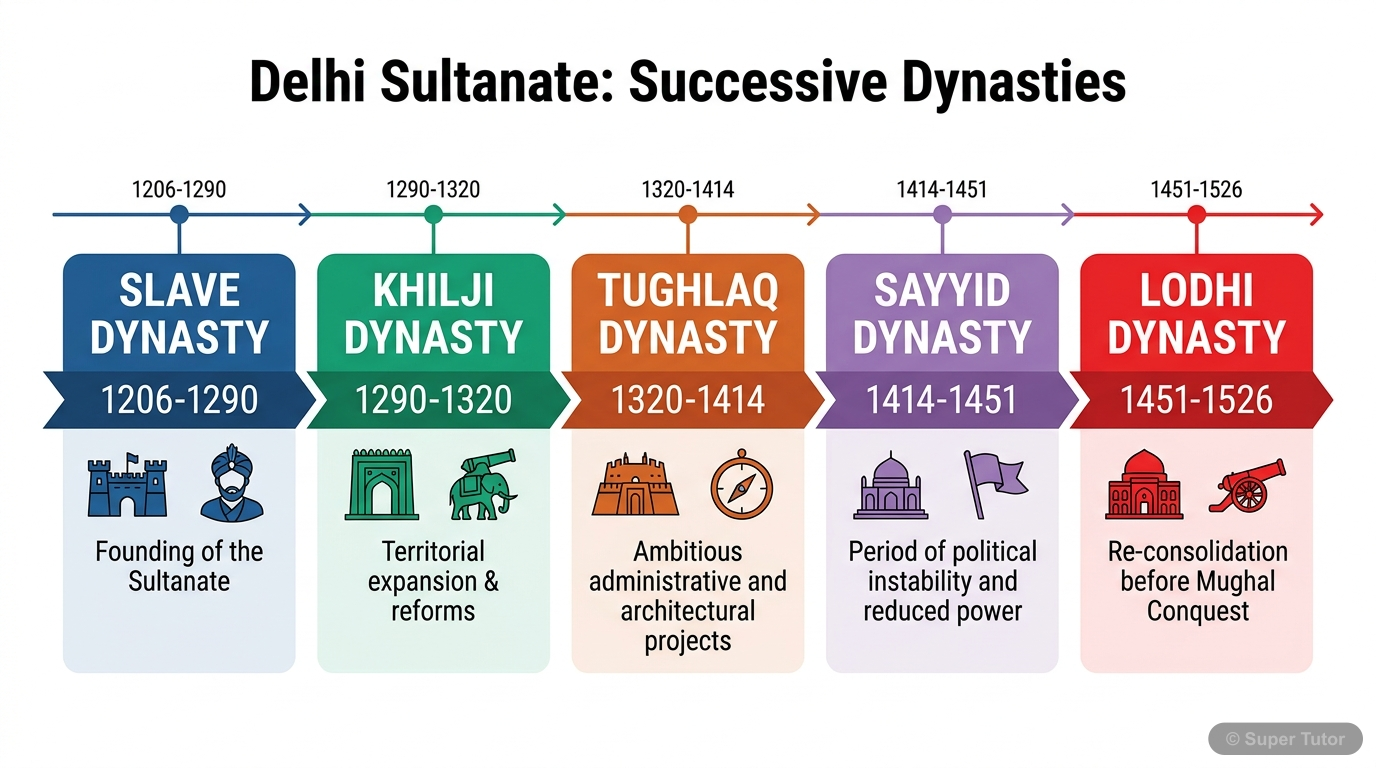
Learn better with visuals Super Tutor pairs illustrations like this with notes and quizzes for Medieval India (B) The Delhi Sultanate.
What is the Delhi Sultanate?
Answer
The Delhi Sultanate was the period from 1206 to 1526 when five dynasties ruled from Delhi. These were the Slave, Khilji, Tughlaq, Sayyid, and Lodhi dynasties.
Why were the Turks able to establish their rule in North India?
Answer
A major reason was the lack of political unity in North India. Many small kingdoms had emerged and were often fighting each other, which made it easier for the Turks to win quick victories.
Who defeated Prithviraj Chauhan at the Second Battle of Tarain?
Answer
Muhammad Ghori defeated Prithviraj Chauhan at the Second Battle of Tarain in 1192. This victory helped Turkish rule spread further in North India.
Who was Qutbuddin Aibak?
Answer
Qutbuddin Aibak was a slave general of Muhammad Ghori who was left as viceroy of the conquered lands. He is regarded as the founder of the Slave dynasty.
Why was Qutbuddin Aibak called Lakhbaksh?
Answer
Qutbuddin Aibak earned the title Lakhbaksh because of his liberal distribution of money. He was also known for his bravery and military skill.
What does the word Mamluk mean?
Answer
Mamluk is an Arabic word meaning owned. The early rulers of the Slave dynasty were called Mamluk Sultans because they had earlier been slaves or sons of slaves.
What were two important conquests of Qutbuddin Aibak?
Answer
Qutbuddin Aibak captured the fort of Kalinjar in Bundelkhand and Anhilwara in Gujarat. These conquests helped in strengthening the Delhi Sultanate.
What happened to Qutbuddin Aibak in 1210?
Answer
Qutbuddin Aibak died in 1210 from a fall from a horse at Lahore while playing chaugan or polo.
+32 more flashcards
Practise AllFrequently Asked Questions
What are the important topics in Medieval India (B) The Delhi Sultanate for ICSE Class 9 History & Civics?
How many flashcards are available for Medieval India (B) The Delhi Sultanate?
How should I revise Medieval India (B) The Delhi Sultanate for Class 9 exams?
Sources & Official References
Content is aligned to the official syllabus. Refer to the board website for the latest curriculum.
More resources for Medieval India (B) The Delhi Sultanate
Practice Quiz
Test yourself with a quick quiz
Important Questions
Exam-style questions with answers
Revision Notes
Key points for last-minute revision
Chapter Summary
Understand the chapter at a glance
Concept Maps
See how topics connect
Study Plan
Step-by-step plan for this chapter
Syllabus
What topics to cover
For serious students
Get the full Medieval India (B) The Delhi Sultanate chapter — start free.
Quizzes, flashcards, an AI doubt solver and a study plan for ICSE Class 9 History & Civics. Free to start, no card needed.