Medieval India (D) Composite Culture — Chapter Summary
ICSE · Class 9 · History & Civics
Summary of Medieval India (D) Composite Culture for ICSE Class 9 History & Civics. Part of the ICSE Class 9 History & Civics syllabus.
Interactive on Super Tutor
Studying Medieval India (D) Composite Culture? Get the full interactive chapter.
Quizzes, flashcards, AI doubt-solver and a step-by-step study plan — built for chapter summary and more.
Free trial, no card needed.
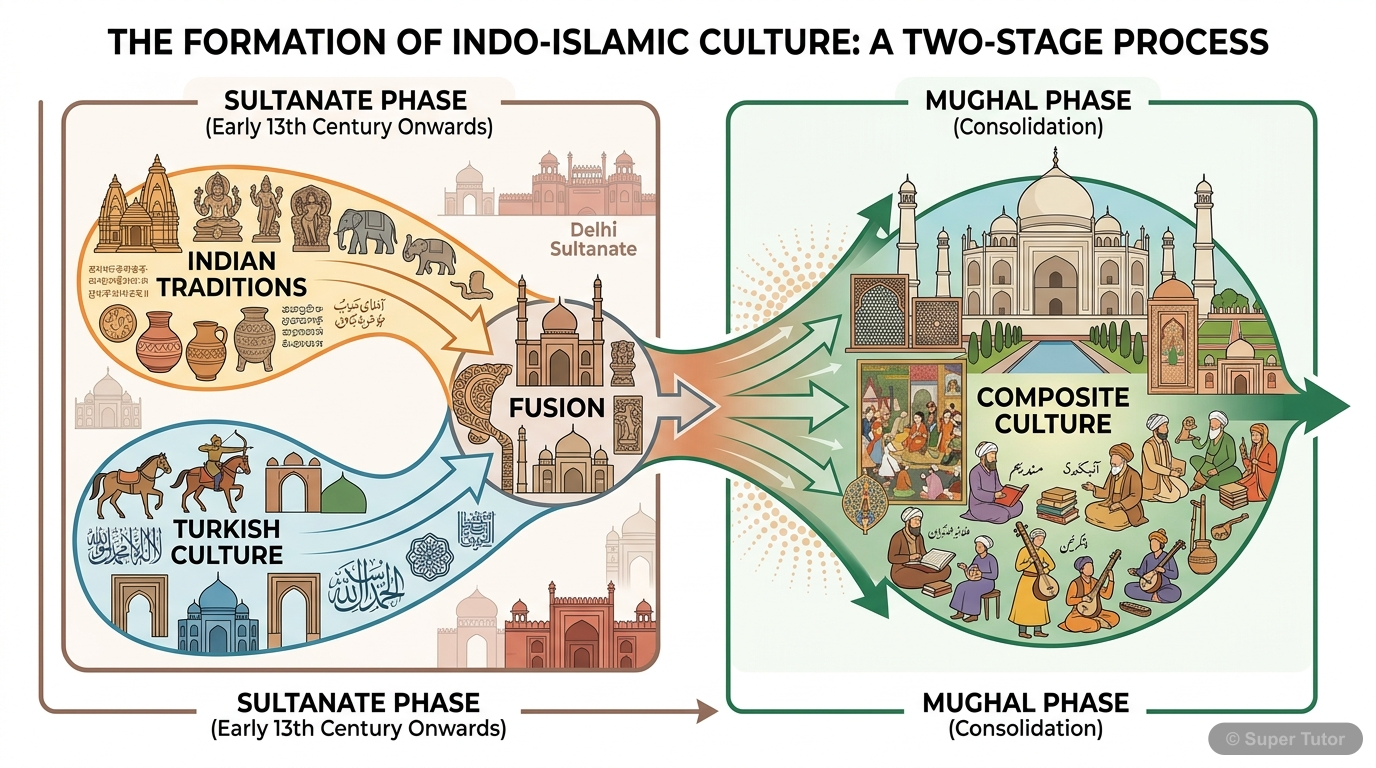
One of 5 illustrations for Medieval India (D) Composite Culture in Super Tutor — alongside flashcards, concept maps and practice questions.
Overview
The establishment of the Delhi Sultanate towards the beginning of the 13th century marked a new phase in the cultural development of India. Interaction between Turks and Indians led to the growth of an Indo-Islamic composite culture. This culture was neither purely Persian nor entirely Indian; it wa
Key Concepts
Composite culture means a new cultural
Composite culture means a new cultural form created by the blending of Indian and Islamic traditions. It developed through close contact between diffe
Bijak is the compilation of
Bijak is the compilation of the verses of Sant Kabir Das. It is preserved by the Kabirpanthis in Varanasi and elsewhere in Uttar Pradesh. Its main sec
Guru Arjan Dev compiled the Adi
Guru Arjan Dev compiled the Adi Granth Sahib in Amritsar, Punjab. Later, Guru Gobind Singh included the compositions of Guru Teg Bahadur, and the scri
Ajmer Sharief is the shrine
Ajmer Sharief is the shrine of Khwajah Moinuddin Chishti, located in Ajmer, Rajasthan. A yearly carnival called Urs is held for six days in his honour
The Bhakti movement began as
The Bhakti movement began as a reaction against caste division and ritualism. Bhakti saints preached devotion to God, equality of all human beings, an
Learning Objectives
- Understand the meaning of composite culture in medieval India
- Identify the main sources that help study composite culture
- Explain the role of Bhakti movement and Sufism in promoting social harmony
- Describe the contributions of Kabir, Guru Nanak Dev, Mirabai, Sant Jnaneswar, and Sufi saints
- Recognise the influence of Christianity through St. Francis Xavier and European churches in India
Frequently Asked Questions
What are the important topics in Medieval India (D) Composite Culture for ICSE Class 9 History & Civics?
How should I revise Medieval India (D) Composite Culture for Class 9 exams?
Sources & Official References
Content is aligned to the official syllabus. Refer to the board website for the latest curriculum.
More resources for Medieval India (D) Composite Culture
For serious students
Get the full Medieval India (D) Composite Culture chapter — start free.
Quizzes, flashcards, an AI doubt solver and a study plan for ICSE Class 9 History & Civics. Free to start, no card needed.