Chapter 14 of 18
Revision Notes
Medieval India (C) The Mughal Empire — Revision Notes
ICSE · Class 9 · History & Civics
Medieval India (C) The Mughal Empire revision notes for ICSE Class 9 History & Civics: 4 topics in quick points.
51 questions36 flashcards5 concepts
Interactive on Super Tutor
Studying Medieval India (C) The Mughal Empire? Get the full interactive chapter.
Quizzes, flashcards, AI doubt-solver and a step-by-step study plan — built for revision notes and more.
Free trial, no card needed.
Super Tutor
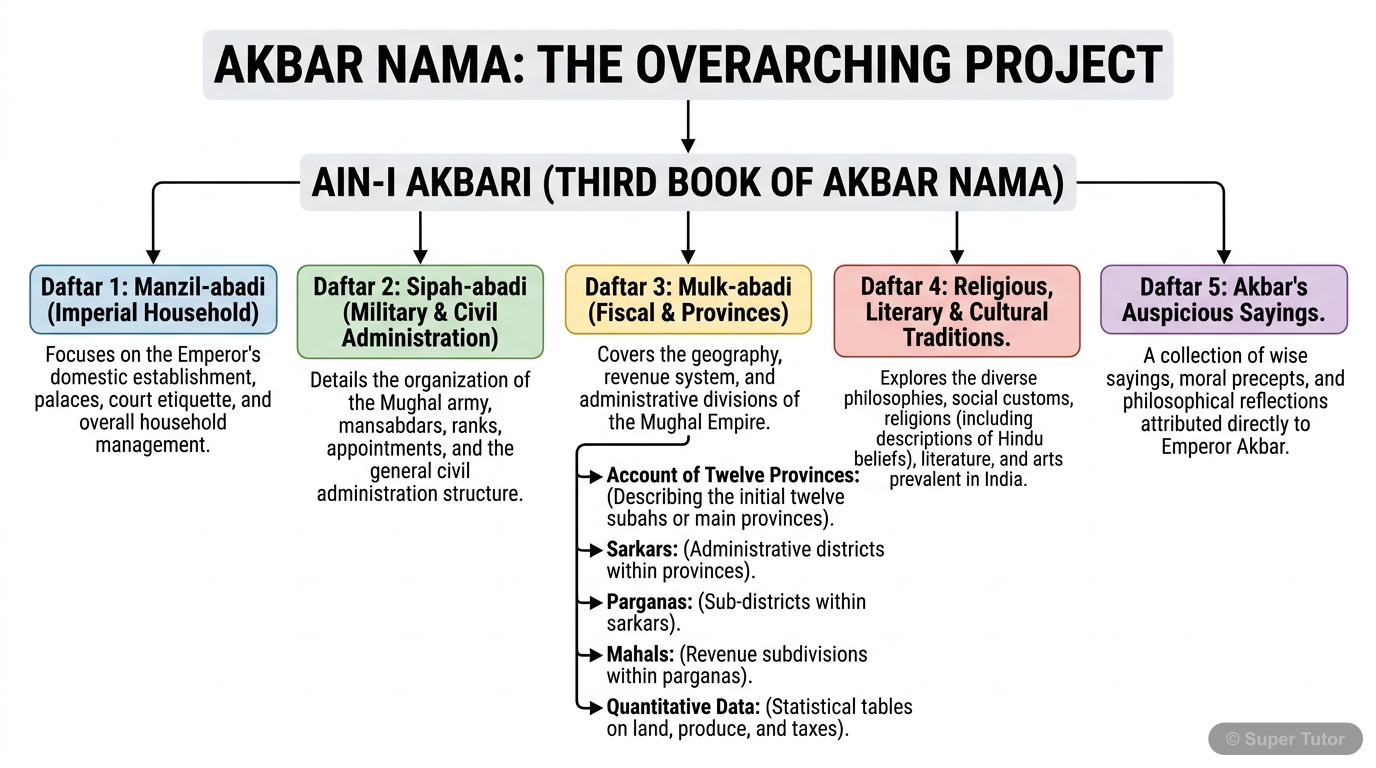
One of 8 illustrations for Medieval India (C) The Mughal Empire in Super Tutor — alongside flashcards, concept maps and practice questions.
Key Topics to Revise
1
Sources of Mughal History
- Ain-i-Akbari was written by Abul Fazl, who was a minister and one of the nine jewels at Akbar's court.
- Ain-i-Akbari is a valuable source for Mughal administration and culture during Akbar's reign.
- The book is divided into five parts dealing with the imperial household, services, administration, Hindu philosophy and customs, and Akbar's sayings plus the author's biography.
2
Babur and the Foundation of Mughal Rule
- Babur's full name was Zahir-ud-din Muhammad Babur.
- He was a descendant of Timur, the Mongol ruler.
- Daulat Khan Lodhi, the Governor of Punjab, invited Babur to oust Ibrahim Lodhi.
3
Akbar: Expansion, Rajput Policy, and Religious Measures
- Akbar was thirteen years old when he ascended the throne and was guided by Bairam Khan.
- At the Second Battle of Panipat, Mughal forces led by Bairam Khan defeated Hemu.
- Hemu was the Wazir of Adil Shah and led regrouped Afghan forces against the Mughals.
4
Aurangzeb and the Later Mughal Empire
- Aurangzeb ascended the throne after a long struggle with his father and three brothers.
- He ruled for 50 years.
- Aurangzeb reversed Akbar's policy of religious tolerance.
Get complete notes with diagrams and examples
Full NotesKey Concepts
AinBaburAkbar ascended the throne atAkbar abolished jizyah and the pilgrimDin
Frequently Asked Questions
What are the important topics in Medieval India (C) The Mughal Empire for ICSE Class 9 History & Civics?
Key topics in Medieval India (C) The Mughal Empire include Sources of Mughal History, Babur and the Foundation of Mughal Rule, Akbar: Expansion, Rajput Policy, and Religious Measures, Aurangzeb and the Later Mughal Empire. Study these first, then practise questions on each for Class 9 exams.
How should I revise Medieval India (C) The Mughal Empire for Class 9 exams?
Learn the core ideas first, then work through the 51 practice questions on Medieval India (C) The Mughal Empire. Revise definitions regularly and use flashcards for quick recall before the exam.
Sources & Official References
Content is aligned to the official syllabus. Refer to the board website for the latest curriculum.
More resources for Medieval India (C) The Mughal Empire
For serious students
Get the full Medieval India (C) The Mughal Empire chapter — start free.
Quizzes, flashcards, an AI doubt solver and a study plan for ICSE Class 9 History & Civics. Free to start, no card needed.