From the Diary of Anne Frank — NCERT Solutions
Madhya Pradesh Board · Class 10 · English
NCERT Solutions for From the Diary of Anne Frank, Madhya Pradesh Board Class 10 English: 32 textbook questions solved step by step.
Interactive on Super Tutor
Studying From the Diary of Anne Frank? Get the full interactive chapter.
Quizzes, flashcards, AI doubt-solver and a step-by-step study plan — built for NCERT solutions and more.
Free trial, no card needed.
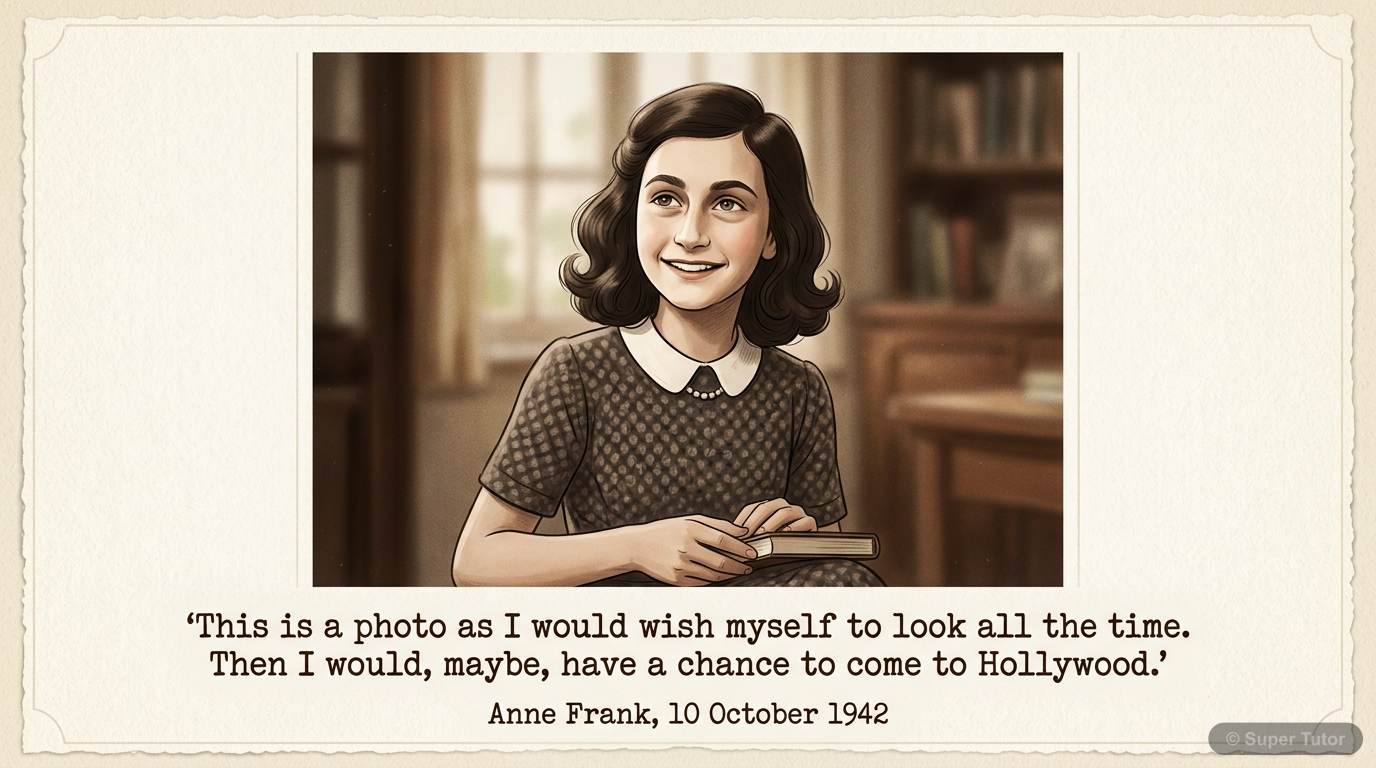
One of 3 illustrations for From the Diary of Anne Frank in Super Tutor — alongside flashcards, concept maps and practice questions.
The first 16 solutions are open to read. The other 16 are free with a Super Tutor account.
Activity
1Do you keep a diary? Given below under 'A' are some terms we use to describe a written record of personal experience. Can you match them with their descriptions under 'B'? (You may look up the terms in a dictionary if you wish.)Show solution
From the given definitions:
- Journal = a book with a separate space or page for each day, where you write thoughts and feelings or events of that day.
- Log = a written record of events with times and dates, usually official.
- Memoir(s) = a record of a person's own life and experiences.
- Diary = a full record of a journey, period of time, or event, written every day.
So the matches are:
- Journal
- Log
- Memoir(s)
- Diary
2Here are some entries from personal records. Use the definitions above to decide which of the entries might be from a diary, a journal, a log or a memoir.Show solution
Using the given meanings:
- Diary: personal thoughts and feelings about events of the day → (i)
- Log: official record of events with times and dates → (ii)
- Journal: record of a journey or period, written daily → (iii)
- Memoir: record of a person's life and experiences → (iv)
Thinking about Language
2Now find the sentences in the lesson that have the phrasal verbs given below. Match them with their meanings. (You have already found out the meanings of some of them.) Are their meanings the same as that of their parts? (Note that two parts of a phrasal verb may occur separated in the text.)Show solution
The correct matches are:
- plunge in → go straight to the topic
- kept back → not promoted
- move up → go to the next grade
- ramble on → speak or write without focus
- get along with → have a good relationship with
- hand in → give an assignment (homework) to a person in authority
- calm down → make (them) remain quiet
- make up for → compensate
- stay in → stay indoors
These are phrasal verbs, so their meanings are often different from the meanings of the individual words.
III. Idioms
1Here are a few sentences from the text which have idiomatic expressions. Can you say what each means? (You might want to consult a dictionary first.)Show solution
The idiomatic expressions mean:
- quaking in its boots → shaking with fear and nervousness
- not to lose heart → not to feel discouraged
- for ages → for a very long time
- the joke was on him → he himself became the person laughed at or fooled
Activity
1Match the terms under 'A' with their descriptions under 'B':
(i) Journal
(ii) Diary
(iii) Log
(iv) Memoir(s)Show solution
Given: Four terms related to written records of personal experience and four descriptions.
Matching:
| Term | Description |
|---|---|
| (i) Journal | A full record of a journey, a period of time, or an event, written every day |
| (ii) Diary | A book with a separate space or page for each day, in which you write down your thoughts and feelings or what has happened on that day |
| (iii) Log | A written record of events with times and dates, usually official |
| (iv) Memoir(s) | A record of a person's own life and experiences (usually, a famous person) |
Explanation:
- A journal is a day-to-day full record of events, journeys or periods.
- A diary is the most personal form — one page per day, recording thoughts and feelings.
- A log is official and time-stamped.
- Memoirs are retrospective accounts of a (usually famous) person's life.
2Decide which of the following entries might be from a diary, a journal, a log or a memoir:
(i) I woke up very late today and promptly got a scolding from Mum! I can't help it — how can I miss the FIFA World Cup matches?
(ii) 10:30 a.m. Went to the office of the Director; 01:00 p.m. Had lunch with Chairman; 05:45 p.m. Received Rahul at the airport; 09:30 p.m. Dinner at home
(iii) The ride to Ooty was uneventful. We rested for a while every 50 km or so… From Ooty we went on to Bangalore. What a contrast! The noise and pollution of this once-beautiful city really broke my heart.
(iv) This is how Raj Kapoor found me — all wet and ragged outside R.K. Studios… he cast me on the spot. The rest, as they say, is history!Show solution
Concept used: Definitions matched in Activity 1.
(i) This entry records personal thoughts and feelings about a specific day (waking up late, watching FIFA). It is written in an informal, emotional tone with a date implied.
(ii) This entry records events with specific times and dates in an official, factual manner — no personal feelings expressed.
(iii) This entry is a full record of a journey written day by day, describing places visited and personal reactions to them.
(iv) This entry is a retrospective account of a significant event in the life of a famous person (a film personality recalling how Raj Kapoor cast him).
Oral Comprehension Check — Part 1 (Before the family sketch)
1What makes writing in a diary a strange experience for Anne Frank?Show solution
Given: Anne Frank begins writing a diary for the first time.
Answer: Writing in a diary is a strange experience for Anne because she has never done it before. She also feels that neither she nor anyone else will be interested in the musings of a thirteen-year-old schoolgirl. Moreover, she does not intend to simply record facts; she wants the diary to be a true friend — someone she can confide in completely. Since she feels she has no such real friend among people, pouring her heart out to a diary feels both unusual and somewhat odd to her.
2Why does Anne want to keep a diary?Show solution
Given: Anne Frank starts writing a diary on her thirteenth birthday.
Answer: Anne wants to keep a diary because she does not have a true, close friend in whom she can confide. Although she has acquaintances and people who care for her, she feels she cannot share her innermost thoughts and feelings with any of them. She therefore decides to treat the diary as her best friend — naming it 'Kitty' — so that she can write down everything she feels without fear of being judged or misunderstood. The diary becomes a substitute for the deep friendship she longs for.
3Why did Anne think she could confide more in her diary than in people?Show solution
Given: Anne reflects on her relationships with people around her.
Answer: Anne felt that although she had friends and family, no one truly understood her or came close enough to her emotionally. She believed that people — even those who cared for her — could not be her confidants in the deepest sense. She was afraid that if she shared her innermost thoughts with people, they might not understand, might judge her, or might not keep her secrets. A diary, on the other hand, would never betray her, never misunderstand her, and would always be available. This is why she could confide more freely in her diary than in any person.
Oral Comprehension Check — Part 2 (After the family sketch)
1Why does Anne provide a brief sketch of her life?Show solution
Given: Anne begins narrating her family background before continuing her diary entries.
Answer: Anne provides a brief sketch of her life because she is writing her diary as if it were letters to an imaginary friend called 'Kitty'. She realises that if she were to plunge straight into her daily stories, Kitty (and any future reader) would not understand the context — who her family members are, where they came from, and what their background is. Therefore, she gives a short account of her family history — her father's and mother's ages at marriage, her sister Margot's birth, her own birth, the family's move from Frankfurt to Holland — so that the reader has the necessary background to follow her diary entries.
2What tells you that Anne loved her grandmother?Show solution
Given: Anne mentions her grandmother's illness, operation, and death in her diary.
Answer: Several things tell us that Anne deeply loved her grandmother:
- When her grandmother fell ill in the summer of 1941, Anne's birthday passed with little celebration — showing that her grandmother's health mattered more to her than her own birthday.
- After her grandmother died in January 1942, Anne writes: 'No one knows how often I think of her and still love her.' This heartfelt statement reveals the depth of her love and how much she missed her.
- At her 1942 birthday celebration, Anne had a candle lit in her grandmother's memory, showing that she honoured and remembered her even after her death.
All these details show that Anne's love for her grandmother was genuine, deep, and lasting.
Oral Comprehension Check — Part 3 (Mr Keesing section)
1Why was Mr Keesing annoyed with Anne? What did he ask her to do?Show solution
Given: Anne describes her relationship with her Maths teacher, Mr Keesing.
Answer: Mr Keesing was annoyed with Anne because she talked too much in class. He had warned her several times, but she continued to chatter. As a punishment, he assigned her extra homework — he asked her to write an essay on the subject 'A Chatterbox'. He hoped this would teach her a lesson and make her feel embarrassed about her habit of talking.
2How did Anne justify her being a chatterbox in her essay?Show solution
Given: Anne writes an essay titled 'A Chatterbox' as punishment.
Answer: Anne justified her talkativeness very cleverly in her essay. She argued that talking is a student's trait and that she would do her best to keep it under control, but she could not completely cure herself of the habit because her mother was also a great talker, and inherited traits are very difficult to overcome. She thus used the argument of heredity — that talking too much was in her nature, passed down from her mother — to justify why she simply could not stop being a chatterbox. This turned the punishment into a witty, convincing piece of writing.
3Do you think Mr Keesing was a strict teacher?Show solution
Given: The text describes Mr Keesing's behaviour towards Anne over several incidents.
Answer: Mr Keesing was strict to some extent — he did assign Anne extra homework as punishment for talking in class, not just once but multiple times. However, he was not excessively strict or humourless. When Anne wrote a clever, witty essay justifying her talkativeness, he took it in good spirit. When she wrote a humorous poem about him (after he gave her the ridiculous topic 'An Incorrigible Chatterbox'), he read it out to the class with his own comments and laughed along. After that, he allowed her to talk and even started making jokes himself.
Therefore, Mr Keesing was strict in maintaining discipline but was also fair, open-minded, and had a good sense of humour. He was not a rigid or unreasonable teacher.
4What made Mr Keesing allow Anne to talk in class?Show solution
Given: Anne writes three essays as punishment; the third one is a poem.
Answer: After Mr Keesing gave Anne the topic 'An Incorrigible Chatterbox' and then 'Quack, Quack, Quack, Said Mistress Chatterback', Anne — with the help of her friend Sanne — wrote a humorous poem. In the poem, a mother duck and a father swan have three baby ducklings. The father bites the ducklings to death because they quack too much. This was a witty, indirect joke aimed at Mr Keesing himself. Mr Keesing appreciated the humour, read the poem aloud to several classes with his own comments, and was so amused that he allowed Anne to talk in class from then on. He even started making jokes himself. It was Anne's wit and creativity that won him over.
Thinking about the Text
1Was Anne right when she said that the world would not be interested in the musings of a thirteen-year-old girl?Show solution
Answer: No, Anne was not right in her assessment. She underestimated herself and the power of her writing. Her diary, The Diary of a Young Girl, has become one of the most widely read books in the world. It has been translated into dozens of languages and has moved millions of readers across generations.
Although Anne thought her thoughts were too ordinary to interest anyone, her diary turned out to be an extraordinary document — a first-hand account of the life of a Jewish family hiding from the Nazis during World War II. Her observations about human nature, her longing for friendship, her fears, her hopes, and her remarkable maturity of thought have made her diary a timeless classic.
Thus, far from being uninteresting, the musings of this thirteen-year-old girl have touched the hearts of people all over the world.
Free with a Super Tutor account
Free with a Super Tutor account
Free with a Super Tutor account
Free with a Super Tutor account
Free with a Super Tutor account
(i) We don't seem to be able to get any closer, and that's the problem. Maybe it's my fault that we don't confide in each other.
(ii) I don't want to jot down the facts in this diary the way most people would, but I want the diary to be my friend.
(iii) Margot went to Holland in December, and I followed in February, when I was plunked down on the table as a birthday present for Margot.
(iv) If you ask me, there are so many dummies that about a quarter of the class should be kept back, but teachers are the most unpredictable creatures on earth.
(v) Anyone could ramble on and leave big spaces between the words, but the trick was to come up with convincing arguments to prove the necessity of talking.
Free with a Super Tutor account
Thinking about Language — I (Compound Words)
1. Heartbreaking
2. Homesick
3. Blockhead
4. Law-abiding
5. Overdo
6. Daydream
7. Breakdown
8. Output
Free with a Super Tutor account
Thinking about Language — II (Phrasal Verbs)
(i) plunge (right) in
(ii) kept back
(iii) ramble on
(iv) get along with
Free with a Super Tutor account
(i) plunge in
(ii) kept back
(iii) move up
(iv) ramble on
(v) get along with
(vi) calm down
(vii) stay in
(viii) make up for
(ix) hand in
Free with a Super Tutor account
Thinking about Language — III (Idioms)
(i) Our entire class is quaking in its boots.
(ii) Until then, we keep telling each other not to lose heart.
(iii) Mr Keesing was annoyed with me for ages because I talked so much.
(iv) Mr Keesing was trying to play a joke on me with this ridiculous subject, but I'd make sure the joke was on him.
Free with a Super Tutor account
(i) caught my eye
(ii) he'd had enough
(iii) laugh ourselves silly
(iv) can't bring myself to
Free with a Super Tutor account
Thinking about Language — IV (Using a Dictionary for Idioms)
1. break somebody's heart
2. close/dear to heart
3. from the (bottom of your) heart
4. have a heart
5. have a heart of stone
6. your heart goes out to somebody
Free with a Super Tutor account
Thinking about Language — V (Contracted Forms)
Free with a Super Tutor account
Free with a Super Tutor account
Speaking (Contracted Forms in Drama)
Free with a Super Tutor account
Writing
Free with a Super Tutor account
16 more solved questions in From the Diary of Anne Frank
They are free with a Super Tutor account, along with practice quizzes and flashcards for this chapter. Free to start, no card needed.
Frequently Asked Questions
What are the important topics in From the Diary of Anne Frank for Madhya Pradesh Board Class 10 English?
Are these NCERT Solutions for From the Diary of Anne Frank free?
How should I revise From the Diary of Anne Frank for the Madhya Pradesh Board Class 10 board exam?
Sources & Official References
Content is aligned to the official syllabus. Refer to the board website for the latest curriculum.
More resources for From the Diary of Anne Frank
Practice Quiz
Test yourself with a quick quiz
Important Questions
Exam-style questions with answers
Revision Notes
Key points for last-minute revision
Chapter Summary
Understand the chapter at a glance
Concept Maps
See how topics connect
Study Plan
Step-by-step plan for this chapter
Flashcards
Quick-fire cards for active recall
Syllabus
What topics to cover
For serious students
Get the full From the Diary of Anne Frank chapter — start free.
Quizzes, flashcards, an AI doubt solver and a study plan for Madhya Pradesh Board Class 10 English. Free to start, no card needed.