Mijbil the Otter — NCERT Solutions
Madhya Pradesh Board · Class 10 · English
NCERT Solutions for Mijbil the Otter, Madhya Pradesh Board Class 10 English: 33 textbook questions solved step by step.
Interactive on Super Tutor
Studying Mijbil the Otter? Get the full interactive chapter.
Quizzes, flashcards, AI doubt-solver and a step-by-step study plan — built for NCERT solutions and more.
Free trial, no card needed.
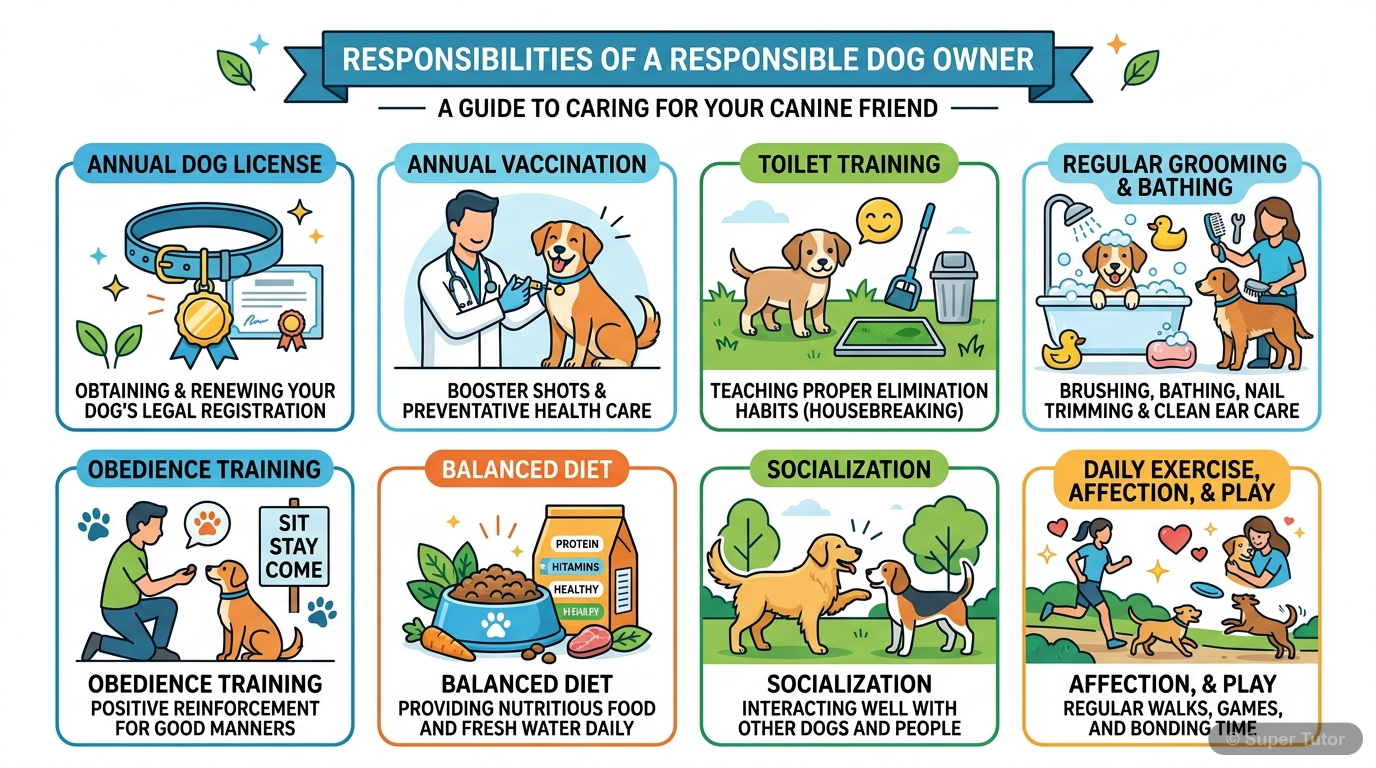
Learn better with visuals Super Tutor pairs illustrations like this with notes and quizzes for Mijbil the Otter.
The first 17 solutions are open to read. The other 16 are free with a Super Tutor account.
Activity
1Do you have a pet? If you do, you perhaps know that a pet is a serious responsibility. Read in the box below what the SPCA — the Society for the Prevention of Cruelty to Animals — has to say about how to care for a pet.Show solution
उत्तर व्यक्तिगत अनुभव पर आधारित है।
यदि आपका पालतू जानवर है, तो आप लिख सकते हैं कि पालतू रखना एक बड़ी जिम्मेदारी है। उसकी देखभाल के लिए भोजन, साफ़ पानी, व्यायाम, टीकाकरण, साफ़-सफाई, और प्रेम की ज़रूरत होती है।
Oral Comprehension Check – I (Maxwell's arrival and getting Mij)
1What 'experiment' did Maxwell think Camusfearna would be suitable for?Show solution
Given: Maxwell is thinking about his home, Camusfearna, in the Scottish Highlands.
Maxwell thought that Camusfearna, with its ring of bright water and the surrounding wilderness, would be a suitable place to keep an otter as a pet. He had long had what he called 'an otter fixation' — a strong desire to keep an otter — and he believed the streams, lochs, and open spaces around Camusfearna would provide the perfect natural environment for such an experiment in keeping an otter as a companion animal.
2Why does he go to Basra? How long does he wait there, and why?Show solution
Given: Maxwell is a writer who has been travelling.
Maxwell goes to Basra (in Iraq) to meet a friend who works for the Consulate-General there. He has to wait for about a month in Basra because he is waiting for his mail to arrive. During this wait, his friend suggests that he get an otter from the local Marsh Arabs, since otters are very common in the marshes near Basra.
3How does he get the otter? Does he like it? Pick out the words that tell you this.Show solution
Given: Maxwell is staying in Basra.
Maxwell gets the otter through two Arabs who are employed by his friend. They bring him a young otter as a gift. Yes, Maxwell clearly likes the otter very much. The words that tell us this are: he describes the otter as having 'a face that was not, it seemed to me, entirely devoid of humour and intelligence.' He also says the otter was 'the colour of milk chocolate' with 'symmetrical pointed scales' — showing he observes it with great affection and admiration. His immediate interest and care for the animal also indicate his fondness.
4Why was the otter named 'Maxwell's otter'?Show solution
Given: The otter belonged to a species not yet known to science.
The otter that Maxwell brought home turned out to belong to a species that was previously unknown to science. Since Maxwell was the person who first brought this species to the attention of the scientific world, the species was named after him — it was called 'Lutrogale perspicillata maxwelli', or Maxwell's otter. This is a standard scientific practice of naming a newly discovered species after its discoverer.
5Tick the right answer. In the beginning, the otter was
- aloof and indifferent
- friendly
- hostileShow solution
Correct answer: aloof and indifferent
Justification: In the beginning, the otter (before it was named Mij) showed no interest in Maxwell. It was neither friendly nor hostile — it simply ignored him, remaining aloof and indifferent to his presence.
6What happened when Maxwell took Mijbil to the bathroom? What did it do two days after that?Show solution
Given: Maxwell had brought Mij to his hotel room in Basra.
When Maxwell took Mij to the bathroom, the otter went wild with joy in the water. It plunged, rolled, and made the water splash everywhere. It was clearly in its element and thoroughly enjoyed itself.
Two days later, Mij escaped from Maxwell's bedroom and made his way to the bathroom on his own. Maxwell found him up on the end of the bathtub, fumbling at the chromium taps with his paws. In less than a minute, Mij had turned the tap far enough to produce a trickle of water, and soon achieved the full flow. This showed remarkable intelligence and initiative on Mij's part.
Oral Comprehension Check – II (Transporting Mij to England)
1How was Mij to be transported to England?Show solution
Given: Maxwell needed to take Mij from Basra to London.
Mij was to be transported to England by aeroplane. Since the airline's rules required that any animal must be carried in a box in the hold of the aircraft (not in the passenger cabin), Maxwell had a box made for Mij. The box had a wire-mesh front so that Mij could breathe and see out.
2What did Mij do to the box?Show solution
Given: Mij was placed in the box before the flight.
Mij was extremely distressed at being confined in the box. He fought and scratched at the box desperately. By the time Maxwell returned to the box (after being delayed), he found that Mij had torn the lining of the box to shreds. The zinc sheeting inside had been torn off, and Mij had bloodied his paws and nose in his frantic attempts to escape. The box was in a terrible state.
3Why did Maxwell put the otter back in the box? How do you think he felt when he did this?Show solution
Given: Mij had escaped from the box and was running loose in the aircraft.
Maxwell put Mij back in the box because the airline rules required that the animal be kept in the box during the flight. He had no choice but to comply with the regulations.
Maxwell must have felt very distressed and guilty when he put Mij back in the box, because he had already seen how much Mij suffered inside it. He knew the otter was frightened and in pain from his earlier attempts to escape. Putting him back must have been a very difficult and painful decision for Maxwell, who clearly loved his pet deeply.
4Why does Maxwell say the air hostess was 'the very queen of her kind'?Show solution
Given: Mij had escaped and was running loose in the aircraft, causing chaos.
Maxwell calls the air hostess 'the very queen of her kind' because she handled the chaotic situation with extraordinary grace, charm, and efficiency. When Mij escaped and ran down the aisle causing panic among the passengers, the air hostess calmly and politely asked Maxwell to return to his seat while she would find the animal and bring it to him. Her composure, kindness, and professional handling of a very unusual and embarrassing situation impressed Maxwell greatly, hence the high praise.
5What happened when the box was opened?Show solution
Given: Maxwell had to open the box before the flight to rearrange Mij.
When the box was opened (just before the flight, as Maxwell was trying to rearrange the contents to make more room for Mij), Mij shot out of the box like a flash. He disappeared at high speed down the aircraft. This caused great panic among the passengers — there were squawks and shrieks, and a woman stood on her seat screaming that there was a rat. Mij ran under the seats and legs of passengers, causing considerable chaos, until he finally found his way back to Maxwell and bounded onto his knee, nuzzling his face and neck with recognition and affection.
Oral Comprehension Check – III (Mij in London)
1What game had Mij invented?Show solution
Given: Maxwell had a damaged suitcase whose lid remained at a slope.
Mij invented a game using Maxwell's damaged suitcase. The lid of the suitcase, when closed, remained at a slope from one end to the other. Mij discovered that if he placed a ping-pong ball on the high end, it would run down the length of the suitcase. He would then dash around to the other end to 'ambush' the ball's arrival — he would crouch and hide from it, then spring up and take it by surprise, grab it, and trot off with it to the high end to start the game all over again. This game could keep him engrossed for up to half an hour at a time.
2What are 'compulsive habits'? What does Maxwell say are the compulsive habits of (i) school children (ii) Mij?Show solution
Given: Maxwell observes Mij's behaviour on walks in London.
Compulsive habits are habits that are impossible to control — things one feels compelled to do repeatedly, almost like a ritual, even if there is no logical reason for doing them.
(i) School children's compulsive habits: Maxwell says that school children, on their way to and from school, must place their feet squarely on the centre of each paving block; must touch every seventh upright of the iron railings; or must pass to the outside of every second lamp post. These are rituals they feel they must follow.
(ii) Mij's compulsive habits: On his walks in the London streets, Mij developed the compulsive habit of tugging Maxwell towards the low wall (about two feet high) that ran along the frontage of the primary school opposite Maxwell's flat. On his way home (but never on his way out), Mij would jump onto this wall and gallop the full length of its thirty yards, causing great distraction to both pupils and staff inside the school.
3What group of animals do otters belong to?Show solution
Given: Londoners were unable to identify Mij.
Otters belong to a comparatively small group of animals called Mustellines. This group is shared by several other animals including the badger, mongoose, weasel, stoat, mink, and others. Despite this, the average Londoner did not recognise Mij as an otter, and made a wide variety of incorrect guesses about what kind of animal he was.
4What guesses did the Londoners make about what Mij was?Show solution
Given: Maxwell walked Mij on a lead through the streets of London.
The Londoners made a remarkable variety of incorrect guesses about Mij's identity. They guessed he was:
- A baby seal
- A squirrel
- A walrus (which made Maxwell giggle)
- A hippo (heard outside a dog show)
- A beaver
- A bear cub
- A leopard (one that had 'changed its spots')
- A brontosaur
The most memorable response came from a labourer digging in the street, who stared at Mij with an expression of surprise and affront and growled, 'Here, Mister — what is that supposed to be?' Maxwell awarded this question the highest score of all.
Thinking about the Text
1What things does Mij do which tell you that he is an intelligent, friendly and fun-loving animal who needs love?Show solution
Given: The text describes Mij's behaviour in detail.
Mij displays intelligence, friendliness, a love of fun, and a need for love through many actions:
Intelligence:
- He figured out how to turn on the bathroom tap by himself within a minute of fumbling with it — a remarkable feat of problem-solving.
- He invented his own game with the ping-pong ball and the sloping suitcase lid.
- He quickly learned to follow Maxwell without a lead and came when called by name.
Friendliness and need for love:
- After the chaos on the aeroplane, Mij bounded onto Maxwell's knee and nuzzled his face and neck with a 'distressed chitter of recognition and welcome' — showing deep affection and relief at finding his owner.
- He would follow Maxwell everywhere without a lead, showing attachment and trust.
Fun-loving nature:
- He spent hours shuffling a rubber ball around the room like a four-footed soccer player, using all four feet to dribble.
- He could throw the ball to a surprising height with a powerful flick of his neck.
- He would lie on his back and juggle marbles on his wide, flat belly without dropping them.
- He invented the suitcase-and-ping-pong-ball game and played it for up to half an hour.
- He developed the compulsive habit of galloping along the school wall on his way home.
All these actions together paint the picture of a highly intelligent, deeply affectionate, and wonderfully playful animal.
Free with a Super Tutor account
Free with a Super Tutor account
| What Mij does | How Mij feels or thinks |
|---|---|
| plunges, rolls in the water and makes the water splash and splash | |
| Screws the tap in the wrong way | |
| Nuzzles Maxwell's face and neck in the aeroplane | |
Free with a Super Tutor account
(i) makes Mij seem almost human, like a small boy.
(ii) shows that he is often irritated with what Mij does.
(iii) shows that he is often surprised by what Mij does.
(iv) of Mij's antics is comical.
(v) shows that he observes the antics of Mij very carefully.
(vi) shows that he thinks Mij is a very ordinary otter.
(vii) shows that he thinks the otter is very unusual.
Free with a Super Tutor account
Thinking about Language
Free with a Super Tutor account
He shook himself, and I half expected a cloud of dust.
The author uses a cloud of dust to give a picture of a large quantity of dust. Phrases like this indicate a particular quantity of something that is not usually countable. For example: a bit of land, a drop of blood, a pinch of salt, a piece of paper.
Free with a Super Tutor account
Thinking about Language – I (Describing a Repeated Action in the Past)
| Emperor Akbar | would | be fond of musical evenings. |
|---|---|---|
| Every evening we | take long walks on the beach. |
| Fifty years ago, very few people | used to | own cars. |
| Till the 1980s, Shanghai | have very dirty streets. |
| My uncle | spend his holidays by the sea. |
Free with a Super Tutor account
Thinking about Language – II (Noun Modifiers)
(i) An otter fixation
(ii) The iron railings
(iii) The Tigris marshes
(iv) The London streets
(v) soft velvet fur
(vi) A four-footed soccer player
Free with a Super Tutor account
Free with a Super Tutor account
Thinking about Language – III (Quantity Phrases)
(i) a portion of
(ii) a pool of
(iii) flakes of
(iv) a huge heap of
(v) a gust of
(vi) little drops of
(vii) a piece of
(viii) a pot of
blood, cotton, stones, gold, fried fish, snow, water, wind
Free with a Super Tutor account
(i) My teacher gave me some advice. → My teacher gave me a bit of advice.
(ii) Can you give me some clay, please.
(iii) The information you gave was very useful.
(iv) Because of these factories, smoke hangs over the city.
(v) Two stones rubbed together can produce sparks of fire.
(vi) He gave me some flowers on my birthday.
Free with a Super Tutor account
Thinking about the Poem – Fog (by Carl Sandburg)
(ii) How does the fog come?
(iii) What does 'it' in the third line refer to?
(iv) Does the poet actually say that the fog is like a cat? Find three things that tell us that the fog is like a cat.
Free with a Super Tutor account
| Storm | tiger | pounces over the fields, growls |
|---|---|---|
| Train | | |
| Fire | | |
| School | | |
| Home | | |
(ii) Think about a storm. Write a poem about the storm comparing it with an animal.
Free with a Super Tutor account
Free with a Super Tutor account
Pre-Reading / Oral Activity
(i) The food it eats.
(ii)
(iii)
(iv)
(v)
Free with a Super Tutor account
Free with a Super Tutor account
16 more solved questions in Mijbil the Otter
They are free with a Super Tutor account, along with practice quizzes and flashcards for this chapter. Free to start, no card needed.
Frequently Asked Questions
What are the important topics in Mijbil the Otter for Madhya Pradesh Board Class 10 English?
Are these NCERT Solutions for Mijbil the Otter free?
How should I revise Mijbil the Otter for the Madhya Pradesh Board Class 10 board exam?
Sources & Official References
Content is aligned to the official syllabus. Refer to the board website for the latest curriculum.
More resources for Mijbil the Otter
Practice Quiz
Test yourself with a quick quiz
Important Questions
Exam-style questions with answers
Revision Notes
Key points for last-minute revision
Chapter Summary
Understand the chapter at a glance
Concept Maps
See how topics connect
Study Plan
Step-by-step plan for this chapter
Flashcards
Quick-fire cards for active recall
Syllabus
What topics to cover
For serious students
Get the full Mijbil the Otter chapter — start free.
Quizzes, flashcards, an AI doubt solver and a study plan for Madhya Pradesh Board Class 10 English. Free to start, no card needed.