Madam Rides the Bus — NCERT Solutions
Madhya Pradesh Board · Class 10 · English
NCERT Solutions for Madam Rides the Bus, Madhya Pradesh Board Class 10 English: 35 textbook questions solved step by step.
Interactive on Super Tutor
Studying Madam Rides the Bus? Get the full interactive chapter.
Quizzes, flashcards, AI doubt-solver and a step-by-step study plan — built for NCERT solutions and more.
Free trial, no card needed.
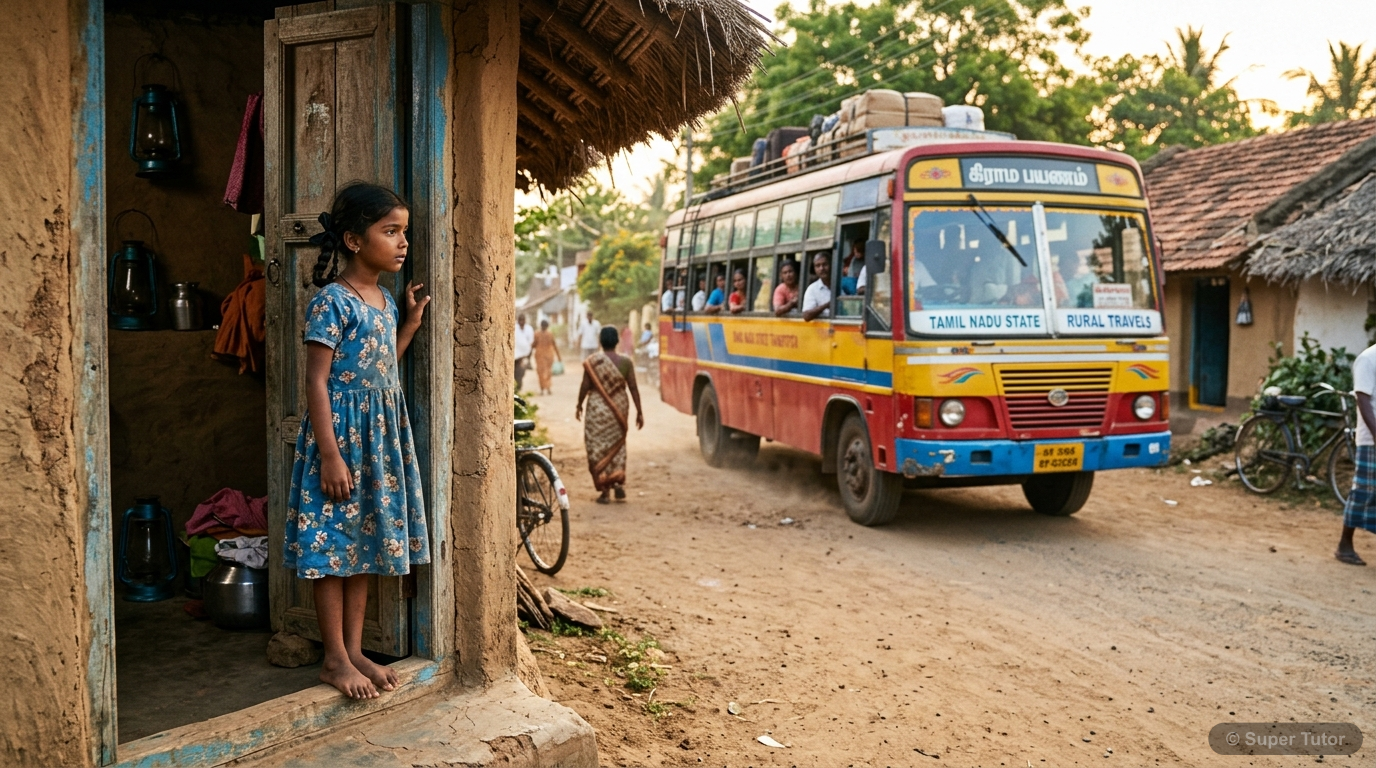
One of 6 illustrations for Madam Rides the Bus in Super Tutor — alongside flashcards, concept maps and practice questions.
The first 18 solutions are open to read. The other 17 are free with a Super Tutor account.
Before You Read
1Look at the words and phrases given below. Then put a tick against the ones you think you will find in the text.Show solution
Tick the phrases that appear in the story: a set of passengers, get on the bus, get off the bus, platform, Tickets, please, a roar and a rattle, a row of seats, slowing down to a crawl, blowing a whistle.
2You must have travelled by bus more than once. What can you see from a fast-moving bus? Given below are some suggestions. Speak briefly about some of these scenes, or about other such scenes that you have seen; or write a sentence or two about them.Show solution
From a fast-moving bus, you can see rivers, green fields, hills, roadside shops, marketplaces, railway tracks, moving trains, vehicles, trees, crowds, clothes in shops, and animals. A student may briefly describe any of these scenes in a few sentences.
Oral Comprehension Check – I
1What was Valli's favourite pastime?Show solution
Given: The story 'Madam Rides the Bus' by Vallikannan.
Answer: Valli's favourite pastime was standing in the front doorway of her house and watching what was happening in the street outside. She found the street to be a source of unending joy and fascination for her.
2What was a source of unending joy for Valli? What was her strongest desire?Show solution
Given: Details about Valli's life from the story.
Answer: The street outside her house was a source of unending joy for Valli. She would watch the people, vehicles, and activities on the street with great curiosity and excitement.
Her strongest desire was to ride the bus that she saw travelling between her village and the nearest town. She longed to ride on that bus at least once, and this desire grew day by day until she decided to fulfil it.
3What did Valli find out about the bus journey? How did she find out these details?Show solution
Given: Valli's preparation for the bus journey.
Answer: Valli found out the following details about the bus journey:
- The distance between her village and the town was six miles.
- The fare was thirty paise one way (sixty paise for the return journey).
- The journey took forty-five minutes each way.
- The afternoon bus left her village at one o'clock and reached the town at one forty-five. It started back at two forty-five and reached the village at three thirty.
She found out these details by listening carefully to conversations between her neighbours and the regular bus passengers, and by asking a few discreet questions here and there. She gathered all this information without letting anyone know what she was planning.
4What do you think Valli was planning to do?Show solution
Given: Valli's curiosity about the bus and the details she collected.
Answer: Valli was planning to ride the bus to the town and return home on the same day, all by herself, without her mother's knowledge. She had carefully gathered all the information about the bus timings and fare, and was saving money to buy her ticket. She planned to travel during the hours when her mother took her afternoon nap so that she would not be missed.
Oral Comprehension Check – II
1Why does the conductor call Valli 'madam'?Show solution
Given: The conductor's behaviour towards Valli on the bus.
Answer: The conductor calls Valli 'madam' in a light-hearted, humorous, and teasing manner. He is a jolly person who is fond of joking. He finds it amusing that such a tiny, young girl is travelling alone and behaving in a very grown-up, self-assured, and independent manner — refusing help to board the bus and asserting herself confidently. To mock her adult-like behaviour playfully and affectionately, he addresses her as 'madam'. It is a term of gentle, good-natured fun rather than a serious form of address.
2Why does Valli stand up on the seat? What does she see now?Show solution
Given: Valli's experience during the bus ride.
Answer: Valli stands up on her seat because the window had a canvas blind that was blocking her view of the outside. She wanted to see the scenery clearly.
When she stands up, she sees a wonderful and exciting view — the road was very narrow, and on one side there was a deep ditch and on the other side there were palm trees, grassland, distant mountains, and the blue sky. She also sees the bus overtaking a slow-moving, overloaded rural cart and a young cow running in front of the bus, which makes her laugh with delight.
3What does Valli tell the elderly man when he calls her a child?Show solution
Given: The conversation between Valli and an elderly man on the bus.
Answer: When the elderly man calls her a child, Valli reacts with indignation and asserts herself firmly. She tells him, "I'm not a child, I tell you." She makes it clear that she does not consider herself a child and does not appreciate being treated as one. She also points out that she is travelling alone and has paid her thirty paise fare just like everyone else, implying that she deserves to be treated as an equal passenger.
4Why didn't Valli want to make friends with the elderly woman?Show solution
Given: The interaction between Valli and the elderly woman on the bus.
Answer: Valli did not want to make friends with the elderly woman because she found her appearance unappealing and her behaviour intrusive. The woman had big earlobes with large holes, and she was chewing betel nut, which Valli found repulsive. Moreover, the woman kept asking Valli unnecessary and nosy questions about where she was going, what the street was, and what the house number was, which Valli found irritating and interfering. Valli felt the woman was talking 'drivel' (silly nonsense) and was prying into her affairs, so she turned away and stared out of the window instead.
Oral Comprehension Check – III
1How did Valli save up money for her first journey? Was it easy for her?Show solution
Given: Details of Valli's savings from the story.
Answer: Valli saved money by carefully and thriftily setting aside every stray coin that came her way. She resisted all temptations to spend money on peppermints, toys, balloons, and other such things. She even controlled her strong desire to ride the merry-go-round at the village fair, though she had the money to do so. In this way, she slowly and steadily saved a total of sixty paise — thirty paise for the journey to town and thirty paise for the return journey.
No, it was not easy for her at all. It required great self-discipline and determination, especially at the village fair where the temptation to spend was very strong. But she resolutely suppressed all such desires in order to fulfil her dream of riding the bus.
2What did Valli see on her way that made her laugh?Show solution
Given: Valli's observations during the bus journey.
Answer: On her way to town, Valli saw a young cow running very fast right in front of the bus, in the middle of the road. The cow's tail was raised and it was galloping along, refusing to move aside despite the bus driver honking the horn repeatedly. The sight of the cow running ahead of the bus in a comical manner, with its tail up, made Valli laugh with great delight and amusement.
3Why didn't she get off the bus at the bus station?Show solution
Given: Valli's actions at the town bus station.
Answer: Valli did not get off the bus at the town bus station because she did not have enough money to do anything in town and then return home. She had saved exactly sixty paise — just enough for the return journey. She had not planned to explore the town; her only desire was to experience the bus ride itself. So she decided to stay in her seat and take the same bus back to her village.
4Why didn't Valli want to go to the stall and have a drink? What does this tell you about her?Show solution
Given: The conductor's offer to Valli at the bus station.
Answer: Valli did not want to go to the stall and have a drink because she did not have any extra money. She had saved exactly sixty paise for the bus fare and had no money left over. She firmly and politely refused the conductor's offer to treat her, saying "No, no" and "please, no."
This tells us that Valli was a very self-respecting, principled, and independent young girl. She did not want to accept charity or favours from anyone. Despite being just eight years old, she had a strong sense of dignity and self-reliance. She had planned her trip carefully within her means and was not willing to be indebted to anyone.
Thinking about the Poem
1Who are the characters in this poem? List them with their pet names.Show solution
The characters are Belinda, her black kitten Ink, her grey mouse Blink, her yellow dog Mustard, her dragon Custard, and the pirate.
2Why did Custard cry for a nice safe cage? Why is the dragon called “cowardly dragon”?Show solution
Custard cried for a nice safe cage because he was afraid and behaved like a coward. The dragon is called “cowardly dragon” because, despite his fierce appearance, he was timid and always wanted protection.
3“Belinda tickled him, she tickled him unmerciful...” Why?Show solution
Belinda tickles Custard unmercifully because she and the other pets are mocking him for being timid. They all laugh at him and call him names, so the tickling is part of their teasing.
4The poet has employed many poetic devices in the poem. For example: “Clashed his tail like iron in a dungeon” — the poetic device here is a simile. Can you, with your partner, list some more such poetic devices used in the poem?Show solution
Examples of poetic devices in the poem include:
- Simile: “Belinda was as brave as a barrel full of bears”
- Simile: “sharp as Mustard”
- Metaphor: “mouth like a fireplace”
- Alliteration: “climbing in the winda”, “pocket flagon”
- Repetition: “Suddenly, suddenly”
- Imagery: “spikes on top of him and scales underneath”
Any such examples from the poem are acceptable.
Free with a Super Tutor account
Free with a Super Tutor account
Free with a Super Tutor account
Free with a Super Tutor account
Writing
Free with a Super Tutor account
Oral Comprehension Check – IV
Free with a Super Tutor account
Thinking about the Text
Free with a Super Tutor account
Free with a Super Tutor account
(i) 'Stop the bus! Stop the bus!' And a tiny hand was raised ____________.
(ii) 'Yes, I ____________ go to town,' said Valli.
(iii) 'There's nobody here ____________,' she said haughtily.
(iv) 'Never mind,' she said, 'I can ____________. You don't have to help me.' 'I'm not a child, I tell you,' she said, ____________.
(v) 'You needn't bother about me. I ____________,' Valli said.
(vi) Then she turned to the conductor and said, 'Well, sir, I hope ____________.'
Free with a Super Tutor account
Free with a Super Tutor account
Free with a Super Tutor account
Free with a Super Tutor account
Free with a Super Tutor account
Free with a Super Tutor account
Writing
Free with a Super Tutor account
Free with a Super Tutor account
Free with a Super Tutor account
17 more solved questions in Madam Rides the Bus
They are free with a Super Tutor account, along with practice quizzes and flashcards for this chapter. Free to start, no card needed.
Frequently Asked Questions
What are the important topics in Madam Rides the Bus for Madhya Pradesh Board Class 10 English?
Are these NCERT Solutions for Madam Rides the Bus free?
How should I revise Madam Rides the Bus for the Madhya Pradesh Board Class 10 board exam?
Sources & Official References
Content is aligned to the official syllabus. Refer to the board website for the latest curriculum.
More resources for Madam Rides the Bus
Practice Quiz
Test yourself with a quick quiz
Important Questions
Exam-style questions with answers
Revision Notes
Key points for last-minute revision
Chapter Summary
Understand the chapter at a glance
Concept Maps
See how topics connect
Study Plan
Step-by-step plan for this chapter
Flashcards
Quick-fire cards for active recall
Syllabus
What topics to cover
For serious students
Get the full Madam Rides the Bus chapter — start free.
Quizzes, flashcards, an AI doubt solver and a study plan for Madhya Pradesh Board Class 10 English. Free to start, no card needed.