The Sermon at Benares — NCERT Solutions
Madhya Pradesh Board · Class 10 · English
NCERT Solutions for The Sermon at Benares, Madhya Pradesh Board Class 10 English: 15 textbook questions solved step by step.
Interactive on Super Tutor
Studying The Sermon at Benares? Get the full interactive chapter.
Quizzes, flashcards, AI doubt-solver and a step-by-step study plan — built for NCERT solutions and more.
Free trial, no card needed.
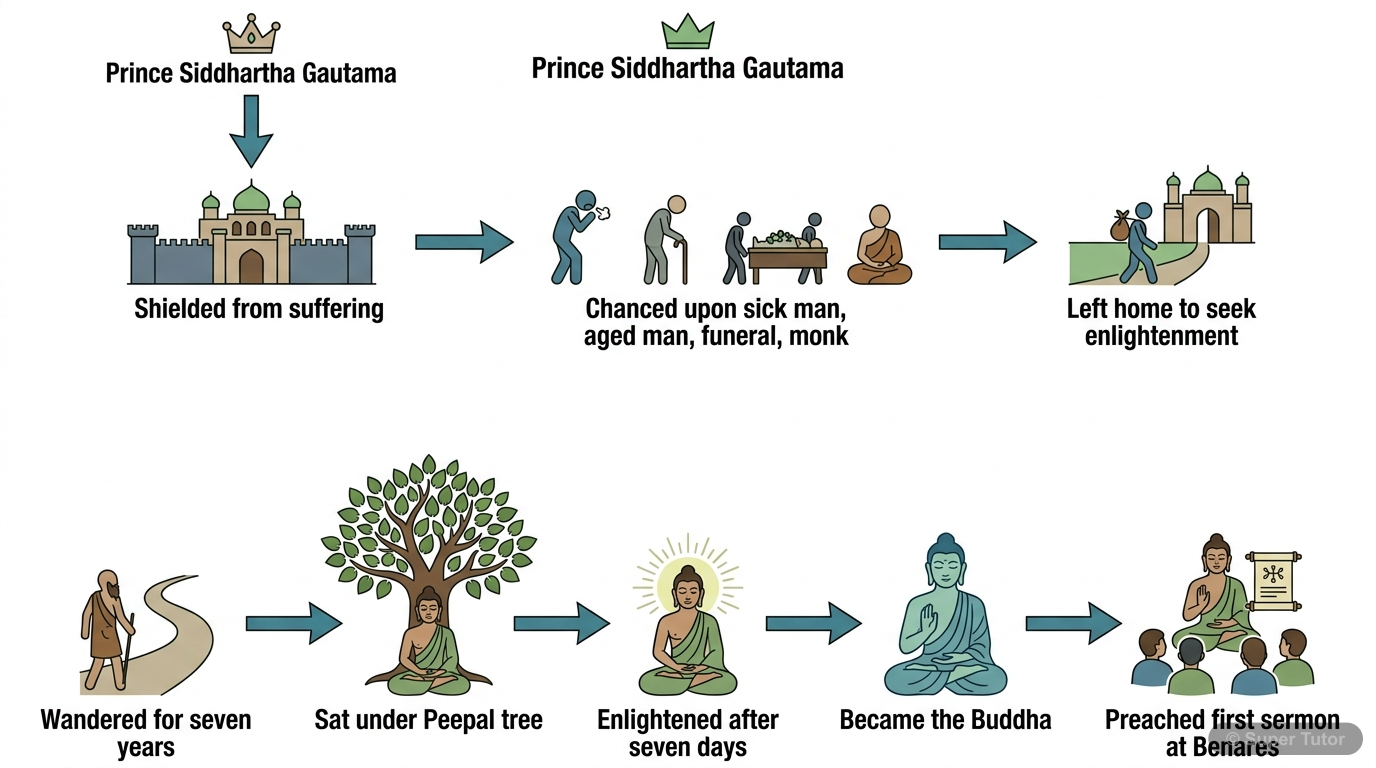
One of 8 illustrations for The Sermon at Benares in Super Tutor — alongside flashcards, concept maps and practice questions.
The first 8 solutions are open to read. The other 7 are free with a Super Tutor account.
Before You Read – Activity
1What is a sermon? Is it different from a lecture or a talk? Can this word also be used in a negative way or as a joke (as in 'my mother's sermon about getting my work done on time...')?Show solution
Given: A discussion-based activity about the word 'sermon'.
A sermon is a religious or moral speech, usually delivered by a spiritual leader (such as a priest, monk, or prophet) to an audience, with the purpose of giving moral or spiritual guidance.
Difference from a lecture or talk: A lecture is typically academic and informational, while a talk is a general, informal address. A sermon, however, is specifically moral or religious in nature and is meant to inspire, guide, or correct behaviour.
Negative/humorous use: Yes, the word 'sermon' can be used negatively or humorously to describe a long, preachy speech that someone does not want to hear. For example, 'My mother gave me a sermon about finishing my homework on time' implies that the speaker found the advice repetitive and tiresome, even if well-intentioned.
2Find out the meanings of the words and phrases: afflicted with, be composed, desolation, lamentation, procure, be subject to.Show solution
Given: Vocabulary activity.
Meanings:
- Afflicted with – To be affected by or suffering from something painful, such as a disease, grief, or misfortune. Example: 'She was afflicted with a terrible illness.'
- Be composed – To be calm, peaceful, and in control of one's emotions. Example: 'Despite the bad news, he remained composed.'
- Desolation – A state of complete emptiness, loneliness, or misery; a feeling of utter sadness and hopelessness. Example: 'After the flood, the village was a scene of desolation.'
- Lamentation – The expression of deep sorrow, grief, or mourning, often through crying or wailing. Example: 'The lamentation of the mourners could be heard throughout the village.'
- Procure – To obtain or acquire something, especially with care or effort. Example: 'She tried to procure medicine for her sick child.'
- Be subject to – To be under the influence, control, or effect of something. Example: 'All living beings are subject to death.'
3Have you heard of the Sermon on the Mount? Who delivered it? Who do you think delivered a sermon at Benares?Show solution
Given: A discussion-based activity.
The Sermon on the Mount was delivered by Jesus Christ. It is one of the most famous sermons in the Bible (found in the Gospel of Matthew, Chapters 5–7) and contains teachings such as the Beatitudes and the Lord's Prayer.
The sermon at Benares was delivered by Gautama Buddha. Benares (also known as Varanasi) is a holy city in India, and it was here that the Buddha delivered his first sermon after attaining enlightenment. This sermon is known as the 'Dhammacakkappavattana Sutta' (Setting the Wheel of Dhamma in Motion).
Thinking about the Text
1When her son dies, Kisa Gotami goes from house to house. What does she ask for? Does she get it? Why not?Show solution
Given: The story of Kisa Gotami from 'The Sermon at Benares'.
When Kisa Gotami's only son died, she was overcome with grief and refused to accept his death. She carried the dead child in her arms and went from house to house asking for medicine to cure her son.
She did not get the medicine she asked for. The reason was that no medicine exists that can bring the dead back to life. The people she approached either did not know what to say or told her that they could not help her. She was in a state of denial and grief, unable to accept the reality of death.
Eventually, someone directed her to the Buddha, who alone could help her.
2Kisa Gotami again goes from house to house after she speaks with the Buddha. What does she ask for, the second time around? Does she get it? Why not?Show solution
Given: Kisa Gotami's second journey from house to house.
The second time, after speaking with the Buddha, Kisa Gotami went from house to house asking for a handful of mustard seeds — but with a specific condition: the mustard seeds had to come from a house where no one had ever died.
She did not get the mustard seeds (with the required condition). The reason was that there was no house in which someone had not died. In every home she visited, someone had lost a father, mother, child, or another relative. Death had touched every household.
This realisation was the key lesson the Buddha wanted her to learn.
3What does Kisa Gotami understand the second time that she failed to understand the first time? Was this what the Buddha wanted her to understand?Show solution
Given: The transformation in Kisa Gotami's understanding.
The first time, Kisa Gotami was so consumed by personal grief that she could not accept the universal truth of death. She believed her suffering was unique and that her son could somehow be brought back to life.
The second time, after going from house to house in search of mustard seeds from a home untouched by death, she understood that death is universal and inevitable. No family is spared from death. Every person who is born must die. Grief and loss are not unique to her — they are the common lot of all human beings.
Yes, this is exactly what the Buddha wanted her to understand. He did not give her a direct answer but sent her on a task that would allow her to discover the truth herself — that death is a part of life, and grief, though natural, should not overwhelm us, because all mortals are subject to death.
4Why do you think Kisa Gotami understood this only the second time? In what way did the Buddha change her understanding?Show solution
Given: The method used by the Buddha to teach Kisa Gotami.
Kisa Gotami could not understand the truth the first time because she was blinded by grief. Her love for her son and her inability to accept his death made her irrational. She was in a state of denial and could not think clearly.
The Buddha changed her understanding not by telling her directly that death is inevitable (which she might have rejected in her grief), but by giving her a practical task — to find mustard seeds from a house where no one had died. This task made her go out, interact with other grieving families, and experience the universality of death firsthand.
As she went from house to house and heard stories of loss from every family, she gradually came to realise that she was not alone in her suffering. This personal discovery was far more powerful than any direct sermon. The Buddha used experiential learning — he guided her to find the truth herself, which made the lesson lasting and meaningful.
Thus, the Buddha changed her understanding by shifting her focus from her own personal grief to the universal human condition.
5How do you usually understand the idea of 'selfishness'? Do you agree with Kisa Gotami that she was being 'selfish in her grief'?Show solution
Given: A reflective question on the concept of selfishness and Kisa Gotami's self-assessment.
Usual understanding of selfishness: Selfishness generally means being excessively concerned with one's own needs, desires, or feelings, without regard for others. A selfish person thinks only of themselves and ignores the needs or pain of those around them.
Kisa Gotami's statement: After her enlightenment, Kisa Gotami realised that in her grief she had been thinking only of herself and her own loss, without recognising that others around her were also suffering from the loss of their loved ones.
Personal opinion: One can agree with Kisa Gotami to a certain extent. Grief, when it becomes all-consuming, can make a person blind to the suffering of others. Kisa Gotami's refusal to accept death and her desperate search for a cure showed that she was focused entirely on her own pain. In that sense, her grief was 'selfish.'
However, it is also important to note that grief is a natural human emotion, and it is not wrong to mourn the loss of a loved one. The Buddha himself does not condemn grief but teaches that excessive lamentation does not help the dead and only causes more suffering to the living. So while Kisa Gotami's self-reflection shows great wisdom and maturity, grief itself is not selfish — it is human. What becomes 'selfish' is when grief prevents us from seeing the larger truth and from helping or empathising with others.
Thinking about Language
Free with a Super Tutor account
'For there is not any means by which those who have been born can avoid dying; after reaching old age there is death; of such a nature are living beings.'
Free with a Super Tutor account
Speaking
Free with a Super Tutor account
Writing
Free with a Super Tutor account
Writing
Free with a Super Tutor account
Free with a Super Tutor account
Free with a Super Tutor account
7 more solved questions in The Sermon at Benares
They are free with a Super Tutor account, along with practice quizzes and flashcards for this chapter. Free to start, no card needed.
Frequently Asked Questions
What are the important topics in The Sermon at Benares for Madhya Pradesh Board Class 10 English?
Are these NCERT Solutions for The Sermon at Benares free?
How should I revise The Sermon at Benares for the Madhya Pradesh Board Class 10 board exam?
Sources & Official References
Content is aligned to the official syllabus. Refer to the board website for the latest curriculum.
More resources for The Sermon at Benares
Practice Quiz
Test yourself with a quick quiz
Important Questions
Exam-style questions with answers
Revision Notes
Key points for last-minute revision
Chapter Summary
Understand the chapter at a glance
Concept Maps
See how topics connect
Study Plan
Step-by-step plan for this chapter
Flashcards
Quick-fire cards for active recall
Syllabus
What topics to cover
For serious students
Get the full The Sermon at Benares chapter — start free.
Quizzes, flashcards, an AI doubt solver and a study plan for Madhya Pradesh Board Class 10 English. Free to start, no card needed.