Glimpses of India — NCERT Solutions
Madhya Pradesh Board · Class 10 · English
NCERT Solutions for Glimpses of India, Madhya Pradesh Board Class 10 English: 31 textbook questions solved step by step.
Interactive on Super Tutor
Studying Glimpses of India? Get the full interactive chapter.
Quizzes, flashcards, AI doubt-solver and a step-by-step study plan — built for NCERT solutions and more.
Free trial, no card needed.
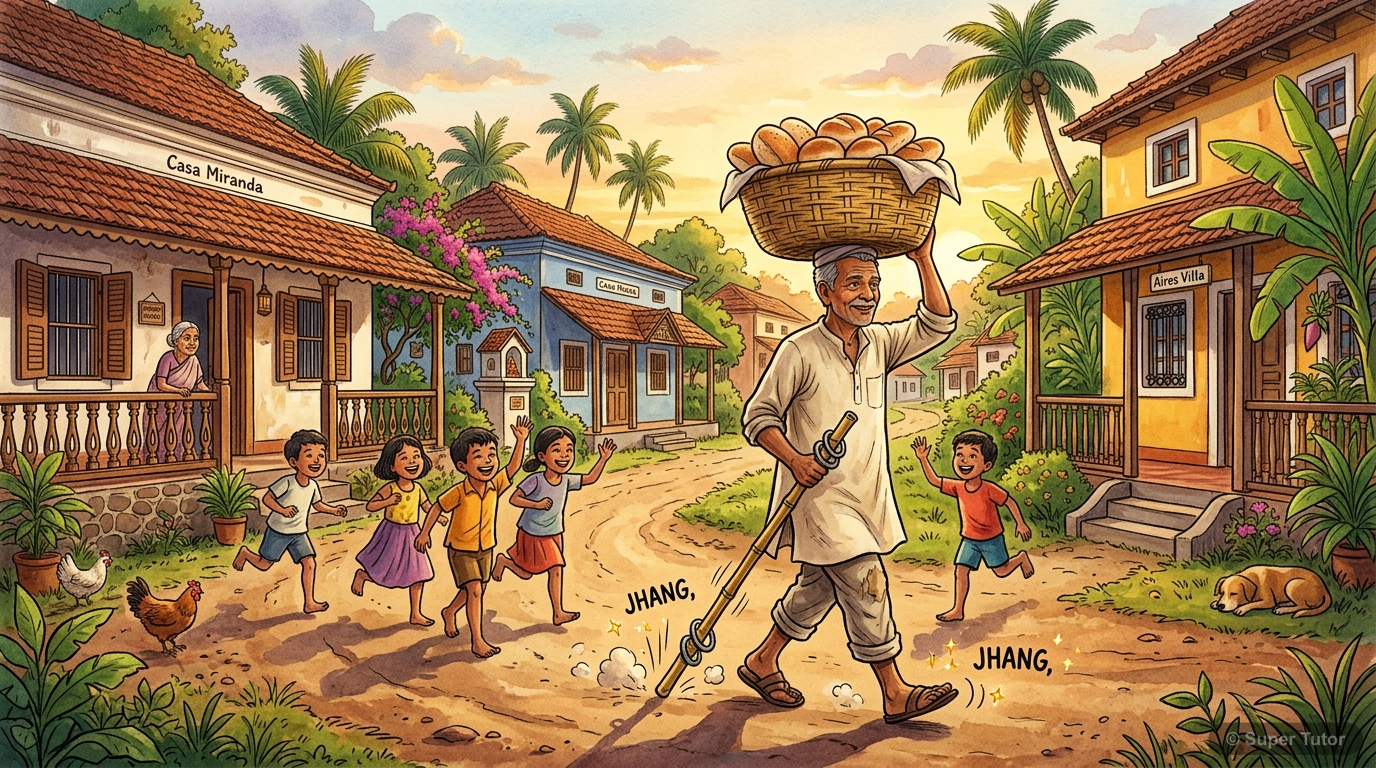
One of 7 illustrations for Glimpses of India in Super Tutor — alongside flashcards, concept maps and practice questions.
The first 16 solutions are open to read. The other 15 are free with a Super Tutor account.
Before You Read
1What images — of people and of places — come to your mind, when you think of our country?Show solution
India brings to mind many different people and places — crowded cities, villages, mountains, beaches, forests, rivers, temples, fields, and markets. It also brings to mind people in many kinds of dress, speaking different languages, and living different ways of life. The chapter shows that our country is varied and beautiful.
2What parts of India have you lived in, or visited? Can you name some popular tourist destinations?Show solution
I may have visited or lived in different parts of India such as Delhi, Rajasthan, Maharashtra, Goa, Kerala, Assam, Karnataka, or Tamil Nadu. Popular tourist destinations include Agra, Jaipur, Goa, Shimla, Kashmir, Darjeeling, Kerala backwaters, and Coorg.
3You may know that apart from the British, the Dutch and the French, the Portuguese have also played a part in the history of our country. Can you say which parts of India show French and Portuguese influences?Show solution
French influence is seen in places like Puducherry (Pondicherry), and Portuguese influence is seen in Goa and parts of Daman and Diu. The chapter especially mentions the Portuguese influence in Goa.
4Can you say which parts of India grow (i) tea, (ii) coffee?Show solution
From the chapter, tea is grown in Assam and Darjeeling, and Coorg is described as coffee country. So tea-growing regions are Assam and Darjeeling, while coffee is grown in Coorg and other southern hill regions.
Oral Comprehension Check — A Baker from Goa
1Match the following. What is a must (i) for a party or a feast? (ii) as marriage gifts? (iii) for a daughter's engagement? (iv) for Christmas?Show solution
Given: Various occasions and the bread/food items associated with them in Goa.
Matching:
| Occasion | What is a must |
|---|---|
| (i) for a party or a feast | bread |
| (ii) as marriage gifts | sweet bread called bol |
| (iii) for a daughter's engagement | sandwiches |
| (iv) for Christmas | cakes and bolinhas |
Explanation: The text states that marriage gifts are meaningless without the bol; a party or feast loses charm without bread; the lady of the house must prepare sandwiches on the occasion of her daughter's engagement; and cakes and bolinhas are a must for Christmas.
2What did the bakers wear: (i) in the Portuguese days? (ii) when the author was young?Show solution
Given: Information about the baker's dress in different periods.
(i) In the Portuguese days:
The baker wore a dress known as the kabai — a single-piece long frock reaching down to the knees.
(ii) When the author was young:
The bakers wore a shirt and trousers which were shorter than full-length ones and longer than half pants (i.e., trousers reaching just below the knees).
3Who invites the comment — 'he is dressed like a pader'? Why?Show solution
Given: A comment made about a person's dress.
Answer: Anyone who wears a half pant that reaches just below the knees invites the comment that he is dressed like a pader.
Reason: The bakers (paders) of the author's childhood days were known for wearing trousers that were shorter than full-length ones and longer than half pants — reaching just below the knees. This style of dressing became so associated with the pader that anyone wearing such trousers is compared to one.
4Where were the monthly accounts of the baker recorded?Show solution
Given: Information about the baker's billing practice.
Answer: The monthly accounts of the baker were recorded on some wall in pencil. The baker collected his bills at the end of the month, and these accounts were maintained on the walls of the houses he supplied bread to.
5What does a 'jackfruit-like appearance' mean?Show solution
Given: The phrase 'jackfruit-like appearance' used in the context of the baker.
Answer: A 'jackfruit-like appearance' means a plump, fat, and round physique — just like a jackfruit, which is large and bulky in shape. The text mentions that the baker and his family always looked happy and prosperous, and their plump physique was an open testimony to their well-being. Even today, any person with such a well-fed, rotund appearance is compared to a baker.
Thinking about the Text — A Baker from Goa
1Which of these statements are correct?
(i) The pader was an important person in the village in old times.
(ii) Paders still exist in Goan villages.
(iii) The paders went away with the Portuguese.
(iv) The paders continue to wear a single-piece long frock.
(v) Bread and cakes were an integral part of Goan life in the old days.
(vi) Traditional bread-baking is still a very profitable business.
(vii) Paders and their families starve in the present times.Show solution
Correct Statements:
(i) The pader was an important person in the village in old times. ✓
The text clearly states that the presence of the baker's furnace in the village was absolutely essential. Bread was required for every occasion — marriages, feasts, engagements, and festivals.
(ii) Paders still exist in Goan villages. ✓
The text says, 'Those age-old, time-tested furnaces still exist' and 'Maybe the father is not alive but the son still carries on the family profession.'
(v) Bread and cakes were an integral part of Goan life in the old days. ✓
The text describes how bread, bol, sandwiches, cakes, and bolinhas were essential for every celebration and occasion in Goa.
Incorrect Statements:
- (iii) is incorrect — the paders did not go away with the Portuguese; they still exist.
- (iv) is incorrect — the paders no longer wear the kabai (single-piece long frock).
- (vi) is incorrect — the text says baking 'was' a profitable profession 'in the old days', implying it may not be as profitable now.
- (vii) is incorrect — the text says the baker and his family 'never starved'; there is no mention of them starving now.
2Is bread an important part of Goan life? How do you know this?Show solution
Given: The passage describes the role of bread in Goan life.
Answer: Yes, bread is an extremely important part of Goan life.
Evidence from the text:
- Marriage: Marriage gifts are considered meaningless without the sweet bread known as the bol.
- Feasts and parties: A party or feast loses its charm without bread.
- Engagements: The lady of the house must prepare sandwiches on the occasion of her daughter's engagement.
- Festivals: Cakes and bolinhas are a must for Christmas as well as other festivals.
- Essential presence: The text states that 'the presence of the baker's furnace in the village is absolutely essential.'
Thus, from birth to marriage, from daily meals to festive celebrations, bread is woven into the very fabric of Goan life.
3Tick the right answer. What is the tone of the author when he says the following?
(i) The thud and the jingle of the traditional baker's bamboo can still be heard in some places. (nostalgic, hopeful, sad)
(ii) Maybe the father is not alive but the son still carries on the family profession. (nostalgic, hopeful, sad)
(iii) I still recall the typical fragrance of those loaves. (nostalgic, hopeful, naughty)
(iv) The tiger never brushed his teeth. Hot tea could wash and clean up everything so nicely, after all. (naughty, angry, funny)
(v) Cakes and bolinhas are a must for Christmas as well as other festivals. (sad, hopeful, matter-of-fact)
(vi) The baker and his family never starved. They always looked happy and prosperous. (matter-of-fact, hopeful, sad)Show solution
(i) The thud and the jingle of the traditional baker's bamboo can still be heard in some places.
Tone: Nostalgic
Justification: The author is fondly remembering the sounds of the baker's arrival from his childhood, expressing a longing for those old times.
(ii) Maybe the father is not alive but the son still carries on the family profession.
Tone: Hopeful
Justification: The author is expressing hope and relief that the tradition of bread-baking continues through the next generation, even if the original baker is gone.
(iii) I still recall the typical fragrance of those loaves.
Tone: Nostalgic
Justification: The author is fondly recalling a sensory memory from his childhood, which is a classic expression of nostalgia.
(iv) The tiger never brushed his teeth. Hot tea could wash and clean up everything so nicely, after all.
Tone: Naughty
Justification: The author is humorously justifying the childhood habit of not brushing teeth before having tea, with a playful, mischievous logic.
(v) Cakes and bolinhas are a must for Christmas as well as other festivals.
Tone: Matter-of-fact
Justification: The author is simply stating a well-known fact about Goan culture without any particular emotion.
(vi) The baker and his family never starved. They always looked happy and prosperous.
Tone: Matter-of-fact
Justification: The author is objectively describing the prosperous condition of the baker's family as a straightforward observation.
Writing — A Baker from Goa
IComplete the following table with the help of the clues on the left. Then write a paragraph about the author's childhood days.
| Clues | Author's childhood days |
|---|---|
| the way bread was baked | |
| the way the pader sold bread | |
| what the pader wore | |
| when the pader was paid | |
| how the pader looked | |Show solution
Completed Table:
| Clues | Author's childhood days |
|---|---|
| the way bread was baked | Bread was baked in age-old, time-tested furnaces (ovens). The baker mixed and moulded the dough and baked the loaves in these traditional furnaces. |
| the way the pader sold bread | The pader went from house to house, announcing his arrival with the thud and jingle of his traditional bamboo. He sold different kinds of bread — loaves, bols, bolinhas, etc. |
| what the pader wore | The pader wore a shirt and trousers that were shorter than full-length ones and longer than half pants — reaching just below the knees. |
| when the pader was paid | The pader collected his bills at the end of the month. Monthly accounts were recorded on some wall in pencil. |
| how the pader looked | The pader and his family always looked happy, prosperous, and plump. Their well-fed, jackfruit-like physique was an open testimony to their comfortable life. |
Paragraph about the author's childhood days:
During the author's childhood in Goa, the baker or pader was an indispensable part of daily life. Every morning, the thud and jingle of the baker's bamboo heralded his arrival in the neighbourhood. The pader baked his bread in age-old furnaces, producing loaves with a typical, unforgettable fragrance. He went from door to door, selling various kinds of bread — loaves, sweet bols, bolinhas, and sandwiches. The pader of those days wore a shirt and trousers that reached just below the knees — a style so distinctive that even today, anyone dressed similarly is said to be 'dressed like a pader.' He did not collect money daily; instead, monthly accounts were recorded on the wall in pencil, and bills were settled at the end of the month. Baking was a profitable profession, and the baker and his family were always well-fed and prosperous, their plump, jackfruit-like appearance being proof of their comfortable life.
II.1Compare the piece from the text (on the left) with the other piece on Goan bakers (on the right). What makes the two texts so different? Are the facts the same? Do both writers give you a picture of the baker?Show solution
Comparison of the Two Texts:
Style and Tone:
- The left piece (by Lucio Rodrigues) is written in a warm, personal, and nostalgic style. The author uses vivid sensory details — the thud and jingle of the bamboo, the fragrance of loaves — and childhood memories to paint a living picture of the pader. The tone is affectionate and emotional.
- The right piece (adapted from Nandakumar Kamat) is written in a factual, journalistic, and informative style. It presents information objectively without personal emotion or childhood memories.
What makes them different:
The left piece is a personal narrative/memoir — it draws the reader into the author's childhood world through emotions, sensory images, and nostalgia. The right piece is an informative article — it gives facts about the paders, their survival strategy (door-to-door delivery), and the origin of bread-baking in Goa.
Are the facts the same?
Broadly, yes — both acknowledge that the paders still exist and continue their profession. However, the right piece adds the specific fact that leavened, oven-baked bread is a gift of the Portuguese to India, and that paders survive through door-to-door delivery — details not mentioned in the left piece.
Do both writers give you a picture of the baker?
- The left piece gives a vivid, human, and emotional picture of the baker — his sounds, his dress, his appearance, his role in village life.
- The right piece gives a more factual and sociological picture — focusing on the pader's survival, his skills, and his historical context.
Conclusion: Both texts inform us about the pader, but the left piece makes us feel the baker's presence through personal experience, while the right piece makes us understand his role through facts and analysis.
II.2Now find a travel brochure about a place you have visited. Look at the description in the brochure. Then write your own account, adding details from your own experience, to give the reader a picture of the place, rather than an impersonal, factual description.Show solution
Note: This is an activity-based writing task. Below is a model answer based on a visit to Shimla.
Brochure description (sample): Shimla, the Queen of Hills, is located at an altitude of 2,206 metres in Himachal Pradesh. It is famous for the Mall Road, Christ Church, Jakhu Temple, and scenic mountain views.
My own account:
I had read about Shimla in brochures — the Mall Road, the colonial architecture, the snow-capped peaks. But nothing prepared me for the moment our bus rounded the last bend and the town appeared, draped in mist like a shy bride. The air hit me first — sharp, clean, and carrying the faint scent of pine. The Mall Road, which the brochure described as a 'popular promenade', was alive with laughter, the smell of hot maggi from roadside stalls, and the excited chatter of tourists wrapped in bright woollens.
The Christ Church stood silent and dignified against the grey sky, its stained-glass windows glowing softly. But it was the Jakhu Temple trail that stayed with me — the steep climb through deodar forests, the mischievous monkeys snatching snacks, and finally, the breathtaking view of the entire valley spread below like a green and white quilt.
Shimla is not just a hill station. It is a feeling — of cold cheeks and warm tea, of old-world charm and mountain magic. No brochure can quite capture that.
Thinking about the Text — Coorg
1Where is Coorg?Show solution
Answer: Coorg, also known as Kodagu, is a district located in the state of Karnataka in South India. It lies midway between Mysore and the coastal town of Mangalore. It is a hilly region covered with misty hills, lush forests, and coffee plantations. Madikeri is the district headquarters and the only gateway to Coorg.
Free with a Super Tutor account
Free with a Super Tutor account
(i) During monsoons it rains so heavily that tourists do not visit Coorg. (para 2)
(ii) Some people say that Alexander's army moved south along the coast and settled there. (para 3)
(iii) The Coorg people are always ready to tell stories of their sons' and fathers' valour. (para 4)
(iv) Even people who normally lead an easy and slow life get smitten by the high-energy adventure sports of Coorg. (para 6)
(v) The theory of the Arab origin is supported by the long coat with embroidered waist-belt they wear. (para 3)
(vi) Macaques, Malabar squirrels observe you carefully from the tree canopy. (para 7)
Free with a Super Tutor account
Thinking about Language — Coorg (Collocations)
Nouns: culture monks surprise experience weather tradition
Adjectives: unique terrible unforgettable serious ancient wide sudden
(i) culture (ii) monks (iii) surprise (iv) experience (v) weather (vi) tradition
Free with a Super Tutor account
(i) tales of ___
(iii) a piece of ___
(v) ___ plantations
(vi) ___ bridge
(vii) wild ___
Free with a Super Tutor account
Thinking about Language — Tea from Assam (I)
(i) A heavy __________ has been forecast due to low pressure in the Bay of Bengal.
(ii) Rakesh will __________ major surgery tomorrow morning.
(iii) My brother is responsible for the __________ of our family property.
(iv) The __________ rate for this accountancy course is very high.
(v) She went to the Enterprise Company to attend a __________ interview.
Free with a Super Tutor account
(i) The Army attempted unsuccessfully to __________ the Government. (throw)
(ii) Scientists are on the brink of a major __________ in cancer research. (break)
(iii) The State Government plans to build a __________ for Bhubaneswar to speed up traffic on the main highway. (pass)
(iv) Gautama's __________ on life changed when he realised that the world is full of sorrow. (look)
(v) Rakesh seemed unusually __________ after the game. (cast)
Free with a Super Tutor account
Thinking about Language — Tea from Assam (II)
(i) a good detective serial on television?
(ii) a debate on your favourite topic 'Homework Should Be Banned'?
(iii) how you feel when you stay indoors due to incessant rain?
(iv) how you feel when you open a present?
(v) how you feel when you watch your favourite programme on television?
(vi) the look on your mother's face as you waited in a queue?
(vii) how you feel when tracking a tiger in a tiger reserve forest?
(viii) the story you have recently read, or a film you have seen?
Free with a Super Tutor account
Free with a Super Tutor account
Thinking about the Poem — Trees
(ii) What picture do these words create in your mind: '...sun bury its feet in shadow...'? What could the poet mean by the sun's 'feet'?
Free with a Super Tutor account
(ii) What does the poet compare their branches to?
Free with a Super Tutor account
(ii) What happens to the house when the trees move out of it?
(iii) Why do you think the poet does not mention 'the departure of the forest from the house' in her letters?
Free with a Super Tutor account
(i) Does the poem present a conflict between man and nature?
(ii) Adrienne Rich has been known to use trees as a metaphor for human beings. What new meanings emerge from the poem if you take its trees to be symbolic of this particular meaning?
Free with a Super Tutor account
Free with a Super Tutor account
Homophones
- The dump was so full that it had to refuse more refuse.
- When shot at, the dove dove into the bushes.
- The insurance was invalid for the invalid.
Free with a Super Tutor account
15 more solved questions in Glimpses of India
They are free with a Super Tutor account, along with practice quizzes and flashcards for this chapter. Free to start, no card needed.
Frequently Asked Questions
What are the important topics in Glimpses of India for Madhya Pradesh Board Class 10 English?
Are these NCERT Solutions for Glimpses of India free?
How should I revise Glimpses of India for the Madhya Pradesh Board Class 10 board exam?
Sources & Official References
Content is aligned to the official syllabus. Refer to the board website for the latest curriculum.
More resources for Glimpses of India
Practice Quiz
Test yourself with a quick quiz
Important Questions
Exam-style questions with answers
Revision Notes
Key points for last-minute revision
Chapter Summary
Understand the chapter at a glance
Concept Maps
See how topics connect
Study Plan
Step-by-step plan for this chapter
Flashcards
Quick-fire cards for active recall
Syllabus
What topics to cover
For serious students
Get the full Glimpses of India chapter — start free.
Quizzes, flashcards, an AI doubt solver and a study plan for Madhya Pradesh Board Class 10 English. Free to start, no card needed.