Human Health and Disease — NCERT Solutions
Madhya Pradesh Board · Class 12 · Biology
NCERT Solutions for Human Health and Disease, Madhya Pradesh Board Class 12 Biology: 17 textbook questions solved step by step.
Interactive on Super Tutor
Studying Human Health and Disease? Get the full interactive chapter.
Quizzes, flashcards, AI doubt-solver and a step-by-step study plan — built for NCERT solutions and more.
Free trial, no card needed.
Learn better with visuals Super Tutor pairs illustrations like this with notes and quizzes for Human Health and Disease.
The first 9 solutions are open to read. The other 8 are free with a Super Tutor account.
EXERCISES — Human Health and Disease
1What are the various public health measures, which you would suggest as safeguard against infectious diseases?Show solution
Given/Concept: Public health measures are community-level steps taken to prevent the spread of infectious diseases.
Answer:
The following public health measures can be suggested as safeguards against infectious diseases:
- Maintenance of personal and public hygiene: Regular washing of hands, keeping surroundings clean, and proper disposal of garbage.
- Safe drinking water: Proper treatment and decontamination (chlorination, boiling) of drinking water to prevent water-borne diseases like cholera and typhoid.
- Proper disposal of waste: Sewage treatment and proper disposal of human excreta to prevent contamination of soil and water.
- Control of vectors: Elimination of breeding sites of mosquitoes (e.g., not allowing stagnant water to collect), use of insecticides, mosquito nets, and larvicides to control vector-borne diseases like malaria and dengue.
- Vaccination and immunisation: Mass immunisation programmes against diseases like polio, tuberculosis, hepatitis, etc., to build herd immunity in the population.
- Isolation of infected individuals: Quarantining patients with highly contagious diseases to prevent spread.
- Health education: Educating the public about modes of disease transmission and preventive measures.
- Regular health check-ups and early diagnosis: Timely detection and treatment of diseases to prevent their spread.
- Control of food adulteration: Ensuring food safety standards to prevent food-borne infections.
- Use of sterilised needles and syringes: Especially in hospitals and clinics to prevent transmission of blood-borne pathogens.
Conclusion: A combination of personal hygiene, environmental sanitation, vector control, and immunisation forms the backbone of public health measures against infectious diseases.
2In which way has the study of biology helped us to control infectious diseases?Show solution
Given/Concept: Biology provides the scientific understanding of pathogens, host–pathogen interactions, immune responses, and methods of disease control.
Answer:
The study of biology has helped us control infectious diseases in the following ways:
- Identification of pathogens: Biological research has helped identify the causative agents (bacteria, viruses, fungi, protozoa, helminths) of various diseases, enabling targeted treatment.
- Understanding disease transmission: Knowledge of how diseases spread (through vectors, air, water, contact) has helped design effective preventive strategies.
- Development of vaccines: Understanding of antigens, antibodies, and immune memory has led to the development of vaccines (e.g., polio vaccine, BCG vaccine, hepatitis B vaccine) that provide immunity without causing disease.
- Development of antibiotics and drugs: Biological research led to the discovery of antibiotics (e.g., penicillin) and antiparasitic drugs that can cure bacterial and parasitic infections.
- Understanding the immune system: Study of innate and acquired immunity has helped in designing immunotherapies and understanding how the body fights pathogens.
- Recombinant DNA technology: Has enabled production of vaccines (e.g., recombinant hepatitis B vaccine) and diagnostic tools.
- Vector biology: Study of vectors like Anopheles mosquitoes has helped in developing strategies to control vector-borne diseases like malaria.
- Epidemiology: Biological and statistical study of disease patterns helps in controlling outbreaks.
Conclusion: Biology has been central to every major advance in the prevention, diagnosis, and treatment of infectious diseases.
3How does the transmission of each of the following diseases take place?
(a) Amoebiasis
(b) Malaria
(c) Ascariasis
(d) PneumoniaShow solution
Concept: Each infectious disease has a specific mode of transmission depending on the nature of the pathogen and its life cycle.
(a) Amoebiasis:
- Causative agent: Entamoeba histolytica (a protozoan)
- Transmission: It is transmitted through the faeco-oral route. The cysts of the parasite are passed in the faeces of an infected person. These cysts contaminate food and water. When a healthy person consumes this contaminated food or water, the cysts enter the intestine and cause infection.
- Houseflies act as mechanical carriers, transferring the cysts from faeces to food.
(b) Malaria:
- Causative agent: Plasmodium species (e.g., P. vivax, P. falciparum)
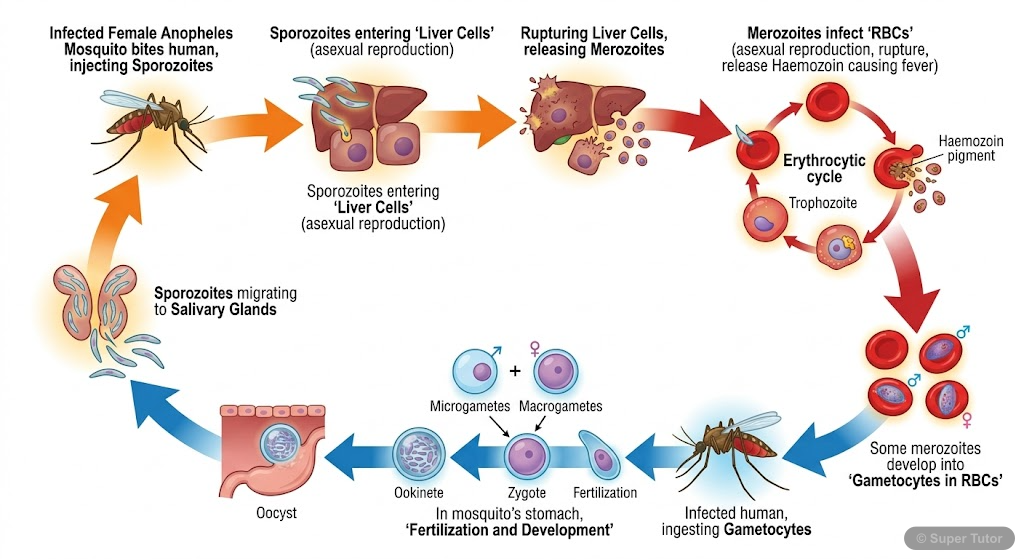
- Transmission: Malaria is transmitted through the **bite of an infected female Anopheles mosquito** (vector). When the mosquito bites an infected person, it ingests the gametocytes of Plasmodium. Sexual reproduction occurs in the mosquito's gut, and sporozoites develop. When this infected mosquito bites a healthy person, sporozoites are injected into the bloodstream, causing malaria.
(c) Ascariasis:
- Causative agent: Ascaris lumbricoides (a roundworm/helminth)
- Transmission: It is transmitted through the faeco-oral route. The eggs of Ascaris are passed in the faeces of an infected person and contaminate soil, water, and food. Ingestion of food or water contaminated with these embryonated eggs leads to infection in a healthy person.
(d) Pneumonia:
- Causative agent: Streptococcus pneumoniae and Haemophilus influenzae (bacteria)
- Transmission: Pneumonia is transmitted through droplet infection (air-borne route). When an infected person coughs, sneezes, or speaks, droplets containing the bacteria are released into the air. A healthy person inhales these droplets and gets infected. The bacteria can also spread by sharing utensils or coming into contact with the saliva of an infected person.
4What measure would you take to prevent water-borne diseases?Show solution
Given/Concept: Water-borne diseases (e.g., cholera, typhoid, amoebiasis, hepatitis A) spread through consumption of contaminated water.
Preventive Measures:
- Boiling of drinking water: Boiling kills most pathogens present in water and is the simplest method of purification.
- Chlorination: Adding chlorine tablets or liquid chlorine to water kills bacteria and other microorganisms.
- Use of water purifiers/filters: Using RO (Reverse Osmosis) or UV-based water purifiers removes or kills pathogens.
- Proper sewage treatment: Treating sewage before releasing it into water bodies prevents contamination of water sources.
- Avoiding open defecation: Constructing and using proper toilets prevents faecal contamination of soil and water.
- Proper disposal of garbage: Preventing garbage from contaminating water sources.
- Regular testing of water quality: Periodic testing of drinking water sources for microbial contamination.
- Avoiding consumption of raw/unwashed food: Washing fruits and vegetables thoroughly before eating.
- Personal hygiene: Washing hands with soap before eating and after using the toilet.
- Vaccination: Getting vaccinated against diseases like typhoid and hepatitis A provides additional protection.
Conclusion: A combination of safe water supply, proper sanitation, and personal hygiene is essential to prevent water-borne diseases.
5Discuss with your teacher what does 'a suitable gene' means, in the context of DNA vaccines.Show solution
Concept: DNA vaccines are a modern approach to immunisation using recombinant DNA technology.
Answer:
In the context of DNA vaccines, a 'suitable gene' refers to a gene that codes for a specific antigenic protein (antigen) of the pathogen — i.e., a protein that can stimulate an immune response in the host without causing the disease.
Explanation:
- A DNA vaccine works by introducing the gene encoding the pathogen's antigen directly into the host's cells.
- Once inside the host cells, this gene is expressed (transcribed and translated), producing the antigenic protein.
- This protein stimulates the immune system to produce antibodies and activate T-cells, providing immunity against the pathogen.
- The 'suitable gene' must:
- Code for a surface protein or antigen of the pathogen that is recognised by the immune system.
- Be non-pathogenic — it should not cause disease by itself.
- Be highly immunogenic — capable of eliciting a strong immune response.
- Be stable and capable of being expressed efficiently in human cells.
Example: In a DNA vaccine against HIV, the gene encoding the HIV envelope protein (gp120) could be a suitable gene, as it is recognised by the immune system and can stimulate protective immunity.
Note: Students are encouraged to discuss further examples and technical details with their teacher.
6Name the primary and secondary lymphoid organs.Show solution
Concept: Lymphoid organs are the sites where lymphocytes (B and T cells) are produced, mature, or become activated.
Primary Lymphoid Organs:
These are the organs where immature lymphocytes mature and become immunocompetent (capable of mounting an immune response).
- Thymus — Site of maturation of T-lymphocytes (T-cells). Located in the thoracic cavity near the heart.
- Bone Marrow — Site of origin and maturation of B-lymphocytes (B-cells). All blood cells, including lymphocytes, are produced here.
Secondary Lymphoid Organs:
These are the organs where mature lymphocytes interact with antigens and proliferate to mount an immune response.
- Spleen — A large bean-shaped organ that filters blood and traps blood-borne antigens.
- Lymph nodes — Small structures located along lymphatic vessels; trap antigens from lymph and tissue fluid.
- Tonsils — Located in the throat region; protect against pathogens entering through the mouth and nose.
- Peyer's patches — Found in the small intestine; protect against gut pathogens.
- MALT (Mucosa-Associated Lymphoid Tissue) — Found in the lining of the digestive, respiratory, and urogenital tracts.
Summary Table:
| Type | Organs |
|---|---|
| Primary | Bone marrow, Thymus |
| Secondary | Spleen, Lymph nodes, Tonsils, Peyer's patches, MALT |
7The following are some well-known abbreviations, which have been used in this chapter. Expand each one to its full form:
(a) MALT
(b) CMI
(c) AIDS
(d) NACO
(e) HIVShow solution
Answer:
| Abbreviation | Full Form |
|---|---|
| (a) MALT | Mucosa-Associated Lymphoid Tissue |
| (b) CMI | Cell-Mediated Immunity |
| (c) AIDS | Acquired Immuno Deficiency Syndrome |
| (d) NACO | National AIDS Control Organisation |
| (e) HIV | Human Immuno-deficiency Virus |
8Differentiate the following and give examples of each:
(a) Innate and acquired immunity
(b) Active and passive immunityShow solution
Concept: The immune system has two broad categories of defence mechanisms.
(a) Innate Immunity vs. Acquired Immunity:
| Feature | Innate Immunity | Acquired Immunity |
|---|---|---|
| Definition | Non-specific, inborn defence present from birth | Specific immunity developed during the lifetime of an individual |
| Specificity | Non-specific; acts against all pathogens | Highly specific; directed against a particular antigen |
| Memory | No immunological memory | Has immunological memory (faster response on re-exposure) |
| Components | Skin, mucous membranes, tears, saliva, phagocytic cells, natural killer cells, complement proteins, fever | B-lymphocytes (antibodies), T-lymphocytes |
| Response time | Immediate | Takes time to develop (days to weeks) |
| Examples | Skin acting as a physical barrier; lysozyme in tears destroying bacteria; phagocytosis by neutrophils | Antibody production after vaccination; immunity after recovering from chickenpox |
(b) Active Immunity vs. Passive Immunity:
| Feature | Active Immunity | Passive Immunity |
|---|---|---|
| Definition | Immunity developed when the host's own immune system produces antibodies in response to an antigen | Immunity acquired by receiving ready-made antibodies from an external source |
| Production | Host produces its own antibodies | Antibodies are produced by another organism and transferred to the host |
| Memory | Long-lasting; immunological memory is formed | Short-lived; no memory is formed |
| Onset | Slow (takes time to develop) | Immediate |
| Examples | Immunity after vaccination (e.g., polio vaccine, BCG); immunity after natural infection | Injection of antitoxin (e.g., tetanus antitoxin); antibodies passed from mother to foetus through placenta or through colostrum (mother's milk) |
9Draw a well-labelled diagram of an antibody molecule.Show solution
Concept: An antibody (immunoglobulin) is a Y-shaped glycoprotein produced by B-lymphocytes/plasma cells in response to an antigen.
Structure of an Antibody Molecule:
An antibody molecule consists of four polypeptide chains:
- 2 Heavy (H) chains — longer chains
- 2 Light (L) chains — shorter chains
These are held together by disulphide bonds (–S–S–).
Each chain has two regions:
- Variable region (V): The N-terminal end; differs between antibodies; forms the antigen-binding site.
- Constant region (C): The C-terminal end; same in all antibodies of the same class; determines the class of antibody.
Labelled Diagram Description:
        Antigen-binding sites
           ↙           ↘
    [VL|VH]           [VH|VL]
      |   |             |   |
    Light  Heavy     Heavy  Light
    chain  chain     chain  chain
      |     |           |     |
      CL    CH1 —S—S— CH1    CL
             |           |
            CH2 —S—S— CH2
             |           |
            CH3         CH3
                 Fc region
                (Constant region)
Key Labels to include in the diagram:
- Heavy chain (H chain)
- Light chain (L chain)
- Variable region (V region) — antigen-binding site
- Constant region (C region)
- Disulphide bonds (–S–S–)
- Antigen-binding site (2 per antibody molecule)
- Fab region (Fragment antigen-binding) — arms of the Y
- Fc region (Fragment crystallisable) — stem of the Y
- Hinge region
Note: The antibody is bivalent — it has two antigen-binding sites, one at the tip of each arm of the Y-shape.
Free with a Super Tutor account
Free with a Super Tutor account
Free with a Super Tutor account
Free with a Super Tutor account
Free with a Super Tutor account
Free with a Super Tutor account
Free with a Super Tutor account
Free with a Super Tutor account
8 more solved questions in Human Health and Disease
They are free with a Super Tutor account, along with practice quizzes and flashcards for this chapter. Free to start, no card needed.
Frequently Asked Questions
What are the important topics in Human Health and Disease for Madhya Pradesh Board Class 12 Biology?
Are these NCERT Solutions for Human Health and Disease free?
How should I revise Human Health and Disease for the Madhya Pradesh Board Class 12 board exam?
Sources & Official References
Content is aligned to the official syllabus. Refer to the board website for the latest curriculum.
More resources for Human Health and Disease
Practice Quiz
Test yourself with a quick quiz
Important Questions
Exam-style questions with answers
Revision Notes
Key points for last-minute revision
Chapter Summary
Understand the chapter at a glance
Concept Maps
See how topics connect
Study Plan
Step-by-step plan for this chapter
Flashcards
Quick-fire cards for active recall
Syllabus
What topics to cover
For serious students
Get the full Human Health and Disease chapter — start free.
Quizzes, flashcards, an AI doubt solver and a study plan for Madhya Pradesh Board Class 12 Biology. Free to start, no card needed.