Organisms and Populations — NCERT Solutions
Madhya Pradesh Board · Class 12 · Biology
NCERT Solutions for Organisms and Populations, Madhya Pradesh Board Class 12 Biology: 10 textbook questions solved step by step. Covers Exercises.
Interactive on Super Tutor
Studying Organisms and Populations? Get the full interactive chapter.
Quizzes, flashcards, AI doubt-solver and a step-by-step study plan — built for NCERT solutions and more.
Free trial, no card needed.
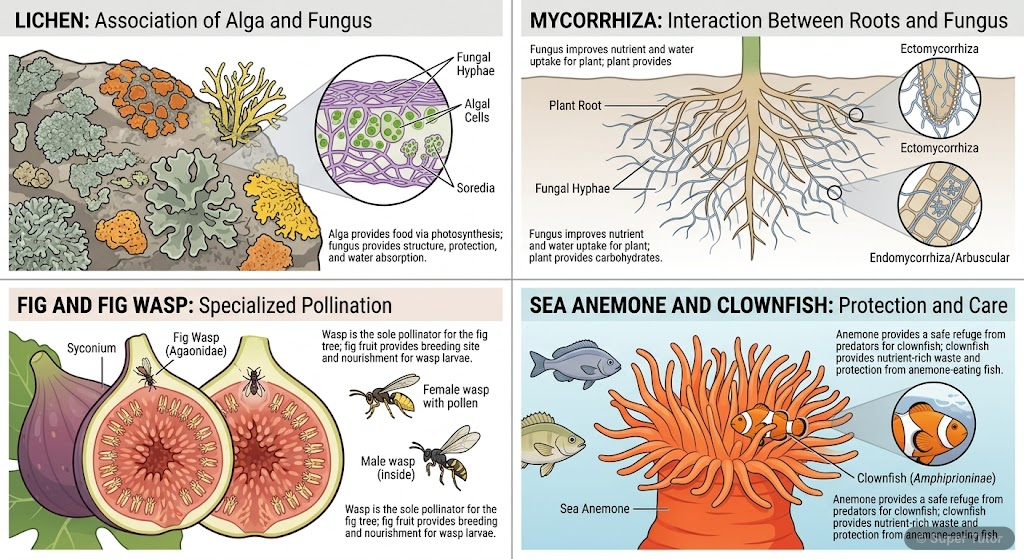
One of 13 illustrations for Organisms and Populations in Super Tutor — alongside flashcards, concept maps and practice questions.
The first 5 solutions are open to read. The other 5 are free with a Super Tutor account.
Exercises
1List the attributes that populations possess but not individuals.Show solution
Given/Concept: A population is a group of individuals of the same species in a defined area. Populations have emergent properties that a single individual cannot possess.
Attributes that populations possess but not individuals:
- Birth Rate (Natality): The number of births per capita in a population per unit time. An individual can give birth, but a 'birth rate' is a property of the whole population.
- Death Rate (Mortality): The number of deaths per capita in a population per unit time. Similarly, an individual can die, but a 'death rate' belongs to the population.
- Sex Ratio: The ratio of males to females in a population (e.g., 60% females : 40% males). A single individual has a sex but not a sex ratio.
- Age Distribution (Age Pyramid): The proportion of individuals in different age groups (pre-reproductive, reproductive, post-reproductive). An individual has an age, but age distribution is a population attribute.
- Population Density: The number of individuals (or biomass) per unit area or volume at a given time.
- Population Growth Rate: The rate at which the population size changes over time (expressed as or ).
Conclusion: Birth rate, death rate, sex ratio, age distribution, population density, and growth rate are all attributes of populations, not of individual organisms.
2If a population growing exponentially doubles in size in 3 years, what is the intrinsic rate of increase (r) of the population?Show solution
Given:
- Population doubles in years, i.e.,
- Growth is exponential.
Formula used:
For exponential growth:
Working:
Substituting :
Taking natural logarithm on both sides:
Conclusion: The intrinsic rate of natural increase of the population is approximately 0.231 per year.
3Name important defence mechanisms in plants against herbivory.Show solution
Concept: Plants cannot escape herbivores by moving away, so they have evolved a variety of morphological (physical) and chemical defence mechanisms.
Important Defence Mechanisms in Plants Against Herbivory:
A. Morphological / Physical Defences:
- Thorns and Spines: Sharp thorns (e.g., Acacia, Cactus) deter herbivores from feeding.
- Tough / Leathery Leaves: Thick cuticle and tough texture make leaves difficult to chew.
- Dense Trichomes (Hair): Hairy leaf surfaces make feeding difficult for insects and small herbivores.
B. Chemical Defences:
- Toxic Alkaloids: Many plants produce alkaloids (e.g., nicotine in tobacco, caffeine in tea) that are poisonous or distasteful to herbivores.
- Terpenes and Resins: Chemicals like terpenes in conifers repel or poison herbivores.
- Tannins: Tannins reduce the digestibility of plant tissue.
- Cardiac Glycosides: Present in plants like Calotropis; highly toxic to animals that consume them.
- Distasteful / Poisonous Chemicals: Calotropis produces highly poisonous cardiac glycosides; the weed Lantana has chemicals toxic to cattle.
Conclusion: Plants use a combination of physical barriers and toxic/distasteful chemicals to defend themselves against herbivory.
4An orchid plant is growing on the branch of mango tree. How do you describe this interaction between the orchid and the mango tree?Show solution
Identification of Interaction:
The interaction between the orchid and the mango tree is Commensalism.
Definition: Commensalism is an interspecific interaction in which one species benefits and the other species is neither harmed nor benefited (unaffected).
Explanation:
- The orchid (epiphyte) benefits by using the branch of the mango tree as a physical support to grow at a height where it can receive adequate sunlight and moisture. It does not derive nutrition from the mango tree.
- The mango tree is neither harmed nor benefited by the presence of the orchid.
Symbol: — where represents the orchid (benefited) and represents the mango tree (unaffected).
Conclusion: This is a classic example of commensalism where the orchid is the commensal and the mango tree is the host.
5What is the ecological principle behind the biological control method of managing with pest insects?Show solution
Ecological Principle:
The ecological principle behind biological control is Predation (and in some cases parasitism) — a natural interspecific interaction where one organism (the predator/parasite) kills or harms another (the prey/host).
Explanation:
- In nature, predators and parasites keep the population of their prey/host under check, preventing any one species from becoming excessively abundant.
- In biological control, a natural enemy (predator, parasite, or pathogen) of the pest is deliberately introduced or encouraged to reduce the pest population to a manageable level.
- This exploits the predator–prey relationship to control pest populations without the use of chemical pesticides.
Example:
- The Cochineal insect (Dactylopius) was used to control the invasive prickly pear cactus (Opuntia).
- The Gambusia fish is used to control mosquito larvae in ponds.
- Bacillus thuringiensis (Bt) is used as a biopesticide against caterpillars.
Conclusion: The principle is that predators/parasites naturally regulate prey/host populations, and this natural regulation is harnessed in biological control methods.
Free with a Super Tutor account
(a) Commensalism
(b) Parasitism
(c) Camouflage
(d) Mutualism
(e) Interspecific competition
Free with a Super Tutor account
Free with a Super Tutor account
(a) One organism is benefited.
(b) Both the organisms are benefited.
(c) One organism is benefited, other is not affected.
(d) One organism is benefited, other is affected.
Free with a Super Tutor account
Free with a Super Tutor account
5 more solved questions in Organisms and Populations
They are free with a Super Tutor account, along with practice quizzes and flashcards for this chapter. Free to start, no card needed.
Frequently Asked Questions
What are the important topics in Organisms and Populations for Madhya Pradesh Board Class 12 Biology?
Are these NCERT Solutions for Organisms and Populations free?
How should I revise Organisms and Populations for the Madhya Pradesh Board Class 12 board exam?
Sources & Official References
Content is aligned to the official syllabus. Refer to the board website for the latest curriculum.
More resources for Organisms and Populations
Practice Quiz
Test yourself with a quick quiz
Important Questions
Exam-style questions with answers
Revision Notes
Key points for last-minute revision
Formula Sheet
The chapter's formulas in one place
Chapter Summary
Understand the chapter at a glance
Concept Maps
See how topics connect
Study Plan
Step-by-step plan for this chapter
Flashcards
Quick-fire cards for active recall
Syllabus
What topics to cover
For serious students
Get the full Organisms and Populations chapter — start free.
Quizzes, flashcards, an AI doubt solver and a study plan for Madhya Pradesh Board Class 12 Biology. Free to start, no card needed.