Biotechnology : Principles and Processes — NCERT Solutions
Madhya Pradesh Board · Class 12 · Biology
NCERT Solutions for Biotechnology : Principles and Processes, Madhya Pradesh Board Class 12 Biology: 12 textbook questions solved step by step.
Interactive on Super Tutor
Studying Biotechnology : Principles and Processes? Get the full interactive chapter.
Quizzes, flashcards, AI doubt-solver and a step-by-step study plan — built for NCERT solutions and more.
Free trial, no card needed.
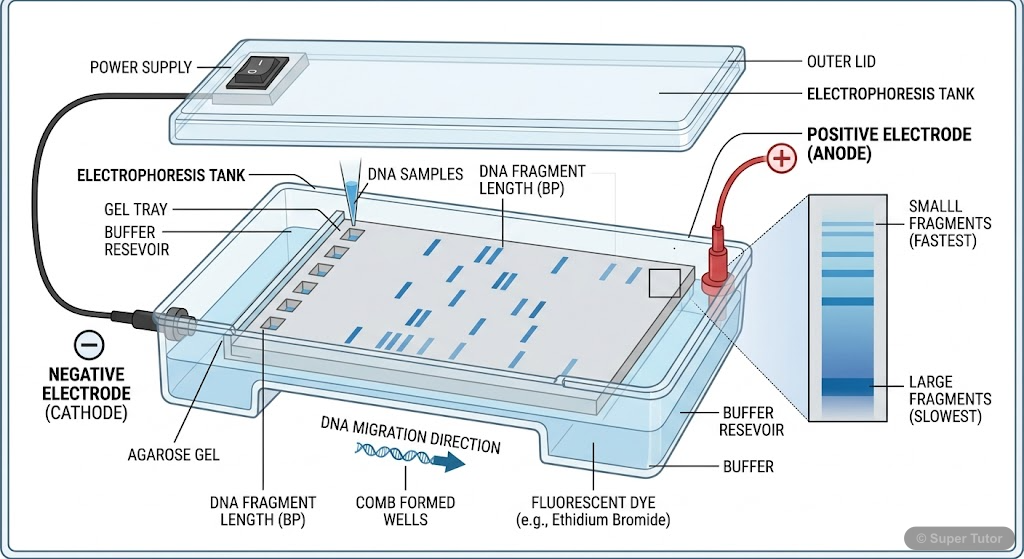
One of 19 illustrations for Biotechnology : Principles and Processes in Super Tutor — alongside flashcards, concept maps and practice questions.
The first 6 solutions are open to read. The other 6 are free with a Super Tutor account.
Exercises
1Can you list 10 recombinant proteins which are used in medical practice? Find out where they are used as therapeutics (use the internet).Show solution
The following are 10 recombinant proteins used in medical practice:
- Recombinant Human Insulin (Humulin) – Used in the treatment of diabetes mellitus (Type 1 and Type 2).
- Recombinant Human Growth Hormone (Somatotropin) – Used to treat growth hormone deficiency and dwarfism.
- Recombinant Erythropoietin (EPO) – Used to treat anaemia, especially in patients with chronic kidney disease or undergoing chemotherapy.
- Recombinant Tissue Plasminogen Activator (tPA / Alteplase) – Used as a thrombolytic agent in the treatment of heart attacks and strokes.
- Recombinant Factor VIII – Used in the treatment of Haemophilia A (clotting factor deficiency).
- Recombinant Factor IX – Used in the treatment of Haemophilia B.
- Recombinant Hepatitis B Vaccine (HBsAg) – Used for immunisation against Hepatitis B virus infection.
- Recombinant Interferon-alpha (IFN-α) – Used in the treatment of viral infections (e.g., Hepatitis C) and certain cancers.
- Recombinant Interleukin-2 (IL-2 / Aldesleukin) – Used in the treatment of metastatic renal cell carcinoma and melanoma.
- Recombinant DNase (Dornase alfa) – Used in the treatment of cystic fibrosis to reduce mucus viscosity in the lungs.
Note: All these proteins are produced by inserting the human gene encoding the protein into a suitable host organism (bacteria, yeast, or mammalian cells) using recombinant DNA technology, allowing large-scale production.
2Make a chart (with diagrammatic representation) showing a restriction enzyme, the substrate DNA on which it acts, the site at which it cuts DNA and the product it produces.Show solution
Example: Restriction Enzyme EcoRI
Given:
- Restriction Enzyme: EcoRI (isolated from Escherichia coli)
- Recognition/Substrate sequence (palindromic): 5′–GAATTC–3′ / 3′–CTTAAG–5′
- Type of cut: Staggered (produces sticky ends)
Diagrammatic Representation:
Substrate DNA (before cutting):
The arrows (↓ and ↑) indicate the cut sites on each strand.
Products (after cutting):
Fragment 1:
Fragment 2:
Summary Table:
| Feature | Detail |
|---|---|
| Enzyme | EcoRI |
| Source organism | Escherichia coli |
| Recognition sequence | 5′-GAATTC-3′ (palindrome) |
| Cut position | Between G and A on both strands |
| Type of ends produced | Sticky ends (cohesive ends) with 5′ overhang: 5′-AATT-3′ |
Conclusion: EcoRI recognises the palindromic sequence 5′-GAATTC-3′ and cuts between G and A on both strands in a staggered manner, producing fragments with 4-nucleotide 5′ overhangs called sticky ends.
3From what you have learnt, can you tell whether enzymes are bigger or DNA is bigger in molecular size? How did you know?Show solution
Answer: DNA is bigger in molecular size than enzymes (proteins).
Reasoning:
- Enzymes are proteins made up of amino acid chains. Even large enzymes typically consist of a few hundred to a few thousand amino acids, giving them a molecular weight in the range of a few thousand to a few hundred thousand Daltons (kDa).
- DNA is a polynucleotide chain. The human genome, for example, consists of approximately base pairs distributed across 23 chromosomes. Even a single chromosome contains DNA with a molecular weight in the range of Daltons or more.
- Evidence from the chapter: Restriction endonucleases (enzymes) recognise and cut specific short sequences (4–8 base pairs) on the DNA molecule. The fact that a relatively small enzyme molecule can act on a specific site of a very long DNA molecule indicates that DNA is far larger than the enzyme.
- Gel electrophoresis also confirms this: DNA fragments (even small ones of a few hundred base pairs) migrate much more slowly than protein molecules of comparable mass, and the intact genomic DNA barely enters the gel — indicating its enormous size.
Conclusion: DNA is much bigger in molecular size compared to enzymes. This is known because restriction enzymes act on specific short recognition sequences within the much larger DNA molecule, and from our knowledge of the structure and composition of both macromolecules.
4What would be the molar concentration of human DNA in a human cell? Consult your teacher.Show solution
Given/Known facts:
- Each human diploid cell contains approximately g (6 picograms) of DNA.
- The average molecular weight of a base pair of DNA g/mol.
- The human haploid genome has base pairs, so the diploid genome has base pairs.
Step 1: Calculate the molecular weight of human diploid DNA:
Step 2: Calculate the number of moles of DNA in one cell:
Step 3: Calculate molar concentration (assuming cell volume pL L):
Conclusion: The molar concentration of human DNA in a human cell is approximately mol/L (1.5 picomolar). This is an extremely small molar concentration, reflecting the enormous molecular weight of the DNA molecule, even though the mass of DNA per cell is significant at the cellular level.
5Do eukaryotic cells have restriction endonucleases? Justify your answer.Show solution
Answer: No, eukaryotic cells do not have restriction endonucleases.
Justification:
- Origin of restriction endonucleases: Restriction endonucleases are naturally found only in prokaryotes (bacteria). They form part of the bacterial restriction-modification system, which acts as a primitive immune defence mechanism against foreign DNA (e.g., bacteriophage DNA).
- Function in prokaryotes: In bacteria, restriction enzymes cut foreign (viral) DNA at specific palindromic sequences, thereby destroying it. The bacterium's own DNA is protected from self-digestion by methylation of the same recognition sequences (modification system).
- Eukaryotes do not need this system: Eukaryotic cells have evolved different and more complex immune and cellular defence mechanisms (e.g., RNA interference, immune system). They do not rely on restriction-modification systems to protect against foreign DNA.
- No evidence of restriction enzymes in eukaryotes: There is no known naturally occurring restriction endonuclease in eukaryotic cells. The restriction enzymes used in recombinant DNA technology are all isolated from bacterial sources (e.g., EcoRI from E. coli, HindIII from Haemophilus influenzae, BamHI from Bacillus amyloliquefaciens).
Conclusion: Eukaryotic cells do not possess restriction endonucleases because these enzymes are a prokaryotic adaptation for defence against foreign DNA, and eukaryotes have evolved entirely different mechanisms for cellular defence and DNA maintenance.
6Besides better aeration and mixing properties, what other advantages do stirred tank bioreactors have over shake flasks?Show solution
Given: Stirred tank bioreactors vs. shake flasks in large-scale production of biotechnological products.
Advantages of Stirred Tank Bioreactors over Shake Flasks (besides aeration and mixing):
- Large volume capacity: Bioreactors can hold volumes ranging from a few litres to thousands of litres (up to litres), enabling large-scale industrial production, whereas shake flasks are limited to small volumes (typically up to a few litres).
- Monitoring and control of physicochemical parameters: Bioreactors are equipped with sensors and control systems to continuously monitor and regulate:
- Temperature
- pH
- Dissolved oxygen levels
- Foam formation
- Substrate concentration
This ensures optimal conditions for microbial/cell growth and product formation.
- Foam control: Bioreactors have foam breakers/antifoam systems to prevent excessive foaming, which can inhibit growth and product yield.
- Aseptic conditions: Bioreactors are designed to maintain strict sterility over long periods, reducing the risk of contamination during large-scale fermentation.
- Continuous or fed-batch operation: Bioreactors can be operated in batch, fed-batch, or continuous mode, allowing flexibility in production strategies and higher productivity.
- Sampling ports: Allow periodic withdrawal of samples for analysis without disturbing the culture or compromising sterility.
- Scalability: The design of stirred tank bioreactors allows easy scale-up from laboratory to industrial scale.
Conclusion: Stirred tank bioreactors offer superior control, scalability, sterility, and operational flexibility compared to shake flasks, making them essential for industrial-scale biotechnological production.
Free with a Super Tutor account
Free with a Super Tutor account
Free with a Super Tutor account
(a) Origin of replication
(b) Bioreactors
(c) Downstream processing
Free with a Super Tutor account
(a) PCR
(b) Restriction enzymes and DNA
(c) Chitinase
Free with a Super Tutor account
(a) Plasmid DNA and Chromosomal DNA
(b) RNA and DNA
(c) Exonuclease and Endonuclease
Free with a Super Tutor account
6 more solved questions in Biotechnology : Principles and Processes
They are free with a Super Tutor account, along with practice quizzes and flashcards for this chapter. Free to start, no card needed.
Frequently Asked Questions
What are the important topics in Biotechnology : Principles and Processes for Madhya Pradesh Board Class 12 Biology?
Are these NCERT Solutions for Biotechnology : Principles and Processes free?
How should I revise Biotechnology : Principles and Processes for the Madhya Pradesh Board Class 12 board exam?
Sources & Official References
Content is aligned to the official syllabus. Refer to the board website for the latest curriculum.
More resources for Biotechnology : Principles and Processes
Practice Quiz
Test yourself with a quick quiz
Important Questions
Exam-style questions with answers
Revision Notes
Key points for last-minute revision
Chapter Summary
Understand the chapter at a glance
Concept Maps
See how topics connect
Study Plan
Step-by-step plan for this chapter
Flashcards
Quick-fire cards for active recall
Syllabus
What topics to cover
For serious students
Get the full Biotechnology : Principles and Processes chapter — start free.
Quizzes, flashcards, an AI doubt solver and a study plan for Madhya Pradesh Board Class 12 Biology. Free to start, no card needed.