Biotechnology and its Applications — NCERT Solutions
Madhya Pradesh Board · Class 12 · Biology
NCERT Solutions for Biotechnology and its Applications, Madhya Pradesh Board Class 12 Biology: 13 textbook questions solved step by step.
Interactive on Super Tutor
Studying Biotechnology and its Applications? Get the full interactive chapter.
Quizzes, flashcards, AI doubt-solver and a step-by-step study plan — built for NCERT solutions and more.
Free trial, no card needed.
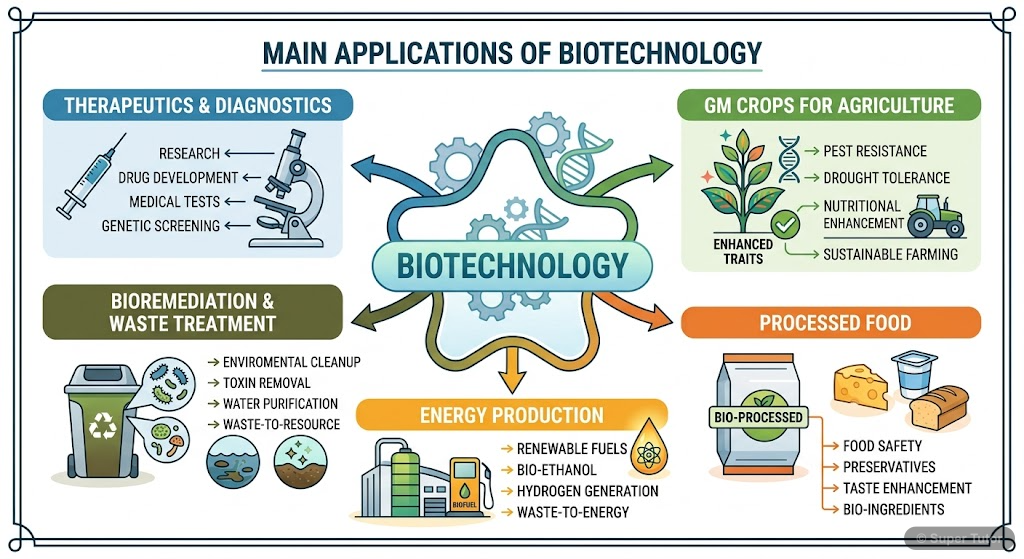
Learn better with visuals Super Tutor pairs illustrations like this with notes and quizzes for Biotechnology and its Applications.
The first 7 solutions are open to read. The other 6 are free with a Super Tutor account.
EXERCISES — Biotechnology and its Applications
1Which part of the plant is best suited for making virus-free plants and why?Show solution
Given / Concept:
Viruses spread systemically through the vascular tissue of plants, but they do not infect the apical meristem (shoot tip) because the meristematic cells divide rapidly and viruses cannot keep pace with the fast-dividing cells. Also, the vascular tissue (phloem) is not yet differentiated in the meristem region, so the virus cannot reach there.
Answer:
The shoot apical meristem (meristematic tip / apical dome) is best suited for making virus-free plants.
Reason:
- Meristematic cells are actively and rapidly dividing; viruses cannot infect them as fast as the cells divide.
- The vascular system (through which viruses travel) is absent or not yet differentiated in the apical meristem.
- When explants from the shoot apex are cultured in vitro (meristem culture), the regenerated plants are free from viral infection.
This technique is widely used to produce virus-free varieties of potato, sugarcane, banana, etc.
2What is the major advantage of producing plants by micropropagation?Show solution
Concept: Micropropagation is the technique of producing a large number of plants from a small piece of plant tissue (explant) under sterile, in vitro conditions.
Major Advantages:
- Rapid mass multiplication: A very large number of plants (thousands to millions) can be produced from a single explant in a short period of time.
- True-to-type plants (somaclonal uniformity): All plants produced are genetically identical to the parent plant (clones), ensuring uniformity.
- Year-round production: Plants can be produced throughout the year, independent of season.
- Disease-free plants: Meristem culture can produce virus-free and pathogen-free plants.
- Conservation of rare/endangered species: Rare plants can be multiplied and conserved.
- Space-saving: Large numbers of plants can be raised in a small laboratory space.
Most significant advantage: It allows production of a large number of genetically identical, disease-free plants in a short time — something not possible through conventional vegetative propagation.
3Find out what the various components of the medium used for propagation of an explant in vitro are?Show solution
Concept: The nutrient medium used for in vitro propagation of explants (tissue culture medium) must supply all the requirements for growth and differentiation of plant cells.
Components of the tissue culture medium (e.g., Murashige and Skoog medium):
| Component | Examples / Role |
|---|---|
| Macronutrients (inorganic salts) | Nitrogen (NO₃⁻, NH₄⁺), Phosphorus, Potassium, Calcium, Magnesium, Sulphur — for general plant nutrition |
| Micronutrients (trace elements) | Iron, Manganese, Zinc, Boron, Copper, Molybdenum — required in small amounts |
| Carbon source (energy source) | Sucrose (2–3%) — since explants cannot photosynthesize sufficiently |
| Vitamins | Thiamine (B₁), Nicotinic acid, Pyridoxine (B₆) — for metabolic activities |
| Plant growth regulators (PGRs) | Auxins (e.g., IAA, 2,4-D) — promote cell elongation and root formation; Cytokinins (e.g., BAP, kinetin) — promote cell division and shoot formation |
| Amino acids | Glycine, glutamine — as nitrogen source |
| Gelling agent | Agar (0.8–1%) — to solidify the medium for solid cultures |
| Water | Distilled/deionised water — solvent for all components |
| pH | Adjusted to 5.7–5.8 |
Note: The ratio of auxin to cytokinin determines organogenesis — high auxin:cytokinin promotes rooting; high cytokinin:auxin promotes shoot formation; equal ratio promotes callus formation.
4Crystals of Bt toxin produced by some bacteria do not kill the bacteria themselves because —
(a) bacteria are resistant to the toxin
(b) toxin is immature;
(c) toxin is inactive;
(d) bacteria encloses toxin in a special sac.Show solution
Correct Answer: (c) toxin is inactive
Justification:
The Bt toxin (δ-endotoxin) is produced by Bacillus thuringiensis as an inactive protoxin (pro-form) and stored as crystalline inclusions (parasporal crystals) inside the bacterial cell. Since the toxin is in its inactive (protoxin) form inside the bacterium, it does not harm the bacterium itself.
When ingested by a susceptible insect larva, the alkaline pH of the insect's midgut (pH ~10) solubilises the crystals, and the inactive protoxin is converted to the active toxin by gut proteases. The active toxin then binds to the epithelial cells of the midgut, creates pores, causes cell swelling and lysis, leading to the death of the insect larva.
Thus, the bacteria are not killed because the toxin remains inactive (as protoxin) inside the bacterial cell.
5What are transgenic bacteria? Illustrate using any one example.Show solution
Definition:
Transgenic bacteria are bacteria into which a foreign gene (from another organism) has been introduced using recombinant DNA technology, enabling them to express a new (foreign) protein or acquire a new trait.
How they are made:
- The gene of interest is isolated from the donor organism.
- It is inserted into a suitable vector (e.g., plasmid).
- The recombinant vector is introduced into the host bacterium (e.g., E. coli).
- The bacterium expresses the foreign gene and produces the desired protein.
Example — Production of Human Insulin (Humulin):
- Human insulin is normally produced by β-cells of the islets of Langerhans in the pancreas.
- Insulin consists of two polypeptide chains — Chain A and Chain B — linked by disulphide bonds.
- Using rDNA technology:
- The gene for insulin A-chain and B-chain were chemically synthesised.
- Each chain gene was separately introduced into plasmids and cloned in E. coli.
- E. coli expressed the genes and produced the respective chains.
- The two chains were extracted, purified, and combined by creating disulphide bonds to form functional human insulin.
- This recombinant human insulin, called Humulin, was first produced by Eli Lilly (USA) in 1982.
Significance: Humulin is identical to human insulin, does not cause immune reactions, and is free from risk of animal-borne infections (unlike earlier pig/cow-derived insulin).
6Compare and contrast the advantages and disadvantages of production of genetically modified crops.Show solution
Genetically Modified (GM) Crops are plants whose DNA has been altered using genetic engineering techniques to introduce one or more new traits.
ADVANTAGES:
| S.No. | Advantage | Example |
|---|---|---|
| 1. | Increased crop yield — improved growth and productivity | Bt cotton, Bt brinjal |
| 2. | Pest resistance — crops express insecticidal proteins, reducing pesticide use | Bt crops expressing Cry proteins |
| 3. | Herbicide tolerance — crops can withstand herbicide application | Herbicide-tolerant soybean |
| 4. | Abiotic stress tolerance — tolerance to drought, cold, salinity | Drought-tolerant maize |
| 5. | Improved nutritional quality — enhanced vitamins, minerals, proteins | Golden Rice (β-carotene/Vitamin A) |
| 6. | Reduced post-harvest losses — delayed ripening, longer shelf life | Flavr Savr tomato |
| 7. | Reduced dependence on chemical pesticides — environmentally friendly | Bt crops |
| 8. | Phytoremediation — plants engineered to remove heavy metals from soil | Tobacco with mercury tolerance |
DISADVANTAGES:
| S.No. | Disadvantage | Concern |
|---|---|---|
| 1. | Potential health risks — allergenicity, toxicity of novel proteins | Unknown long-term effects on humans |
| 2. | Loss of biodiversity — monoculture of GM crops may displace native varieties | Genetic erosion |
| 3. | Gene flow to wild relatives — transgenes may spread to wild plants creating 'superweeds' | Ecological imbalance |
| 4. | Ethical concerns — 'playing God', patenting of life forms | Biopiracy, corporate monopoly |
| 5. | Resistance development in pests — insects may develop resistance to Bt toxin over time | Reduced effectiveness |
| 6. | Harm to non-target organisms — Bt toxin may affect beneficial insects like bees | Ecological disruption |
| 7. | Economic concerns — high cost of GM seeds, dependence on seed companies | Farmer exploitation |
Conclusion: While GM crops offer significant benefits in food security and agriculture, their large-scale adoption requires careful risk assessment, regulation, and ethical consideration.
7What are Cry proteins? Name an organism that produces it. How has man exploited this protein to his benefit?Show solution
What are Cry proteins?
Cry proteins (also called δ-endotoxins or Bt toxins) are insecticidal proteins encoded by cry genes. They are produced as inactive protoxin crystals (parasporal crystals) during the sporulation phase of the bacterium.
Organism that produces Cry proteins:
Bacillus thuringiensis (Bt) — a gram-positive, soil-dwelling bacterium.
Mechanism of action:
- Cry proteins are produced as inactive protoxins.
- When ingested by a susceptible insect larva, the alkaline pH of the midgut solubilises the crystals.
- Gut proteases convert the protoxin into the active toxin.
- The active toxin binds to specific receptors on the epithelial cells of the midgut.
- It creates pores/holes in the cell membrane, causing cell swelling, lysis, and ultimately death of the insect larva.
Different Cry proteins are specific to different insects:
- CryIAc and CryIIAb → target bollworms (cotton pests)
- CryIAb → target corn borer
- CryIIIAb → target Colorado potato beetle
- CryIVB → target mosquito larvae
How man has exploited Cry proteins:
- Bt crops (Transgenic crops): The cry genes have been isolated from B. thuringiensis and introduced into crop plants using rDNA technology.
- Bt cotton — contains cryIAc and cryIIAb genes — resistant to bollworms.
- Bt corn — contains cryIAb gene — resistant to corn borer.
- Bt brinjal — resistant to fruit and shoot borer.
- Biopesticides: Spore-crystal mixtures of B. thuringiensis are used as biological pesticides (sprayed on crops) — an eco-friendly alternative to chemical pesticides.
Benefit: Reduced use of chemical pesticides → lower cost of cultivation, less environmental pollution, and safer food.
Free with a Super Tutor account
Free with a Super Tutor account
Free with a Super Tutor account
Free with a Super Tutor account
Free with a Super Tutor account
Free with a Super Tutor account
6 more solved questions in Biotechnology and its Applications
They are free with a Super Tutor account, along with practice quizzes and flashcards for this chapter. Free to start, no card needed.
Frequently Asked Questions
What are the important topics in Biotechnology and its Applications for Madhya Pradesh Board Class 12 Biology?
Are these NCERT Solutions for Biotechnology and its Applications free?
How should I revise Biotechnology and its Applications for the Madhya Pradesh Board Class 12 board exam?
Sources & Official References
Content is aligned to the official syllabus. Refer to the board website for the latest curriculum.
More resources for Biotechnology and its Applications
Practice Quiz
Test yourself with a quick quiz
Important Questions
Exam-style questions with answers
Revision Notes
Key points for last-minute revision
Chapter Summary
Understand the chapter at a glance
Concept Maps
See how topics connect
Study Plan
Step-by-step plan for this chapter
Flashcards
Quick-fire cards for active recall
Syllabus
What topics to cover
For serious students
Get the full Biotechnology and its Applications chapter — start free.
Quizzes, flashcards, an AI doubt solver and a study plan for Madhya Pradesh Board Class 12 Biology. Free to start, no card needed.