Molecular Basis of Inheritance — NCERT Solutions
Madhya Pradesh Board · Class 12 · Biology
NCERT Solutions for Molecular Basis of Inheritance, Madhya Pradesh Board Class 12 Biology: 14 textbook questions solved step by step.
Interactive on Super Tutor
Studying Molecular Basis of Inheritance? Get the full interactive chapter.
Quizzes, flashcards, AI doubt-solver and a step-by-step study plan — built for NCERT solutions and more.
Free trial, no card needed.
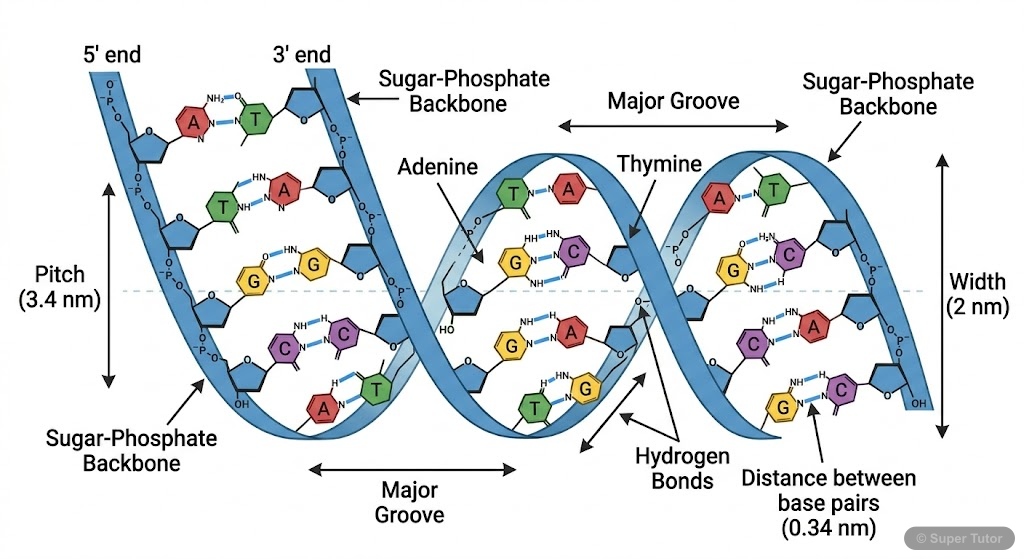
Learn better with visuals Super Tutor pairs illustrations like this with notes and quizzes for Molecular Basis of Inheritance.
The first 7 solutions are open to read. The other 7 are free with a Super Tutor account.
EXERCISES — Molecular Basis of Inheritance
1Group the following as nitrogenous bases and nucleosides: Adenine, Cytidine, Thymine, Guanosine, Uracil and Cytosine.Show solution
Given: A list of six compounds — Adenine, Cytidine, Thymine, Guanosine, Uracil, Cytosine.
Concept: A nitrogenous base is a nitrogen-containing ring compound (purine or pyrimidine) that is NOT attached to a sugar. A nucleoside = nitrogenous base + pentose sugar (no phosphate group).
Classification:
Nitrogenous Bases:
- Adenine (purine)
- Thymine (pyrimidine)
- Uracil (pyrimidine)
- Cytosine (pyrimidine)
Nucleosides:
- Cytidine (Cytosine + Ribose sugar)
- Guanosine (Guanine + Ribose sugar)
Summary Table:
| Category | Compounds |
|---|---|
| Nitrogenous Bases | Adenine, Thymine, Uracil, Cytosine |
| Nucleosides | Cytidine, Guanosine |
2If a double stranded DNA has 20 per cent of cytosine, calculate the per cent of adenine in the DNA.Show solution
Given: Percentage of Cytosine (C) = 20%
Concept Used — Chargaff's Rules:
In a double-stranded DNA:
- and (complementary base pairing)
Step 1: Since ,
Step 2: Total percentage of G + C:
Step 3: Therefore, percentage of A + T:
Step 4: Since :
Answer: The percentage of Adenine in the DNA = 30%
3If the sequence of one strand of DNA is written as follows: 5'-ATGCATGCATGCATGCATGCATGCATGC-3'. Write down the sequence of complementary strand in 5'→3' direction.Show solution
Given strand (Template):
Concept: The complementary strand is antiparallel and follows base-pairing rules:
- A pairs with T
- T pairs with A
- G pairs with C
- C pairs with G
Step 1: Write the complementary strand in 3'→5' direction (antiparallel to the given strand):
Step 2: Reverse it to write in 5'→3' direction:
Answer: The complementary strand in 5'→3' direction is:
4If the sequence of the coding strand in a transcription unit is written as follows: 5'-ATGCATGCATGCATGCATGCATGCATGC-3'. Write down the sequence of mRNA.Show solution
Given Coding Strand:
Concept:
- The coding strand (non-template strand) has the same sequence as the mRNA, except that in mRNA, Thymine (T) is replaced by Uracil (U).
- The template strand is complementary and antiparallel to the coding strand.
- mRNA is synthesised in the 5'→3' direction and is complementary to the template strand (= same as coding strand with T replaced by U).
Step 1: Replace every T with U in the coding strand sequence:
Coding strand: -ATGCATGCATGCATGCATGCATGCATGC-
mRNA sequence: -AUGCAUGCAUGCAUGCAUGCAUGCAUGC-
Answer: The mRNA sequence is:
5Which property of DNA double helix led Watson and Crick to hypothesise semi-conservative mode of DNA replication? Explain.Show solution
Property of DNA that led to the hypothesis:
The complementary base pairing between the two strands of the DNA double helix (A pairs with T via 2 H-bonds; G pairs with C via 3 H-bonds) led Watson and Crick to propose the semi-conservative mode of replication.
Explanation:
- Watson and Crick observed that the two strands of the DNA double helix are complementary to each other — the sequence of one strand automatically determines the sequence of the other strand.
- They reasoned that if the two strands were to separate (unwind), each strand could serve as a template for the synthesis of a new complementary strand.
- Free deoxyribonucleoside triphosphates (dNTPs) present in the cell would align opposite to their complementary bases on each template strand, following the base-pairing rules.
- This would result in the formation of two daughter DNA molecules, each consisting of:
- One original (parental) strand, and
- One newly synthesised complementary strand.
- Since each daughter DNA retains (conserves) one parental strand, this mode is called semi-conservative replication.
This hypothesis was later experimentally proved by Meselson and Stahl (1958) using N and N isotopes of nitrogen.
6Depending upon the chemical nature of the template (DNA or RNA) and the nature of nucleic acids synthesised from it (DNA or RNA), list the types of nucleic acid polymerases.Show solution
Concept: Nucleic acid polymerases are enzymes that synthesise nucleic acids using a template. They are classified based on the nature of the template used and the product synthesised.
Types of Nucleic Acid Polymerases:
| Type | Template | Product Synthesised | Example/Occurrence |
|---|---|---|---|
| DNA-dependent DNA Polymerase | DNA | DNA | DNA replication in all organisms |
| DNA-dependent RNA Polymerase | DNA | RNA | Transcription in all organisms |
| RNA-dependent RNA Polymerase (RdRp / Replicase) | RNA | RNA | RNA replication in RNA viruses |
| RNA-dependent DNA Polymerase (Reverse Transcriptase) | RNA | DNA | Retroviruses (e.g., HIV) |
Summary:
- DNA → DNA: DNA-dependent DNA Polymerase (during replication)
- DNA → RNA: DNA-dependent RNA Polymerase (during transcription)
- RNA → RNA: RNA-dependent RNA Polymerase (in RNA viruses)
- RNA → DNA: Reverse Transcriptase (in retroviruses)
7How did Hershey and Chase differentiate between DNA and protein in their experiment while proving that DNA is the genetic material?Show solution
Hershey and Chase Experiment (1952):
Aim: To prove that DNA (and not protein) is the genetic material.
Organism used: Bacteriophage T2 (a virus that infects E. coli)
Method of Differentiation — Use of Radioactive Isotopes:
Hershey and Chase used two different radioactive isotopes to label DNA and protein separately:
- Labelling DNA: They grew bacteriophages in a medium containing radioactive P (phosphorus). Since DNA contains phosphorus (in the phosphate backbone) but protein does not, only the DNA of the phage was labelled with P.
- Labelling Protein: They grew bacteriophages in a medium containing radioactive S (sulphur). Since proteins contain sulphur (in amino acids like cysteine and methionine) but DNA does not, only the protein coat of the phage was labelled with S.
Experimental Steps:
- Both sets of labelled phages were allowed to infect E. coli bacteria separately.
- After infection, the mixture was agitated in a blender to separate phage coats from bacteria, then centrifuged.
- The bacteria (heavier) settled as a pellet; the phage coats remained in the supernatant.
Observations:
- In the P experiment: Radioactivity was found in the bacterial pellet (inside the bacteria), indicating that DNA was injected into the bacteria.
- In the S experiment: Radioactivity was found in the supernatant (phage coats outside), indicating that protein did NOT enter the bacteria.
Conclusion: Since only DNA entered the bacterial cell and directed the production of new phages, DNA is the genetic material, not protein.
This experiment elegantly differentiated DNA from protein using the unique chemical property that DNA contains phosphorus (P) and proteins contain sulphur (S).
Free with a Super Tutor account
Free with a Super Tutor account
Free with a Super Tutor account
Free with a Super Tutor account
Free with a Super Tutor account
Free with a Super Tutor account
Free with a Super Tutor account
7 more solved questions in Molecular Basis of Inheritance
They are free with a Super Tutor account, along with practice quizzes and flashcards for this chapter. Free to start, no card needed.
Frequently Asked Questions
What are the important topics in Molecular Basis of Inheritance for Madhya Pradesh Board Class 12 Biology?
Are these NCERT Solutions for Molecular Basis of Inheritance free?
How should I revise Molecular Basis of Inheritance for the Madhya Pradesh Board Class 12 board exam?
Sources & Official References
Content is aligned to the official syllabus. Refer to the board website for the latest curriculum.
More resources for Molecular Basis of Inheritance
Practice Quiz
Test yourself with a quick quiz
Important Questions
Exam-style questions with answers
Revision Notes
Key points for last-minute revision
Formula Sheet
The chapter's formulas in one place
Chapter Summary
Understand the chapter at a glance
Concept Maps
See how topics connect
Study Plan
Step-by-step plan for this chapter
Flashcards
Quick-fire cards for active recall
Syllabus
What topics to cover
For serious students
Get the full Molecular Basis of Inheritance chapter — start free.
Quizzes, flashcards, an AI doubt solver and a study plan for Madhya Pradesh Board Class 12 Biology. Free to start, no card needed.