Chapter 13 of 13
NCERT Solutions

Biodiversity and Conservation

Madhya Pradesh Board · Class 12 · Biology

NCERT Solutions for Biodiversity and Conservation — Madhya Pradesh Board Class 12 Biology.

48 questions50 flashcards5 concepts

Interactive on Super Tutor

Studying Biodiversity and Conservation? Get the full interactive chapter.

Quizzes, flashcards, AI doubt-solver and a step-by-step study plan — built for ncert solutions and more.

1,000+ Class 12 students started this chapter today

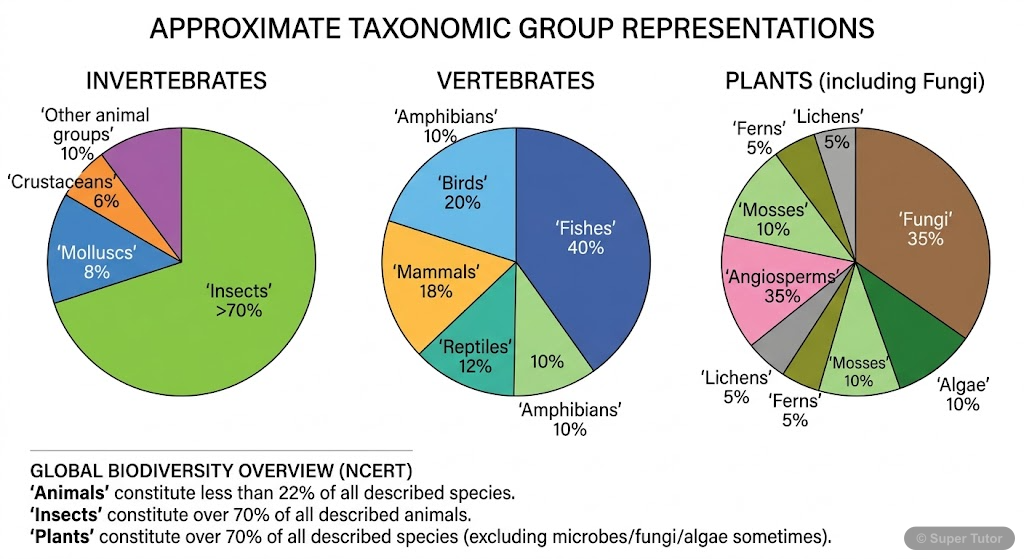
Pie charts illustrating the proportionate number of species for major groups of invertebrates, vertebrates, and plants, based on Robert May's global estimates.
Super Tutor

This is just one of 10+ visuals inside Super Tutor's Biodiversity and Conservation chapter

Explore the full set
10 Questions Solved · 1 Section

EXERCISES — Biodiversity and Conservation

1Name the three important components of biodiversity.Show solution
Given/Concept: Biodiversity refers to the variety of life on Earth at all its levels.

Answer:
The three important components of biodiversity are:
1. Genetic diversity – Diversity at the genetic level within a species (e.g., different varieties/races of the same species).
2. Species diversity – Diversity at the species level, i.e., the variety of species in a given region.
3. Ecological (Community/Ecosystem) diversity – Diversity at the ecosystem level, i.e., the variety of habitats, communities and ecological processes in a biosphere.
2How do ecologists estimate the total number of species present in the world?Show solution
Given/Concept: The actual number of species on Earth is not known precisely. Ecologists use statistical comparison methods to estimate the total.

Method used by ecologists:
- Ecologists use the statistical comparison of the species richness of well-studied groups (e.g., plants, mammals, birds) in temperate regions versus tropical regions.
- Since temperate regions are better studied, the ratio of temperate to tropical species for a well-known group is calculated.
- This ratio is then applied to poorly known groups (e.g., insects, fungi, nematodes) to extrapolate the total number of species in the tropics and hence the world.
- For example, if the ratio of temperate to tropical species for a known group is 1:3, the same ratio is applied to estimate the tropical species of a lesser-known group.

Result: Using such extrapolations, the estimated total number of species on Earth ranges from 5 to 50 million, though only about 1.5 million species have been formally described and named so far.
3Give three hypotheses for explaining why tropics show greatest levels of species richness.Show solution
Given/Concept: Tropical regions harbour far greater species diversity than temperate or polar regions. Three major hypotheses explain this:

Hypothesis 1 – Greater Evolutionary Time:
Tropical regions have remained relatively undisturbed for millions of years (unlike temperate regions which were affected by glaciation). This gave species more time to evolve, diversify and adapt, resulting in greater species richness.

Hypothesis 2 – Relatively Constant Environment:
Tropical environments are less seasonal and more constant and predictable compared to temperate environments. This promotes niche specialisation and allows more species to coexist, leading to greater species diversity.

Hypothesis 3 – Greater Solar Energy and Productivity:
Tropics receive more solar energy throughout the year, which leads to higher primary productivity. Greater productivity means more food and resources are available, which can support a larger number of species and more complex food webs.

Conclusion: All three hypotheses together explain why species richness is highest in the tropics and decreases towards the poles.
4What is the significance of the slope of regression in a species-area relationship?Show solution
Given/Concept: The species-area relationship was studied by Alexander von Humboldt. It is expressed as:
logS=logC+ZlogA\log S = \log C + Z \log A
where SS = species richness, AA = area, ZZ = slope of regression (regression coefficient), CC = y-intercept.

Significance of the slope ZZ:
- The slope ZZ (regression coefficient) indicates the rate at which species richness increases with increasing area.
- Studies have shown that the value of ZZ lies in the range of 0.1 to 0.2 regardless of the taxonomic group or region (for smaller areas within a continent).
- However, when the analysis is done for very large areas (like entire continents), the slope is much steeper, with ZZ values ranging from 0.6 to 1.2.
- For example, for frugivorous birds and mammals in tropical forests of different continents, ZZ values of 1.15 have been obtained.

Conclusion: The slope ZZ tells us how sensitive species richness is to changes in area. A steeper slope means that a greater loss of area will lead to a proportionally greater loss of species — this has important implications for conservation biology (e.g., predicting species loss due to habitat destruction).
5What are the major causes of species losses in a geographical region?Show solution
Given/Concept: The current rate of species extinction is 100–1000 times higher than in pre-human times, largely due to human activities. The major causes are often summarised as the 'Evil Quartet':

1. Habitat loss and fragmentation:
- This is the most important cause. Destruction of forests, wetlands, grasslands, etc., for agriculture, urbanisation and development destroys the natural habitat of species.
- Fragmentation of large habitats into small, isolated patches reduces population size and gene flow, increasing extinction risk.

2. Over-exploitation:
- Overuse of natural resources by humans (e.g., over-hunting, over-fishing, over-harvesting of plants) leads to population decline and extinction.
- Example: Steller's sea cow, passenger pigeon.

3. Alien species invasions:
- Introduction of exotic (non-native) species into a region can outcompete, prey upon or bring diseases to native species, causing their decline or extinction.
- Example: Nile perch introduced in Lake Victoria caused extinction of many native cichlid fish species.

4. Co-extinctions:
- When one species becomes extinct, the species that are obligatorily dependent on it (e.g., host-specific parasites, mutualistic partners) also become extinct.
- Example: Extinction of a host plant leads to extinction of its host-specific insect pollinator.

Conclusion: These four causes collectively account for the alarming rate of biodiversity loss observed today.
6How is biodiversity important for ecosystem functioning?Show solution
Given/Concept: Biodiversity plays a crucial role in maintaining the stability and functioning of ecosystems.

Importance of biodiversity for ecosystem functioning:

1. Productivity: Communities with higher species diversity tend to have greater primary productivity. More diverse plant communities utilise resources more efficiently.

2. Stability: Ecosystems with higher biodiversity show less year-to-year variation in biomass production and are more stable. They can better withstand and recover from environmental disturbances (resilience).

3. Resistance to invasions: More diverse communities are more resistant to biological invasions by alien species.

4. Nutrient cycling: A greater variety of decomposers, producers and consumers ensures efficient nutrient cycling and energy flow.

5. Ecosystem services: Biodiversity underpins essential ecosystem services such as pollination, pest control, water purification, climate regulation, flood control and soil formation.

6. Rivet Popper Hypothesis (Paul Ehrlich): Just as an aeroplane loses rivets one by one and eventually crashes, the loss of species (even seemingly unimportant ones) weakens the ecosystem and can lead to its collapse.

Conclusion: Biodiversity is not merely a collection of species but the very foundation of ecosystem functioning and the services that sustain all life, including humans.
7What are sacred groves? What is their role in conservation?Show solution
Given/Concept: Sacred groves are a traditional, community-based form of in situ conservation practised in India.

Definition:
Sacred groves are tracts of forest that are set aside and protected by local communities due to religious and cultural traditions. These patches of forest are considered sacred and dedicated to local deities. No human activity (cutting of trees, hunting, etc.) is permitted in these areas.

Distribution in India:
Sacred groves are found in:
- Khasi and Jaintia Hills of Meghalaya
- Aravalli Hills of Rajasthan
- Western Ghats of Karnataka and Maharashtra
- Sarguja, Chanda and Bastar areas of Madhya Pradesh/Chhattisgarh

Role in Conservation:
1. They serve as refugia (refuges) for a large number of plants and animals, including rare and threatened species.
2. They help in protecting biodiversity without any formal government intervention — purely through community effort.
3. They maintain undisturbed natural habitats, allowing species to thrive and ecosystems to function naturally.
4. They act as gene banks for wild relatives of crop plants and medicinal plants.
5. They help in watershed protection, maintaining local water sources and preventing soil erosion.

Conclusion: Sacred groves represent an ancient and effective form of community-led in situ conservation that has preserved biodiversity for centuries.
8Among the ecosystem services are control of floods and soil erosion. How is this achieved by the biotic components of the ecosystem?Show solution
Given/Concept: Ecosystem services include flood control and prevention of soil erosion. These are achieved largely through the biotic components — especially plants and soil organisms.

Control of Floods:
1. Vegetation (trees, shrubs, grasses): Plant roots bind the soil and increase its permeability, allowing rainwater to percolate into the ground rather than running off as surface flow. This reduces the volume and speed of runoff, thereby preventing floods.
2. Forest canopy: Intercepts rainfall, reducing the impact of heavy rain on the soil surface and slowing down water flow.
3. Wetland plants: Wetland vegetation acts as a natural sponge, absorbing and storing large amounts of water during heavy rains and releasing it slowly.

Control of Soil Erosion:
1. Plant roots: Roots of trees, grasses and shrubs bind soil particles together, preventing them from being washed or blown away.
2. Leaf litter and ground cover: Decomposing organic matter (humus) produced by decomposers improves soil structure and water-holding capacity.
3. Canopy cover: Reduces the direct impact of raindrops on the soil surface (raindrop splash erosion).
4. Microorganisms: Soil bacteria and fungi improve soil aggregation, making it more resistant to erosion.

Conclusion: The biotic components — particularly plants and soil microorganisms — work together to regulate water flow and hold soil in place, thereby providing the critical ecosystem services of flood control and prevention of soil erosion.
9The species diversity of plants (22 per cent) is much less than that of animals (72 per cent). What could be the explanations to how animals achieved greater diversification?Show solution
Given/Concept: Among all described species, animals constitute about 72% while plants constitute only 22%. This suggests animals have undergone far greater diversification.

Possible explanations for greater diversification in animals:

1. Greater morphological complexity: Animals show a much greater range of body plans, organ systems and structural complexity compared to plants. This allows them to occupy a wider variety of ecological niches.

2. Mobility: Animals can move and actively seek out different habitats, food sources and mates. This leads to geographical isolation and allopatric speciation more readily than in plants.

3. Co-evolution with plants: The enormous diversity of plants (as food sources) has driven the diversification of herbivores, which in turn drove the diversification of predators. This co-evolutionary arms race has multiplied animal species.

4. Diverse feeding strategies: Animals have evolved a vast array of feeding modes (herbivory, carnivory, omnivory, parasitism, filter feeding, etc.), each requiring different adaptations and leading to new species.

5. Insects — the dominant group: Insects alone constitute about 70% of all animal species. Their small size, short generation time, ability to fly, and co-evolution with flowering plants (for pollination, feeding) has led to explosive speciation.

6. Sexual selection: In animals, sexual selection (mate choice) is a powerful driver of speciation, leading to rapid divergence in traits and the formation of new species.

7. Shorter generation time: Many animals (especially invertebrates) have shorter generation times than plants, allowing faster rates of evolution and speciation.

Conclusion: The combination of mobility, morphological complexity, diverse ecological roles, co-evolution with plants, and especially the extraordinary diversification of insects explains why animals have achieved far greater species diversity than plants.
10Can you think of a situation where we deliberately want to make a species extinct? How would you justify it?Show solution
Given/Concept: While conservation biology generally aims to prevent extinction, there are rare situations where deliberate extinction of a species may be considered justifiable.

Situation — Eradication of disease-causing organisms:
The most well-known example is the **smallpox virus (*Variola* virus). The World Health Organization (WHO) successfully eradicated smallpox globally by 1980 through a worldwide vaccination programme. The virus now exists only in two high-security laboratories (in the USA and Russia).

Another example under consideration is the
Guinea worm (*Dracunculus medinensis*), which causes the painful disease dracunculiasis. Efforts are underway to completely eradicate it.

Justification:
1.
Human welfare: These organisms cause immense human suffering, disability and death. Their eradication directly saves millions of human lives.
2.
No ecological role: Obligate human parasites like the smallpox virus have no known role in any natural ecosystem. Their extinction does not disrupt any food web or ecological process.
3.
No alternative hosts:** Species like *Variola* virus infect only humans; their eradication does not affect any other species or ecosystem service.
4. Ethical responsibility: We have a moral obligation to reduce human suffering. When a species serves no ecological function and causes only harm, deliberate extinction can be ethically justified.

Conclusion: While the deliberate extinction of any species is an extreme step and must be approached with great caution, in the case of obligate human pathogens with no ecological role (like the smallpox virus), it can be scientifically and ethically justified on the grounds of protecting human health and welfare.

Stuck on a step?

Ask Super Tutor AI to explain any solution on this page in a simpler way — free, 24x7.

Ask a Doubt Free

Frequently Asked Questions

What are the important topics in Biodiversity and Conservation for Madhya Pradesh Board Class 12 Biology?
Biodiversity and Conservation covers several key topics that are frequently asked in Madhya Pradesh Board Class 12 board exams. Focus on the core concepts listed on this page and practise related questions to build confidence.
How to score full marks in Biodiversity and Conservation — Madhya Pradesh Board Class 12 Biology?
Understand the core concepts first, then work through the 48 practice questions available for this chapter. Revise formulas and definitions regularly, and use flashcards for quick recall before the exam.
Where can I get free NCERT Solutions for Biodiversity and Conservation Class 12 Biology?
This page has free step-by-step NCERT Solutions for every exercise question in Biodiversity and Conservation (Madhya Pradesh Board Class 12 Biology) — written the way examiners award marks: given, formula, working, answer.

Sources & Official References

Content is aligned to the official syllabus. Refer to the board website for the latest curriculum.

For serious students

Get the full Biodiversity and Conservation chapter — for free.

Quizzes, flashcards, AI doubt-solver and a step-by-step study plan for Madhya Pradesh Board Class 12 Biology.