Sexual Reproduction in Flowering Plants — NCERT Solutions
Madhya Pradesh Board · Class 12 · Biology
NCERT Solutions for Sexual Reproduction in Flowering Plants, Madhya Pradesh Board Class 12 Biology: 18 textbook questions solved step by step.
Interactive on Super Tutor
Studying Sexual Reproduction in Flowering Plants? Get the full interactive chapter.
Quizzes, flashcards, AI doubt-solver and a step-by-step study plan — built for NCERT solutions and more.
Free trial, no card needed.
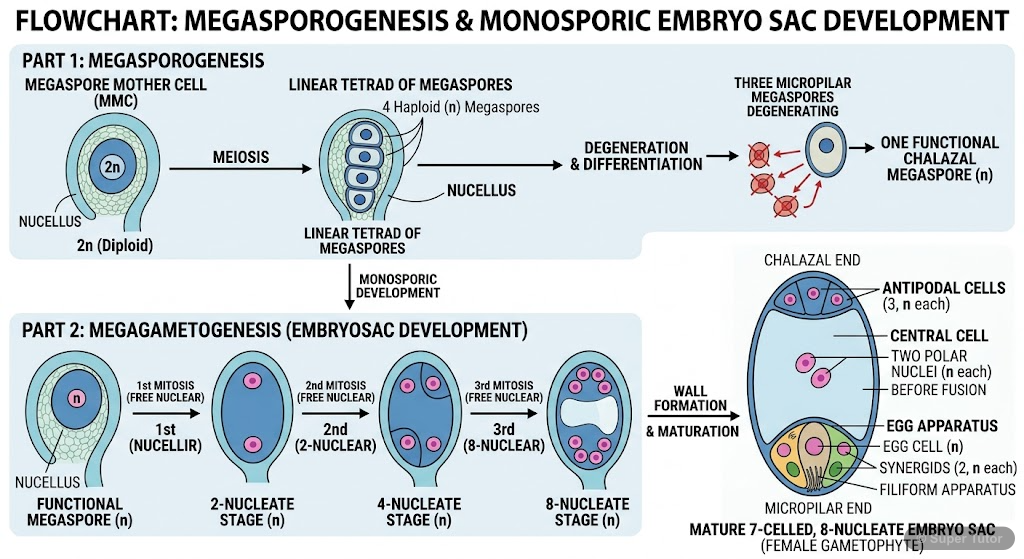
One of 16 illustrations for Sexual Reproduction in Flowering Plants in Super Tutor — alongside flashcards, concept maps and practice questions.
The first 9 solutions are open to read. The other 9 are free with a Super Tutor account.
EXERCISES — Sexual Reproduction in Flowering Plants
1Name the parts of an angiosperm flower in which development of male and female gametophyte take place.Show solution
Given: We need to identify the floral parts where male and female gametophytes develop.
Male Gametophyte Development:
The male gametophyte (pollen grain) develops inside the microsporangia (pollen sacs) present in the anther of the stamen.
- The sporogenous tissue within the microsporangium undergoes meiosis (microsporogenesis) to form microspore tetrads.
- Each microspore matures into a pollen grain (male gametophyte).
Female Gametophyte Development:
The female gametophyte (embryo sac) develops inside the ovule, which is present within the ovary of the pistil (gynoecium).
- The megaspore mother cell in the nucellus undergoes meiosis (megasporogenesis) to form megaspores.
- One functional megaspore develops into the embryo sac (female gametophyte).
Answer:
- Male gametophyte → Anther (microsporangia/pollen sacs)
- Female gametophyte → Ovule (inside the ovary)
2Differentiate between microsporogenesis and megasporogenesis. Which type of cell division occurs during these events? Name the structures formed at the end of these two events.Show solution
Differences between Microsporogenesis and Megasporogenesis:
| Feature | Microsporogenesis | Megasporogenesis |
|---|---|---|
| Definition | Process of formation of microspores (pollen grains) from the pollen mother cell (PMC) | Process of formation of megaspores from the megaspore mother cell (MMC) |
| Site | Microsporangia (anther) | Nucellus of the ovule |
| Mother cell | Pollen Mother Cell (PMC) / Microspore Mother Cell | Megaspore Mother Cell (MMC) |
| Number of functional spores | All four microspores of the tetrad are functional | Usually only one megaspore is functional (3 degenerate) |
| Product | Microspore tetrad → Pollen grains | Megaspore tetrad → One functional megaspore |
| Further development | Each microspore → male gametophyte (pollen grain) | Functional megaspore → female gametophyte (embryo sac) |
Type of Cell Division:
Both microsporogenesis and megasporogenesis involve meiosis (meiotic division / reductive division).
Structures formed at the end:
- Microsporogenesis → Microspore tetrad (which further matures into pollen grains — the male gametophyte)
- Megasporogenesis → Megaspore tetrad (one functional megaspore, which develops into the embryo sac — the female gametophyte)
3Arrange the following terms in the correct developmental sequence: Pollen grain, sporogenous tissue, microspore tetrad, pollen mother cell, male gametes.Show solution
Given terms: Pollen grain, sporogenous tissue, microspore tetrad, pollen mother cell, male gametes.
Concept: During microsporogenesis, the sporogenous tissue gives rise to pollen mother cells, which undergo meiosis to form microspore tetrads, which mature into pollen grains, which finally produce male gametes.
Correct Developmental Sequence:
Explanation:
- Sporogenous tissue — mass of compactly arranged homogeneous cells in the centre of microsporangium.
- Pollen mother cell (PMC) — cells of sporogenous tissue differentiate into PMCs.
- Microspore tetrad — each PMC undergoes meiosis to form a tetrad of four microspores.
- Pollen grain — individual microspores dissociate and mature into pollen grains (male gametophyte).
- Male gametes — the generative cell inside the pollen grain divides to form two male gametes.
4With a neat, labelled diagram, describe the parts of a typical angiosperm ovule.Show solution
Parts of a Typical Angiosperm Ovule:
[Note: Draw a neat diagram of a longitudinal section of an ovule with the following parts labelled.]
A typical angiosperm ovule has the following parts:
- Funicle (Funiculus): A stalk that attaches the ovule to the placenta of the ovary wall. It provides the vascular supply to the ovule.
- Hilum: The point of attachment of the funicle to the body of the ovule.
- Integuments: Protective covering(s) surrounding the ovule. Most angiosperms have two integuments — outer integument and inner integument. They protect the nucellus and the embryo sac.
- Micropyle: A small pore or opening at one end of the ovule formed by the integuments. It is the entry point for the pollen tube during fertilisation.
- Chalaza: The basal part of the ovule opposite to the micropyle, where the integuments and nucellus merge.
- Nucellus: The central mass of parenchymatous cells enclosed by the integuments. It provides nutrition to the developing embryo sac. The embryo sac is embedded within the nucellus.
- Embryo Sac (Female Gametophyte): Located inside the nucellus. It is the 7-celled, 8-nucleate female gametophyte containing the egg apparatus (egg cell + 2 synergids), 3 antipodal cells, and a central cell with 2 polar nuclei.
- Raphe: The ridge formed by the fusion of the funicle with the body of the ovule (present in anatropous ovules).
Diagram description:
- Draw an oval-shaped ovule.
- Show funicle at the bottom connecting to hilum.
- Draw two integuments (outer and inner) surrounding the nucellus.
- Show micropyle at the top (narrow opening).
- Show chalaza at the base.
- Inside the nucellus, draw the embryo sac with egg apparatus at micropylar end, antipodals at chalazal end, and central cell in the middle.
5What is meant by monosporic development of female gametophyte?Show solution
Monosporic Development of Female Gametophyte:
Definition: When the female gametophyte (embryo sac) develops from only one (mono = single) of the four megaspores formed after meiosis of the megaspore mother cell, it is called monosporic development.
Process:
- The megaspore mother cell (MMC) present in the nucellus undergoes meiosis to produce a linear tetrad of four megaspores.
- Out of the four megaspores, three megaspores degenerate.
- Only one functional megaspore (usually the one towards the chalazal end) remains and develops into the female gametophyte (embryo sac).
- This single functional megaspore undergoes three successive mitotic divisions to form the mature 7-celled, 8-nucleate embryo sac.
This type of development is called monosporic because only a single megaspore participates in the formation of the embryo sac.
Example: This is the most common type of embryo sac development found in the majority of angiosperms (e.g., Polygonum type — the most common type).
6With a neat diagram explain the 7-celled, 8-nucleate nature of the female gametophyte.Show solution
7-Celled, 8-Nucleate Female Gametophyte (Embryo Sac):
[Note: Draw a neat labelled diagram of the mature embryo sac showing all 7 cells and 8 nuclei.]
Development:
The functional megaspore undergoes three successive mitotic divisions:
- 1st mitotic division → 2 nuclei
- 2nd mitotic division → 4 nuclei
- 3rd mitotic division → 8 nuclei
These 8 nuclei are organised into 7 cells as follows:
At the Micropylar End — Egg Apparatus (3 cells):
- Egg cell (1): The female gamete; large cell with a prominent nucleus; located at the centre of the egg apparatus.
- Synergids (2): Two cells flanking the egg cell. They have special cellular thickenings called filiform apparatus at the micropylar tip, which help in guiding the pollen tube and absorbing nutrients.
At the Chalazal End — Antipodal Cells (3 cells):
- Antipodal cells (3): Three cells present at the chalazal end. Their exact function is not clearly known; they may help in nutrition. They degenerate after fertilisation.
At the Centre — Central Cell (1 cell with 2 nuclei):
- Central cell (1): The largest cell of the embryo sac. It contains two polar nuclei (one from each pole). During fertilisation, the two polar nuclei fuse with one male gamete to form the triploid primary endosperm nucleus (PEN).
Summary:
Hence the mature embryo sac is 7-celled and 8-nucleate.
7What are chasmogamous flowers? Can cross-pollination occur in cleistogamous flowers? Give reasons for your answer.Show solution
Chasmogamous Flowers:
Flowers that are open (exposed) at the time of pollination, with exposed anthers and stigma, are called chasmogamous flowers. In these flowers, both self-pollination and cross-pollination are possible.
Examples: Most common flowers like those of Hibiscus, Petunia, etc.
Can cross-pollination occur in cleistogamous flowers?
No, cross-pollination cannot occur in cleistogamous flowers.
Reasons:
- Cleistogamous flowers are flowers that never open at all (remain permanently closed).
- Since the flowers remain closed, pollen from another flower (of the same or different plant) cannot reach the stigma of a cleistogamous flower.
- In cleistogamous flowers, the anthers and stigma lie close together within the closed flower, so only self-pollination (autogamy) is possible.
- These flowers are therefore obligate self-pollinators and always produce seeds by self-pollination.
Examples of cleistogamous flowers: Viola (common violet), Oxalis, Commelina — these plants produce both chasmogamous and cleistogamous flowers.
Significance: Cleistogamy ensures seed production even in the absence of pollinators, guaranteeing reproductive success.
8Mention two strategies evolved to prevent self-pollination in flowers.Show solution
Two Strategies to Prevent Self-Pollination:
Strategy 1: Dichogamy
In some flowers, the anther and stigma mature at different times, so that pollen is not available when the stigma is receptive (or vice versa).
- Protandry: Anthers mature and release pollen before the stigma of the same flower becomes receptive. Example: Salvia, sunflower.
- Protogyny: Stigma becomes receptive before the anthers of the same flower mature. Example: Mirabilis, Magnolia.
This ensures that self-pollen cannot fertilise the egg of the same flower.
Strategy 2: Self-Incompatibility (Herkogamy / Genetic Incompatibility)
- Self-incompatibility is a genetic mechanism that prevents the germination of self-pollen on the stigma or prevents the growth of the pollen tube in the style.
- The pollen and pistil recognise each other through biochemical (molecular) interactions. If pollen carries the same S-allele as the pistil, the pollen is rejected and does not germinate.
- This prevents self-fertilisation even if self-pollen lands on the stigma.
Other strategies (bonus):
- Herkogamy: Physical separation of anthers and stigma in the same flower (e.g., different heights).
- Unisexuality (Dioecy): Male and female flowers on separate plants (e.g., papaya, date palm).
9What is self-incompatibility? Why does self-pollination not lead to seed formation in self-incompatible species?Show solution
Self-Incompatibility:
Definition: Self-incompatibility is a genetic mechanism in flowering plants that prevents self-fertilisation by inhibiting the germination of self-pollen on the stigma or by preventing the growth of the pollen tube through the style, even when viable self-pollen lands on a receptive stigma of the same flower or plant.
Mechanism:
- It is controlled by a multi-allelic gene called the S-gene (S-locus).
- Both the pollen grain and the pistil (stigma/style) carry specific S-alleles.
- When the S-allele of the pollen matches the S-allele of the pistil (i.e., self-pollen), a recognition reaction occurs.
- This triggers a rejection response: the pistil produces proteins (S-proteins/ribonucleases) that inhibit pollen germination or degrade the RNA in the pollen tube, preventing its growth.
Why self-pollination does not lead to seed formation:
- When self-pollen lands on the stigma of a self-incompatible species, the pollen is recognised as "self" due to matching S-alleles.
- The stigma/style produces inhibitory proteins that either:
- Prevent the pollen grain from germinating on the stigma, OR
- Inhibit the growth of the pollen tube through the style.
- As a result, the pollen tube never reaches the ovule, and the male gametes are not delivered to the embryo sac.
- Without fertilisation, no zygote is formed, and consequently no seed is produced.
Thus, self-incompatibility acts as a barrier to self-fertilisation and promotes cross-pollination and outbreeding.
Free with a Super Tutor account
Free with a Super Tutor account
Free with a Super Tutor account
(a) hypocotyl and epicotyl;
(b) coleoptile and coleorrhiza;
(c) integument and testa;
(d) perisperm and pericarp.
Free with a Super Tutor account
Free with a Super Tutor account
Free with a Super Tutor account
Free with a Super Tutor account
Free with a Super Tutor account
Free with a Super Tutor account
9 more solved questions in Sexual Reproduction in Flowering Plants
They are free with a Super Tutor account, along with practice quizzes and flashcards for this chapter. Free to start, no card needed.
Frequently Asked Questions
What are the important topics in Sexual Reproduction in Flowering Plants for Madhya Pradesh Board Class 12 Biology?
Are these NCERT Solutions for Sexual Reproduction in Flowering Plants free?
How should I revise Sexual Reproduction in Flowering Plants for the Madhya Pradesh Board Class 12 board exam?
Sources & Official References
Content is aligned to the official syllabus. Refer to the board website for the latest curriculum.
More resources for Sexual Reproduction in Flowering Plants
Practice Quiz
Test yourself with a quick quiz
Important Questions
Exam-style questions with answers
Revision Notes
Key points for last-minute revision
Chapter Summary
Understand the chapter at a glance
Concept Maps
See how topics connect
Study Plan
Step-by-step plan for this chapter
Flashcards
Quick-fire cards for active recall
Syllabus
What topics to cover
For serious students
Get the full Sexual Reproduction in Flowering Plants chapter — start free.
Quizzes, flashcards, an AI doubt solver and a study plan for Madhya Pradesh Board Class 12 Biology. Free to start, no card needed.