Chapter 11 of 17
NCERT Solutions

Planning and Sustainable Development in Indian Context

Madhya Pradesh Board · Class 12 · Geography

NCERT Solutions for Planning and Sustainable Development in Indian Context — Madhya Pradesh Board Class 12 Geography.

46 questions25 flashcards5 concepts

Interactive on Super Tutor

Studying Planning and Sustainable Development in Indian Context? Get the full interactive chapter.

Quizzes, flashcards, AI doubt-solver and a step-by-step study plan — built for ncert solutions and more.

1,000+ Class 12 students started this chapter today

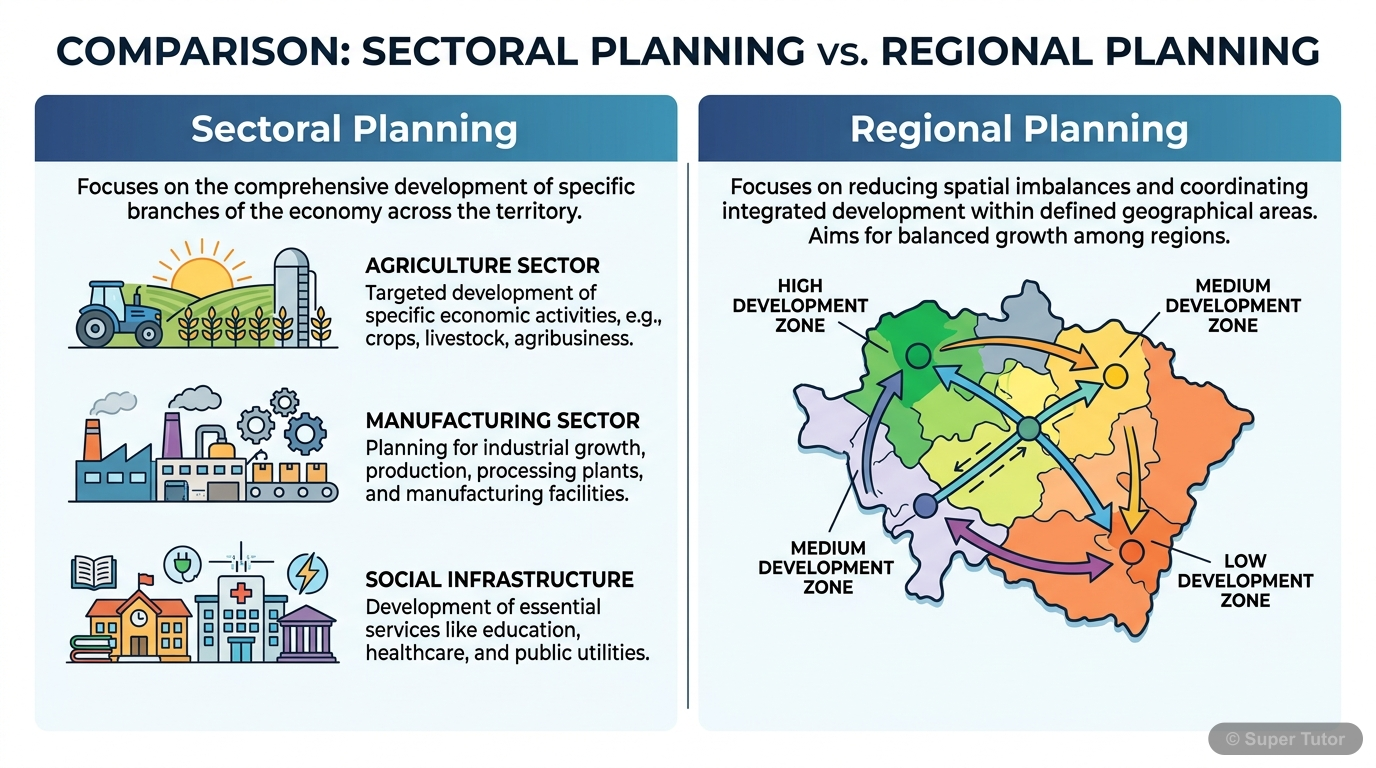
A comparison chart illustrating the key differences between sectoral planning and regional planning, including their definitions, focus areas, and objectives in economic development.
Super Tutor

Learn better with visuals Super Tutor has hundreds of illustrations like this across every chapter — all free to try.

Get started
10 Questions Solved · 1 Section

EXERCISES

1(i)Regional planning relates to:
(a) Development of various sectors of economy.
(b) Area specific approach of development.
(c) Area differences in transportation network.
(d) Development of rural areas.
Show solution
Correct Answer: (b) Area specific approach of development.

Justification: Regional planning focuses on the development of a specific geographic area by identifying its resources, problems, and potentials, and then formulating strategies accordingly. It is an area-specific approach rather than a sector-specific or economy-wide approach.
1(ii)ITDP refers to which one of the following?
(a) Integrated Tourism Development Programme
(b) Integrated Travel Development Programme
(c) Integrated Tribal Development Programme
(d) Integrated Transport Development Programme
Show solution
Correct Answer: (c) Integrated Tribal Development Programme.

Justification: ITDP stands for Integrated Tribal Development Programme. It was launched to address the socio-economic backwardness of tribal communities in India by providing them with education, health, infrastructure, and livelihood support in a holistic and integrated manner.
1(iii)Which one of the following is the most crucial factor for sustainable development in Indira Gandhi Canal Command Area?
(a) Agricultural development
(b) Eco-development
(c) Transport development
(d) Colonisation of land
Show solution
Correct Answer: (b) Eco-development.

Justification: The Indira Gandhi Canal Command Area faces serious ecological problems such as waterlogging, soil salinity, and desertification due to excessive irrigation. Eco-development — which involves maintaining ecological balance while promoting development — is the most crucial factor for ensuring long-term sustainable development in this fragile desert ecosystem.
2(i)What are the social benefits of ITDP in the Bharmaur tribal region?Show solution
Given: The Bharmaur tribal region in Himachal Pradesh was covered under the Integrated Tribal Development Programme (ITDP).

Social Benefits of ITDP in Bharmaur Tribal Region:

1. Education: The programme led to a significant increase in literacy rates, especially among women. Schools and educational institutions were established, improving access to education.

2. Health: Health centres, hospitals, and dispensaries were set up, reducing infant mortality rates and improving overall health conditions of the tribal population.

3. Women Empowerment: The sex ratio improved and the condition of women improved due to better health and educational facilities.

4. Infrastructure: Roads, communication networks, and other basic amenities were developed, reducing the isolation of the tribal communities.

Thus, ITDP brought about significant social transformation in the Bharmaur region by improving the quality of life of the tribal people.
2(ii)Define the concept of sustainable development.Show solution
Given: The concept of sustainable development is a key principle in modern planning.

Definition: Sustainable development is defined as development that meets the needs of the present generation without compromising the ability of future generations to meet their own needs. (Brundtland Commission, 1987)

Key aspects:
- It involves the judicious use of natural resources so that they are not depleted.
- It aims to maintain a balance between economic growth, social equity, and environmental protection.
- It ensures that development is long-lasting and does not cause irreversible damage to the ecosystem.

In essence, sustainable development seeks to integrate economic development with environmental conservation for the well-being of both present and future generations.
2(iii)What are the positive impacts of irrigation on Indira Gandhi Canal Command Area?Show solution
Given: The Indira Gandhi Canal (formerly Rajasthan Canal) brought irrigation to the arid regions of Rajasthan.

Positive Impacts of Irrigation on Indira Gandhi Canal Command Area:

1. Agricultural Development: Irrigation transformed the desert land into agriculturally productive land. Crops like wheat, cotton, groundnut, and mustard are now grown in the region.

2. Increase in Cultivated Area: Large tracts of previously barren and arid land have been brought under cultivation.

3. Improvement in Living Standards: The availability of water improved the socio-economic conditions of the local population.

4. Reduction in Aridity: The canal brought water to one of the most arid regions of India (Thar Desert), reducing the harshness of the desert environment.

5. Development of Settlements: New colonisation of land took place, and new towns and villages developed in the command area.

Thus, irrigation through the Indira Gandhi Canal has been a major catalyst for development in the region.
3(i)Write short notes on drought-prone area programme. How does this programme help in the development of dryland agriculture in India?Show solution
Drought-Prone Area Programme (DPAP):

Introduction:
The Drought-Prone Area Programme (DPAP) was launched by the Government of India in 1973. It is one of the earliest area development programmes aimed at mitigating the effects of drought and promoting development in drought-prone regions.

Objectives:
- To minimise the adverse effects of drought on crop production, livestock, and human life.
- To restore ecological balance by developing and conserving natural resources such as land, water, livestock, and human resources.
- To promote economic development to improve the living standards of the rural poor.

Coverage:
The programme covers the most drought-prone districts of India, particularly in states like Rajasthan, Gujarat, Andhra Pradesh, Karnataka, Maharashtra, Odisha, and Madhya Pradesh.

Strategies:
- Development of water harvesting structures such as tanks, check dams, and percolation ponds.
- Afforestation and pasture development.
- Soil conservation measures.
- Development of alternative livelihood options for the rural poor.

Role in Development of Dryland Agriculture:

1. Water Conservation: The programme promotes construction of water harvesting structures which store rainwater and make it available for dryland farming during dry spells.

2. Soil Moisture Conservation: Techniques like contour bunding, terracing, and mulching are promoted to conserve soil moisture, which is critical for dryland crops.

3. Promotion of Drought-Resistant Crops: Farmers are encouraged to grow drought-resistant and short-duration crop varieties that can survive with limited water.

4. Watershed Development: Integrated watershed management is promoted, which helps in the overall improvement of the dryland ecosystem.

5. Reducing Vulnerability: By providing alternative income sources and improving infrastructure, the programme reduces the vulnerability of farmers to drought conditions.

Conclusion:
The DPAP has played a significant role in stabilising agricultural production in drought-prone areas and has contributed to the development of sustainable dryland agriculture in India.
3(ii)Suggest the measures of promotion of sustainability in Indira Gandhi Canal Command Area.Show solution
Measures for Promotion of Sustainability in Indira Gandhi Canal Command Area:

The Indira Gandhi Canal Command Area faces serious ecological problems such as waterlogging, soil salinity, and sand dune encroachment due to over-irrigation. The following measures are suggested for promoting sustainability:

1. Regulation of Canal Water Use:
- Strict regulation of the release of canal water should be enforced to prevent over-irrigation.
- Warabandi system (rotational distribution of canal water) should be effectively implemented to ensure equitable and judicious use of water.

2. Lining of Canal Channels:
- The canal channels should be lined to prevent seepage of water into the ground, which is a major cause of waterlogging and soil salinity.

3. Promotion of Drip and Sprinkler Irrigation:
- Farmers should be encouraged to adopt micro-irrigation techniques like drip irrigation and sprinkler irrigation to reduce water wastage and prevent waterlogging.

4. Afforestation and Shelter Belts:
- Plantation of trees along the canal banks and in the command area should be promoted to check sand dune encroachment and desertification.
- Shelter belts of trees should be developed to protect agricultural land from wind erosion.

5. Eco-Development:
- The development of the region should be guided by the principles of eco-development, ensuring that economic activities do not damage the fragile desert ecosystem.
- Grazing should be regulated to prevent overgrazing and land degradation.

6. Crop Planning:
- Farmers should be advised to grow crops that require less water (like millets, pulses) rather than water-intensive crops, to reduce pressure on irrigation water.

7. Awareness and Education:
- Local communities should be educated about the importance of sustainable use of water and land resources.
- Participatory approaches involving local people in resource management should be promoted.

8. Monitoring and Evaluation:
- Regular monitoring of soil health, water table levels, and land use changes should be carried out to detect problems early and take corrective measures.

Conclusion:
Sustainability in the Indira Gandhi Canal Command Area can be achieved only through a combination of technological interventions, policy measures, community participation, and ecological sensitivity. The goal should be to balance agricultural development with environmental conservation for long-term well-being.
Project(i)Find out the area development programmes being implemented in your region. Assess the impact of such programmes on the society and economy in your locality.Show solution
Note: This is a project-based activity to be done by students based on their own locality. The following is a suggested framework/guideline for completing this project.

Step 1 – Identify Area Development Programmes:
Visit the local Panchayat office, Block Development Office, or District Collectorate to find out which area development programmes are being implemented in your region. Examples may include:
- Mahatma Gandhi National Rural Employment Guarantee Act (MGNREGA)
- Pradhan Mantri Gram Sadak Yojana (PMGSY)
- Pradhan Mantri Awas Yojana (PMAY)
- Integrated Watershed Management Programme (IWMP)
- Drought-Prone Area Programme (DPAP)
- Desert Development Programme (DDP)

Step 2 – Collect Information:
- Collect data on the objectives, coverage, and activities of the identified programmes.
- Interview local beneficiaries, government officials, and community leaders.

Step 3 – Assess Social Impact:
- Has the programme improved literacy, health, or living standards?
- Has it empowered women or marginalised communities?
- Has it reduced migration from the area?

Step 4 – Assess Economic Impact:
- Has agricultural productivity increased?
- Has employment and income of local people improved?
- Has infrastructure (roads, markets, irrigation) been developed?

Step 5 – Prepare Report:
Prepare a report with maps, photographs, and data tables summarising your findings and assessment.

*Students should complete this project based on their own region and present their findings in class.*
Project(ii)Select your own area or identify an area facing severe environmental and socio-economic problems. Make an assessment of its resources and prepare their inventory. Suggest the measures for its sustainable development as it has been done in the case of Indira Gandhi Canal Command Area.Show solution
Note: This is a field-based project activity. The following is a suggested framework for completing this project.

Step 1 – Select the Area:
Identify an area in your locality or region that faces severe environmental and/or socio-economic problems. Examples: a flood-prone area, a drought-prone area, a tribal region, an area affected by industrial pollution, or a coastal area facing erosion.

Step 2 – Identify Problems:
List the major environmental and socio-economic problems of the area, such as:
- Deforestation, soil erosion, waterlogging, salinity
- Poverty, unemployment, lack of education and health facilities
- Migration, social inequality

Step 3 – Resource Inventory:
Prepare an inventory of the resources available in the area:

| Resource Type | Details |
|---|---|
| Land Resources | Total area, cultivated land, wasteland, forest land |
| Water Resources | Rivers, ponds, groundwater, rainfall |
| Mineral Resources | Available minerals, if any |
| Human Resources | Population, literacy rate, skill levels |
| Biological Resources | Flora, fauna, biodiversity |

Step 4 – Suggest Measures for Sustainable Development:
Based on the resource inventory and problems identified, suggest measures such as:
- Watershed development and water harvesting for water-scarce areas
- Afforestation and soil conservation for degraded lands
- Promotion of organic farming and sustainable agriculture
- Development of eco-tourism for areas with natural beauty
- Skill development and livelihood programmes for the local population
- Strengthening of local governance and community participation

Step 5 – Prepare Report:
Prepare a detailed report with maps, data, photographs, and recommendations. Present it in the class for discussion.

*Students should complete this project based on their chosen area and submit a written report with supporting evidence.*

Stuck on a step?

Ask Super Tutor AI to explain any solution on this page in a simpler way — free, 24x7.

Ask a Doubt Free

Frequently Asked Questions

What are the important topics in Planning and Sustainable Development in Indian Context for Madhya Pradesh Board Class 12 Geography?
Planning and Sustainable Development in Indian Context covers several key topics that are frequently asked in Madhya Pradesh Board Class 12 board exams. Focus on the core concepts listed on this page and practise related questions to build confidence.
How to score full marks in Planning and Sustainable Development in Indian Context — Madhya Pradesh Board Class 12 Geography?
Understand the core concepts first, then work through the 46 practice questions available for this chapter. Revise formulas and definitions regularly, and use flashcards for quick recall before the exam.
Where can I get free NCERT Solutions for Planning and Sustainable Development in Indian Context Class 12 Geography?
This page has free step-by-step NCERT Solutions for every exercise question in Planning and Sustainable Development in Indian Context (Madhya Pradesh Board Class 12 Geography) — written the way examiners award marks: given, formula, working, answer.

Sources & Official References

Content is aligned to the official syllabus. Refer to the board website for the latest curriculum.

For serious students

Get the full Planning and Sustainable Development in Indian Context chapter — for free.

Quizzes, flashcards, AI doubt-solver and a step-by-step study plan for Madhya Pradesh Board Class 12 Geography.