Population : Distribution, Density, Growth and Composition
Madhya Pradesh Board · Class 12 · Geography
NCERT Solutions for Population : Distribution, Density, Growth and Composition — Madhya Pradesh Board Class 12 Geography.
Interactive on Super Tutor
Studying Population : Distribution, Density, Growth and Composition? Get the full interactive chapter.
Quizzes, flashcards, AI doubt-solver and a step-by-step study plan — built for ncert solutions and more.
1,000+ Class 12 students started this chapter today

This is just one of 8+ visuals inside Super Tutor's Population : Distribution, Density, Growth and Composition chapter
Explore the full setEXERCISES
1(i)India's population as per 2011 census is:
(a) 1028 million
(b) 3182 million
(c) 3287 million
(d) 1210 millionShow solution
As per the Census of 2011, India's total population was approximately 1210 million (121 crore). Option (a) 1028 million refers to the 2001 Census figure. Options (b) and (c) are incorrect figures not related to India's population.
1(ii)Which one of the following states has the highest density of population in India?
(a) West Bengal
(b) Kerala
(c) Uttar Pradesh
(d) BiharShow solution
As per the 2011 Census, Bihar has the highest population density among all Indian states with a density of 1,106 persons per sq. km, making it the most densely populated state in India. West Bengal comes second with 1,028 persons per sq. km.
1(iii)Which one of the following states has the highest proportion of urban population in India according to 2011 Census?
(a) Tamil Nadu
(b) Maharashtra
(c) Kerala
(d) GoaShow solution
According to the 2011 Census, Goa has the highest proportion of urban population among all Indian states, with about 62.2% of its population living in urban areas. This is due to its small geographical size, high level of tourism, trade, and economic development leading to rapid urbanisation.
1(iv)Which one of the following is the largest linguistic group of India?
(a) Sino-Tibetan
(b) Indo-Aryan
(c) Austric
(d) DravidianShow solution
The Indo-Aryan linguistic group is the largest in India, spoken by about 73% of the total population. It includes major languages such as Hindi, Bengali, Marathi, Gujarati, Punjabi, Urdu, Odia, and Rajasthani. The Dravidian group is the second largest, spoken by about 25% of the population.
2(i)Very hot and dry and very cold and wet regions of India have low density of population. In this light, explain the role of climate on the distribution of population.Show solution
Given: Very hot & dry regions (like Rajasthan desert) and very cold & wet regions (like the Himalayas and North-East) have low population density.
Role of Climate in Population Distribution:
Climate is one of the most important factors influencing the distribution of population:
1. Extreme heat and aridity (e.g., Thar Desert in Rajasthan) make agriculture nearly impossible, water is scarce, and living conditions are harsh — leading to very sparse population.
2. Extreme cold (e.g., Himalayan regions like Ladakh, Sikkim) makes agriculture difficult, limits economic activities, and makes survival challenging — resulting in low population density.
3. Excessive rainfall and wetness (e.g., parts of North-East India) create dense forests and difficult terrain, limiting human settlement.
4. In contrast, regions with moderate and favourable climate (like the Indo-Gangetic Plain) support agriculture, trade, and settlement, leading to high population density.
Thus, climate acts as a major determinant of where people choose to live.
2(ii)Which states have large rural population in India? Give one reason for such large rural population.Show solution
States with Large Rural Population:
States such as Himachal Pradesh, Bihar, Odisha, Assam, Uttar Pradesh, Rajasthan, Madhya Pradesh, Jharkhand, and Chhattisgarh have a very large proportion of rural population.
One Reason:
These states are predominantly agrarian economies where the majority of the population depends on agriculture and allied activities for their livelihood. The level of industrialisation and urbanisation in these states is relatively low, which means fewer employment opportunities in urban areas. As a result, people continue to live in villages and engage in farming, leading to a large rural population.
2(iii)Why do some states of India have higher rates of work participation than others?Show solution
Work participation rate (WPR) refers to the proportion of workers to the total population. Some states have higher WPR than others due to the following reasons:
1. Level of economic development: States with more industries, services, and agricultural activities (e.g., Himachal Pradesh, Nagaland, Chhattisgarh) provide more employment opportunities, leading to higher WPR.
2. Female work participation: States where women actively participate in agricultural or other economic activities (e.g., tribal states, southern states) show higher WPR.
3. Age structure: States with a higher proportion of working-age population tend to have higher WPR.
4. Socio-cultural factors: In some states, social norms restrict women from working outside the home, reducing the overall WPR.
5. Availability of work: States with diverse economic activities — farming, mining, manufacturing — offer more employment, raising WPR.
2(iv)'The agricultural sector has the largest share of Indian workers.' – Explain.Show solution
The statement is largely true and can be explained as follows:
1. Historical dependence: India has been an agrarian economy for centuries. A large proportion of the population has traditionally depended on farming for their livelihood.
2. Rural population: About 69% of India's population lives in rural areas where agriculture is the primary occupation.
3. Limited alternative employment: Despite growth in industry and services, the secondary and tertiary sectors have not been able to absorb the entire rural workforce. Many workers remain in agriculture by default.
4. Census data: According to the 2011 Census, about 54.6% of India's total workers are engaged in agriculture (as cultivators and agricultural labourers), making it the single largest employment sector.
5. Subsistence farming: A large number of small and marginal farmers practice subsistence farming, keeping them tied to agriculture.
However, there is a declining trend — from 58.2% in 2001 to 54.6% in 2011 — indicating a gradual shift towards secondary and tertiary sectors.
3(i)Discuss the spatial pattern of density of population in India.Show solution
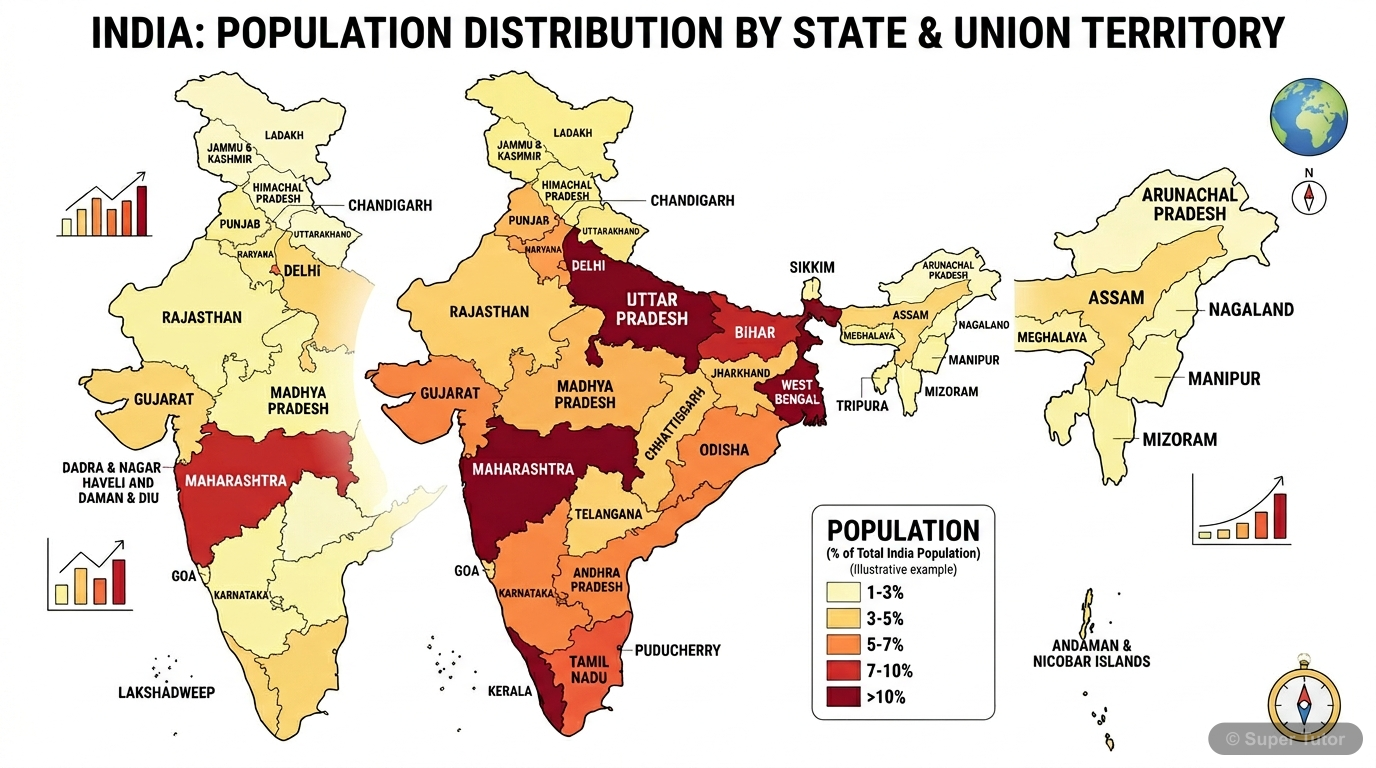
Population Density refers to the number of persons living per unit area (sq. km). India's average population density is 382 persons per sq. km (2011 Census), but there is a wide spatial variation across the country.
1. High Density Regions:
- The Northern Plains (Uttar Pradesh, Bihar, West Bengal) are the most densely populated regions due to fertile alluvial soil, flat terrain, adequate rainfall, and well-developed agriculture and industry.
- Bihar has the highest density (1,106 per sq. km), followed by West Bengal (1,028 per sq. km).
- Kerala (860 per sq. km) in the south is also densely populated due to high literacy, health facilities, and economic development.
2. Moderate Density Regions:
- States like Tamil Nadu, Andhra Pradesh, Madhya Pradesh, Gujarat, and Odisha have moderate population densities.
- These states have mixed economies with agriculture, industry, and services.
3. Low Density Regions:
- Arunachal Pradesh has the lowest density (17 per sq. km) due to rugged terrain, dense forests, and limited accessibility.
- Rajasthan, Jammu & Kashmir (now UTs), Himachal Pradesh, and Uttarakhand also have low densities due to desert conditions, mountainous terrain, and harsh climate.
- The North-Eastern states (Mizoram, Nagaland, Manipur) have low densities due to hilly terrain and dense forests.
Conclusion:
The spatial pattern of population density in India is largely determined by physical factors (terrain, climate, soil, water availability) and human factors (economic development, industrialisation, urbanisation, and historical settlement patterns). The plains are densely populated while mountains and deserts are sparsely populated.
3(ii)Give an account of the occupational structure of India's population.Show solution
Occupational Structure refers to the distribution of the working population among different types of economic activities. In India, workers are broadly classified into main workers and marginal workers, and are engaged in three sectors:
1. Primary Sector (Agriculture and Allied Activities):
- This includes cultivators (those who own or lease land and cultivate it) and agricultural labourers (those who work on others' land for wages).
- As per 2011 Census, about 54.6% of India's workers are engaged in this sector.
- The proportion has declined from 58.2% in 2001, indicating a shift away from agriculture.
- States like Himachal Pradesh, Nagaland, Bihar, Odisha, and Chhattisgarh have a high proportion of agricultural workers.
2. Secondary Sector (Household Industries and Manufacturing):
- This includes workers in household industries (small-scale, cottage industries run at home) and other manufacturing and construction activities.
- The proportion of workers in this sector has been gradually increasing.
- States with high industrialisation like Maharashtra, Gujarat, Tamil Nadu have more workers in this sector.
3. Tertiary Sector (Other Services):
- This includes workers in trade, commerce, transport, communication, banking, education, health, and administration.
- Highly urbanised areas like Delhi, Chandigarh, and Puducherry have a very large proportion of workers in this sector.
- The share of tertiary sector workers has been rising with increasing urbanisation and economic development.
Gender Dimension:
- The number of female workers is relatively high in the primary sector.
- In recent years, there has been some improvement in women's participation in secondary and tertiary sectors.
Conclusion:
India's occupational structure reflects a gradual sectoral shift from farm-based to non-farm-based occupations. While agriculture still dominates, the growing share of secondary and tertiary sectors indicates economic diversification and development.
Stuck on a step?
Ask Super Tutor AI to explain any solution on this page in a simpler way — free, 24x7.
Ask a Doubt FreeFrequently Asked Questions
What are the important topics in Population : Distribution, Density, Growth and Composition for Madhya Pradesh Board Class 12 Geography?
How to score full marks in Population : Distribution, Density, Growth and Composition — Madhya Pradesh Board Class 12 Geography?
Where can I get free NCERT Solutions for Population : Distribution, Density, Growth and Composition Class 12 Geography?
Sources & Official References
Content is aligned to the official syllabus. Refer to the board website for the latest curriculum.
More resources for Population : Distribution, Density, Growth and Composition
Important Questions
Practice with board exam-style questions
Syllabus
What topics to cover
Revision Notes
Key points for last-minute revision
Study Plan
Step-by-step plan to ace this chapter
Flashcards
Quick-fire cards for active recall
Formula Sheet
All formulas in one place
Chapter Summary
Understand the chapter at a glance
Practice Quiz
Test yourself with a quick quiz
Concept Maps
See how topics connect visually
For serious students
Get the full Population : Distribution, Density, Growth and Composition chapter — for free.
Quizzes, flashcards, AI doubt-solver and a step-by-step study plan for Madhya Pradesh Board Class 12 Geography.