Atoms — Chapter Summary
Madhya Pradesh Board · Class 12 · Physics
Summary of Atoms for Madhya Pradesh Board Class 12 Physics. Key concepts: An atom was first pictured as, Alpha and A beam of 5.
Interactive on Super Tutor
Studying Atoms? Get the full interactive chapter.
Quizzes, flashcards, AI doubt-solver and a step-by-step study plan — built for chapter summary and more.
Free trial, no card needed.
One of 9 illustrations for Atoms in Super Tutor — alongside flashcards, concept maps and practice questions.
Overview
Atomic structure developed through successive models. Thomson established the presence of electrons and proposed a model with positive charge spread uniformly through the atom and electrons embedded in it. Rutherford’s scattering experiment revealed that most of the atom is empty space and that posi
Key Concepts
An atom was first pictured as
An atom was first pictured as a sphere of positive charge with electrons embedded in it like seeds in a watermelon. This model explains electrical neu
Alpha
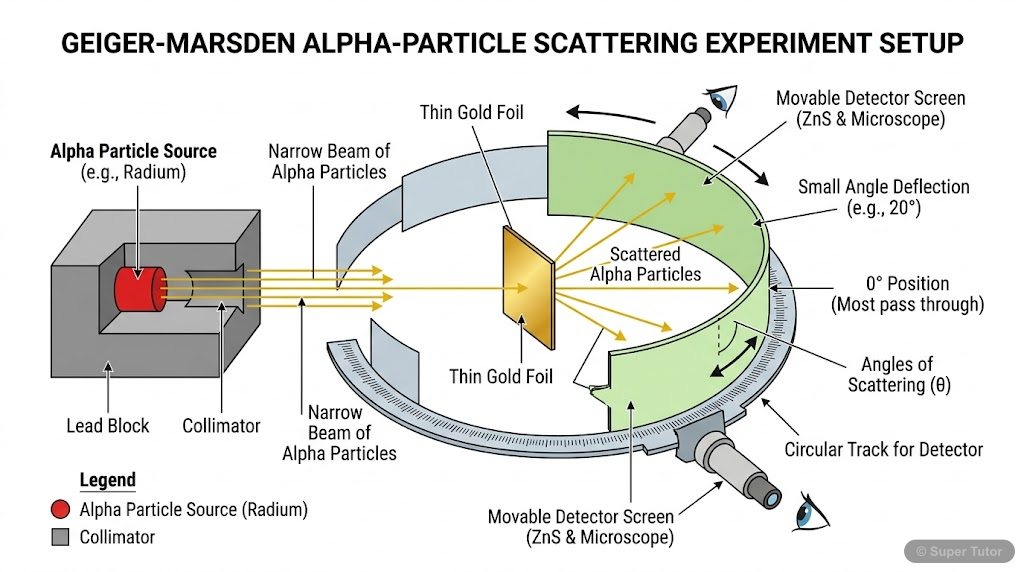
Alpha-particle scattering showed that the atom has a tiny, dense, positively charged nucleus containing most of the mass, with electrons revolving aro
A beam of 5
A beam of 5.5 MeV alpha-particles from a Bi-214 source was directed at a thin gold foil of thickness 2.1 × 10^-7 m. Most particles passed through, ver
For a head
For a head-on alpha-particle, kinetic energy is converted into electrostatic potential energy at the turning point. The relation is d = 2Ze^2 / (4pi e
A revolving electron is accelerating
A revolving electron is accelerating, so classical theory says it should radiate energy and spiral into the nucleus. The model also cannot explain the
Learning Objectives
- Understand the development from Thomson’s model to Rutherford’s nuclear model and Bohr’s model
- Explain the alpha-particle scattering experiment and its conclusions
- Use Coulomb’s law and energy conservation to find the distance of closest approach
- Apply Bohr’s postulates to hydrogen atom energy levels and spectral lines
- Relate hydrogen spectrum, absorption spectrum, and emission spectrum
Frequently Asked Questions
What are the important topics in Atoms for Madhya Pradesh Board Class 12 Physics?
How should I revise Atoms for the Madhya Pradesh Board Class 12 board exam?
Sources & Official References
Content is aligned to the official syllabus. Refer to the board website for the latest curriculum.
More resources for Atoms
Practice Quiz
Test yourself with a quick quiz
Important Questions
Exam-style questions with answers
Revision Notes
Key points for last-minute revision
Formula Sheet
The chapter's formulas in one place
Concept Maps
See how topics connect
Study Plan
Step-by-step plan for this chapter
Flashcards
Quick-fire cards for active recall
Syllabus
What topics to cover
NCERT Solutions
Every textbook question solved step by step
For serious students
Get the full Atoms chapter — start free.
Quizzes, flashcards, an AI doubt solver and a study plan for Madhya Pradesh Board Class 12 Physics. Free to start, no card needed.