Wave Optics — Chapter Summary
Madhya Pradesh Board · Class 12 · Physics
Summary of Wave Optics for Madhya Pradesh Board Class 12 Physics. Part of the Madhya Pradesh Board Class 12 Physics syllabus.
Interactive on Super Tutor
Studying Wave Optics? Get the full interactive chapter.
Quizzes, flashcards, AI doubt-solver and a step-by-step study plan — built for chapter summary and more.
Free trial, no card needed.
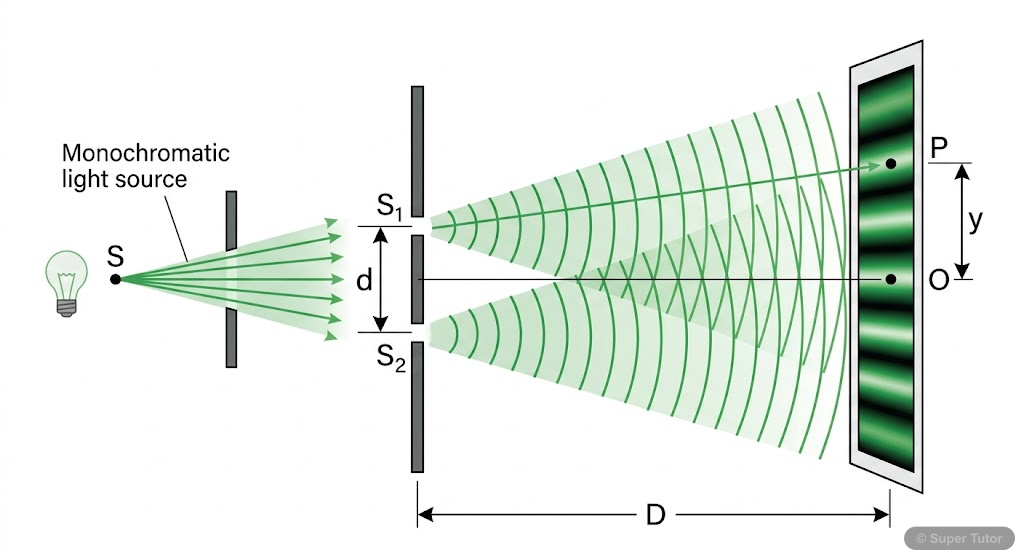
Learn better with visuals Super Tutor pairs illustrations like this with notes and quizzes for Wave Optics.
Overview
Wave optics explains the behaviour of light using wave ideas. The chapter begins with the wave theory of light, the meaning of a wavefront, and Huygens principle. It then derives the laws of reflection and refraction, explains coherent and incoherent superposition, and uses Young's double slit exper
Key Concepts
Light behaves as a wave
Light behaves as a wave. The wave model explains reflection, refraction, interference, diffraction, and polarisation. It also predicts that when light
A wavefront is a surface
A wavefront is a surface of constant phase. For a point source it is spherical, and far from the source it can be treated as plane. The direction of e
Each point on a wavefront acts
Each point on a wavefront acts as a source of secondary wavelets, and the forward envelope of these wavelets gives the new wavefront at a later time.
Using wavefront geometry
Using wavefront geometry, the speed ratio and angle ratio satisfy sin i over sin r equals v1 over v2. In refractive-index form, n1 sin i = n2 sin r. W
For light going from denser
For light going from denser to rarer medium, the critical angle satisfies sin ic = n2 over n1. If the angle of incidence becomes greater than ic, no r
Learning Objectives
- Understand why light is treated as a wave and how this view differs from the corpuscular model
- Define wavefronts and explain Huygens principle
- Derive the laws of reflection and refraction using wavefront construction
- Relate speed, wavelength, frequency, and refractive index in different media
- Understand coherence, interference, and the conditions for bright and dark fringes
Frequently Asked Questions
What are the important topics in Wave Optics for Madhya Pradesh Board Class 12 Physics?
How should I revise Wave Optics for the Madhya Pradesh Board Class 12 board exam?
Sources & Official References
Content is aligned to the official syllabus. Refer to the board website for the latest curriculum.
More resources for Wave Optics
Practice Quiz
Test yourself with a quick quiz
Important Questions
Exam-style questions with answers
Revision Notes
Key points for last-minute revision
Formula Sheet
The chapter's formulas in one place
Concept Maps
See how topics connect
Study Plan
Step-by-step plan for this chapter
Flashcards
Quick-fire cards for active recall
Syllabus
What topics to cover
NCERT Solutions
Every textbook question solved step by step
For serious students
Get the full Wave Optics chapter — start free.
Quizzes, flashcards, an AI doubt solver and a study plan for Madhya Pradesh Board Class 12 Physics. Free to start, no card needed.