Magnetism and Matter — Chapter Summary
Madhya Pradesh Board · Class 12 · Physics
Summary of Magnetism and Matter for Madhya Pradesh Board Class 12 Physics. Key concepts: A bar magnet has two poles, Magnetic field lines and A current.
Interactive on Super Tutor
Studying Magnetism and Matter? Get the full interactive chapter.
Quizzes, flashcards, AI doubt-solver and a step-by-step study plan — built for chapter summary and more.
Free trial, no card needed.
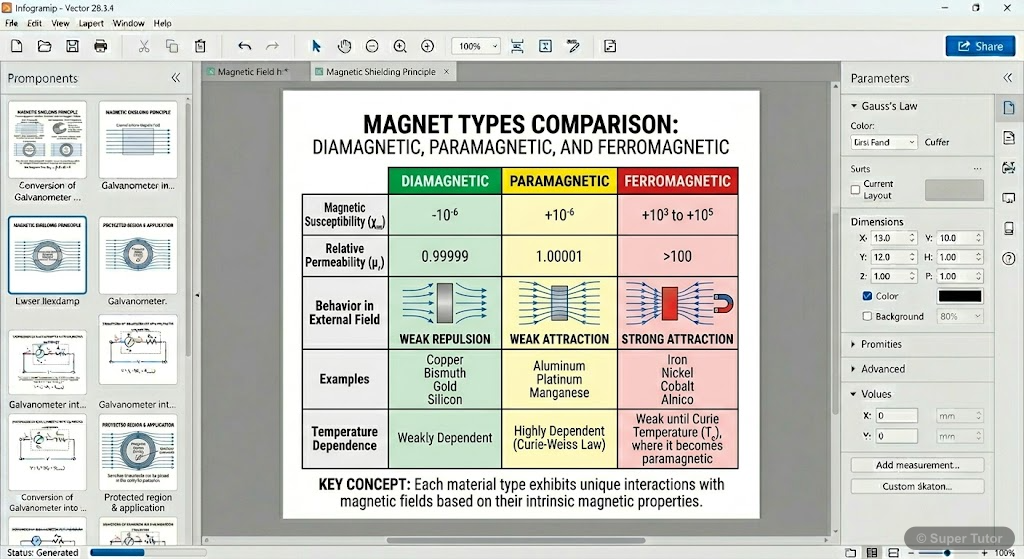
Learn better with visuals Super Tutor pairs illustrations like this with notes and quizzes for Magnetism and Matter.
Overview
Magnetism is a fundamental property of nature linked to moving charges and current. Magnetic phenomena appear in the Earth, magnets, atoms, and materials of different kinds. A bar magnet behaves like a magnetic dipole with two inseparable poles, and its field lines form continuous closed loops. The
Key Concepts
A bar magnet has two poles
A bar magnet has two poles, North and South. The poles always occur together, and cutting a magnet gives two smaller magnets, each with both poles. An
Magnetic field lines of a magnet
Magnetic field lines of a magnet or solenoid form continuous closed loops. The tangent at any point gives the direction of the magnetic field, and a d
A current
A current-carrying finite solenoid produces a field pattern similar to a bar magnet. At large distances, its axial field has the same form as that of
A magnetic dipole in a uniform
A magnetic dipole in a uniform magnetic field experiences torque given by τ = m × B and magnitude τ = mB sinθ. The dipole tends to align with the fiel
The potential energy of a magnetic
The potential energy of a magnetic dipole in a uniform field is U_m = -m · B = -mB cosθ. It is minimum at θ = 0° and maximum at θ = 180°. The zero of
Learning Objectives
- Understand the basic properties of magnets and magnetic field lines.
- Explain why magnetic monopoles do not exist in ordinary magnetism.
- Describe a bar magnet as an equivalent solenoid at large distances.
- Use torque and potential energy formulas for a magnetic dipole in a uniform field.
- State and apply Gauss's law for magnetism.
Frequently Asked Questions
What are the important topics in Magnetism and Matter for Madhya Pradesh Board Class 12 Physics?
How should I revise Magnetism and Matter for the Madhya Pradesh Board Class 12 board exam?
Sources & Official References
Content is aligned to the official syllabus. Refer to the board website for the latest curriculum.
More resources for Magnetism and Matter
Practice Quiz
Test yourself with a quick quiz
Important Questions
Exam-style questions with answers
Revision Notes
Key points for last-minute revision
Formula Sheet
The chapter's formulas in one place
Concept Maps
See how topics connect
Study Plan
Step-by-step plan for this chapter
Flashcards
Quick-fire cards for active recall
Syllabus
What topics to cover
NCERT Solutions
Every textbook question solved step by step
For serious students
Get the full Magnetism and Matter chapter — start free.
Quizzes, flashcards, an AI doubt solver and a study plan for Madhya Pradesh Board Class 12 Physics. Free to start, no card needed.