Globalization — NCERT Solutions
Madhya Pradesh Board · Class 12 · Political Science
NCERT Solutions for Globalization, Madhya Pradesh Board Class 12 Political Science: 11 textbook questions solved step by step. Covers Exercise Questions.
Interactive on Super Tutor
Studying Globalization? Get the full interactive chapter.
Quizzes, flashcards, AI doubt-solver and a step-by-step study plan — built for NCERT solutions and more.
Free trial, no card needed.
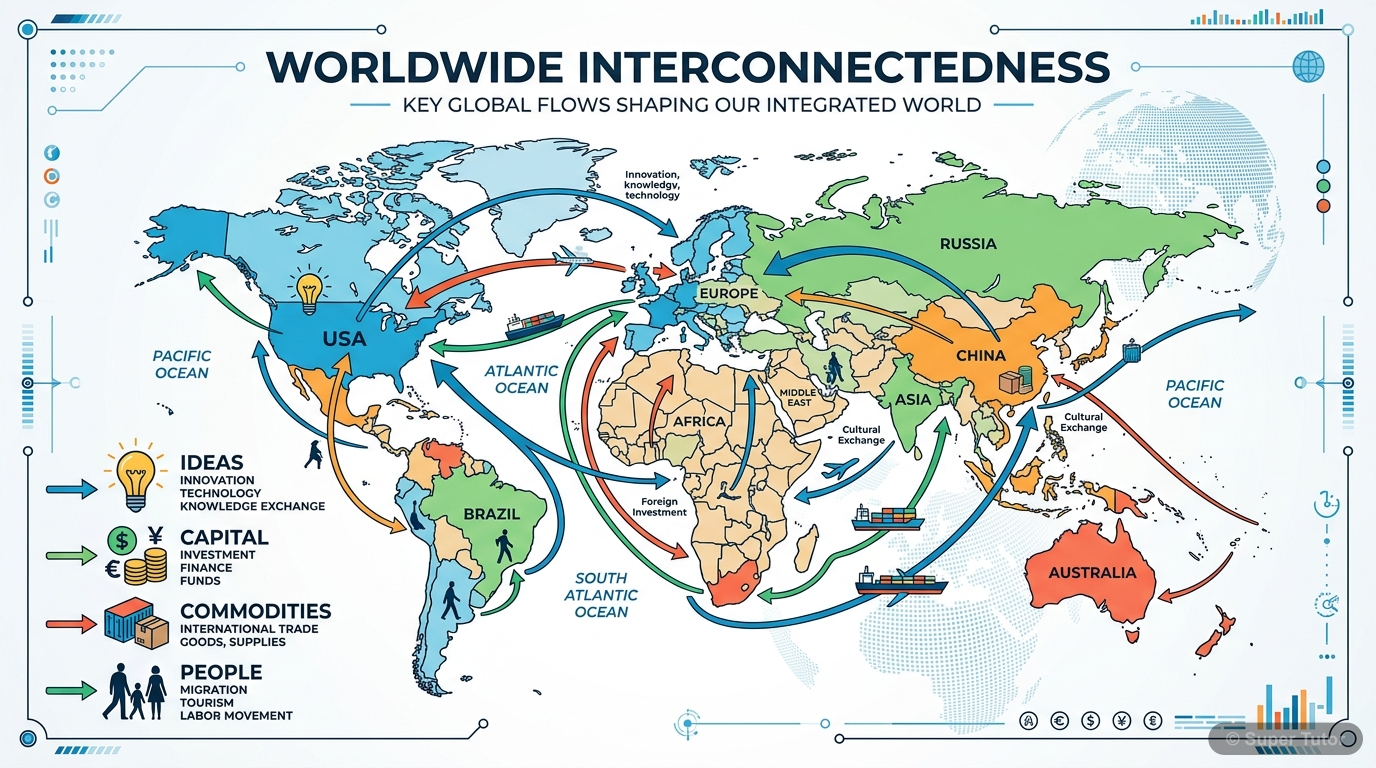
One of 13 illustrations for Globalization in Super Tutor — alongside flashcards, concept maps and practice questions.
The first 6 solutions are open to read. The other 5 are free with a Super Tutor account.
Exercise Questions
1Which of the statements are TRUE about globalisation?
a. Globalisation is purely an economic phenomenon.
b. Globalisation began in 1991.
c. Globalisation is the same thing as westernisation.
d. Globalisation is a multi-dimensional phenomenon.Show solution
Correct Option: (d) Globalisation is a multi-dimensional phenomenon.
Justification:
- Option (a) is FALSE: Globalisation is not purely an economic phenomenon. It has political, cultural, social, and technological dimensions as well.
- Option (b) is FALSE: Globalisation did not begin in 1991. Although India's economic liberalisation began in 1991, globalisation as a process has much older roots — the movement of people, goods, and ideas across the world has been happening for centuries.
- Option (c) is FALSE: Globalisation is not the same as westernisation. While western ideas and culture do spread through globalisation, the process also involves the spread of ideas, goods, and cultures from non-western parts of the world.
- Option (d) is TRUE: Globalisation is indeed a multi-dimensional phenomenon encompassing economic, political, cultural, and social dimensions simultaneously.
2Which of the statements are TRUE about the impact of globalisation?
a. Globalisation has been uneven in its impact on states and societies.
b. Globalisation has had a uniform impact on all states and societies.
c. The impact of globalisation has been confined to the political sphere.
d. Globalisation inevitably results in cultural homogeneity.Show solution
Correct Option: (a) Globalisation has been uneven in its impact on states and societies.
Justification:
- Option (a) is TRUE: The impact of globalisation has not been uniform. Developed countries have generally benefited more, while developing and least-developed countries have often faced challenges such as economic marginalisation, job losses, and cultural disruption. Even within countries, the benefits and costs are unevenly distributed.
- Option (b) is FALSE: The impact has been uneven, not uniform, across states and societies.
- Option (c) is FALSE: The impact of globalisation extends far beyond the political sphere — it affects economics, culture, society, environment, and technology.
- Option (d) is FALSE: Globalisation does not inevitably result in cultural homogeneity. It can also lead to cultural heterogeneity, as local cultures interact with global influences and produce new, hybrid cultural forms.
3Which of the statements are TRUE about the causes of globalisation?
a. Technology is an important cause of globalisation.
b. Globalisation is caused by a particular community of people.
c. Globalisation originated in the US.
d. Economic interdependence alone causes globalisation.Show solution
Correct Option: (a) Technology is an important cause of globalisation.
Justification:
- Option (a) is TRUE: Technology — particularly advances in communication (internet, satellite), transportation, and information technology — has been a major driver of globalisation. It has made the movement of ideas, capital, goods, and people faster and cheaper.
- Option (b) is FALSE: Globalisation is not caused by any particular community of people. It is a complex process driven by multiple factors including technology, trade, capital flows, and political decisions.
- Option (c) is FALSE: Globalisation did not originate in the US. It is a worldwide process with roots going back centuries, involving multiple civilisations and regions.
- Option (d) is FALSE: Economic interdependence is one cause of globalisation, but not the only one. Technology, political decisions, cultural exchanges, and migration also contribute to globalisation.
4Which of the statements are TRUE about globalisation?
a. Globalisation is only about movement of commodities.
b. Globalisation does not involve a conflict of values.
c. Services are an insignificant part of globalisation.
d. Globalisation is about worldwide interconnectedness.Show solution
Correct Option: (d) Globalisation is about worldwide interconnectedness.
Justification:
- Option (a) is FALSE: Globalisation involves not just the movement of commodities but also the movement of capital, people, ideas, technology, and cultural practices across national boundaries.
- Option (b) is FALSE: Globalisation does involve a conflict of values. For example, there are tensions between global free-market values and local cultural or social values, and between advocates and critics of neo-liberal globalisation.
- Option (c) is FALSE: Services (such as IT, banking, finance, healthcare, education) are a very significant and growing part of globalisation, especially for countries like India.
- Option (d) is TRUE: At its core, globalisation refers to the increasing worldwide interconnectedness of societies, economies, cultures, and political systems across the globe.
5Which of the statements are FALSE about globalisation?
a. Advocates of globalisation argue that it will result in greater economic growth.
b. Critics of globalisation argue that it will result in greater economic disparity.
c. Advocates of globalisation argue that it will result in cultural homogenisation.
d. Critics of globalisation argue that it will result in cultural homogenisation.Show solution
Correct Option: (c) Advocates of globalisation argue that it will result in cultural homogenisation.
Justification:
- Option (a) is TRUE: Advocates of globalisation do argue that free trade, foreign investment, and open markets will lead to greater economic growth and prosperity for all.
- Option (b) is TRUE: Critics of globalisation do argue that its benefits are unevenly distributed and that it increases economic disparity between rich and poor nations, and within nations.
- Option (c) is FALSE (the answer to the question): It is the critics of globalisation — not its advocates — who argue that it leads to cultural homogenisation (i.e., the dominance of western, particularly American, culture over local cultures). Advocates generally do not highlight this as a positive outcome.
- Option (d) is TRUE: Critics do argue that globalisation results in cultural homogenisation, where local and diverse cultures are replaced by a uniform global (often western) culture, leading to loss of cultural identity and heritage.
Therefore, statement (c) is FALSE because it incorrectly attributes the argument about cultural homogenisation to advocates rather than critics of globalisation.
6What is worldwide interconnectedness? What are its components?Show solution
Given/Introduction:
Worldwide interconnectedness is the central idea behind globalisation. It refers to the growing links and interdependencies among countries, societies, and peoples across the globe.
Definition:
Worldwide interconnectedness means that events, decisions, and activities in one part of the world have significant consequences for people and communities in distant parts of the world. It implies that the world is increasingly becoming a single, integrated space where boundaries between nations are becoming less significant.
Components of Worldwide Interconnectedness:
(i) Economic Interconnectedness:
This involves the flow of goods, services, capital, and investment across national borders. Trade liberalisation, multinational corporations, and global financial markets are key aspects. For example, a financial crisis in one country (like the 2008 US financial crisis) quickly affects economies worldwide.
(ii) Political Interconnectedness:
This involves the growing role of international organisations (like the UN, WTO, IMF), international treaties, and global governance mechanisms. Political decisions in powerful states affect weaker states. Issues like terrorism, climate change, and nuclear proliferation require collective political responses.
(iii) Cultural Interconnectedness:
This involves the spread of ideas, values, lifestyles, music, food, fashion, and media across the world. The global spread of Hollywood films, fast food chains, and social media platforms are examples. This can lead to both cultural homogenisation and cultural heterogeneity.
(iv) Technological Interconnectedness:
Advances in communication technology (internet, mobile phones, satellites) and transportation have dramatically reduced the barriers of time and space, enabling rapid exchange of information and movement of people and goods.
(v) Social Interconnectedness:
This involves the movement of people (migration, tourism), the spread of social movements, and the sharing of knowledge and ideas across borders.
Conclusion:
Worldwide interconnectedness is thus a multi-dimensional concept that encompasses economic, political, cultural, technological, and social linkages among nations and peoples, making the world increasingly interdependent.
Free with a Super Tutor account
Free with a Super Tutor account
Free with a Super Tutor account
Free with a Super Tutor account
Free with a Super Tutor account
5 more solved questions in Globalization
They are free with a Super Tutor account, along with practice quizzes and flashcards for this chapter. Free to start, no card needed.
Frequently Asked Questions
What are the important topics in Globalization for Madhya Pradesh Board Class 12 Political Science?
Are these NCERT Solutions for Globalization free?
How should I revise Globalization for the Madhya Pradesh Board Class 12 board exam?
Sources & Official References
Content is aligned to the official syllabus. Refer to the board website for the latest curriculum.
More resources for Globalization
Practice Quiz
Test yourself with a quick quiz
Important Questions
Exam-style questions with answers
Revision Notes
Key points for last-minute revision
Chapter Summary
Understand the chapter at a glance
Concept Maps
See how topics connect
Study Plan
Step-by-step plan for this chapter
Flashcards
Quick-fire cards for active recall
Syllabus
What topics to cover
For serious students
Get the full Globalization chapter — start free.
Quizzes, flashcards, an AI doubt solver and a study plan for Madhya Pradesh Board Class 12 Political Science. Free to start, no card needed.