Challenges to and restoration of the congress system — NCERT Solutions
Madhya Pradesh Board · Class 12 · Political Science
NCERT Solutions for Challenges to and restoration of the congress system, Madhya Pradesh Board Class 12 Political Science: 12 textbook questions solved.
Interactive on Super Tutor
Studying Challenges to and restoration of the congress system? Get the full interactive chapter.
Quizzes, flashcards, AI doubt-solver and a step-by-step study plan — built for NCERT solutions and more.
Free trial, no card needed.
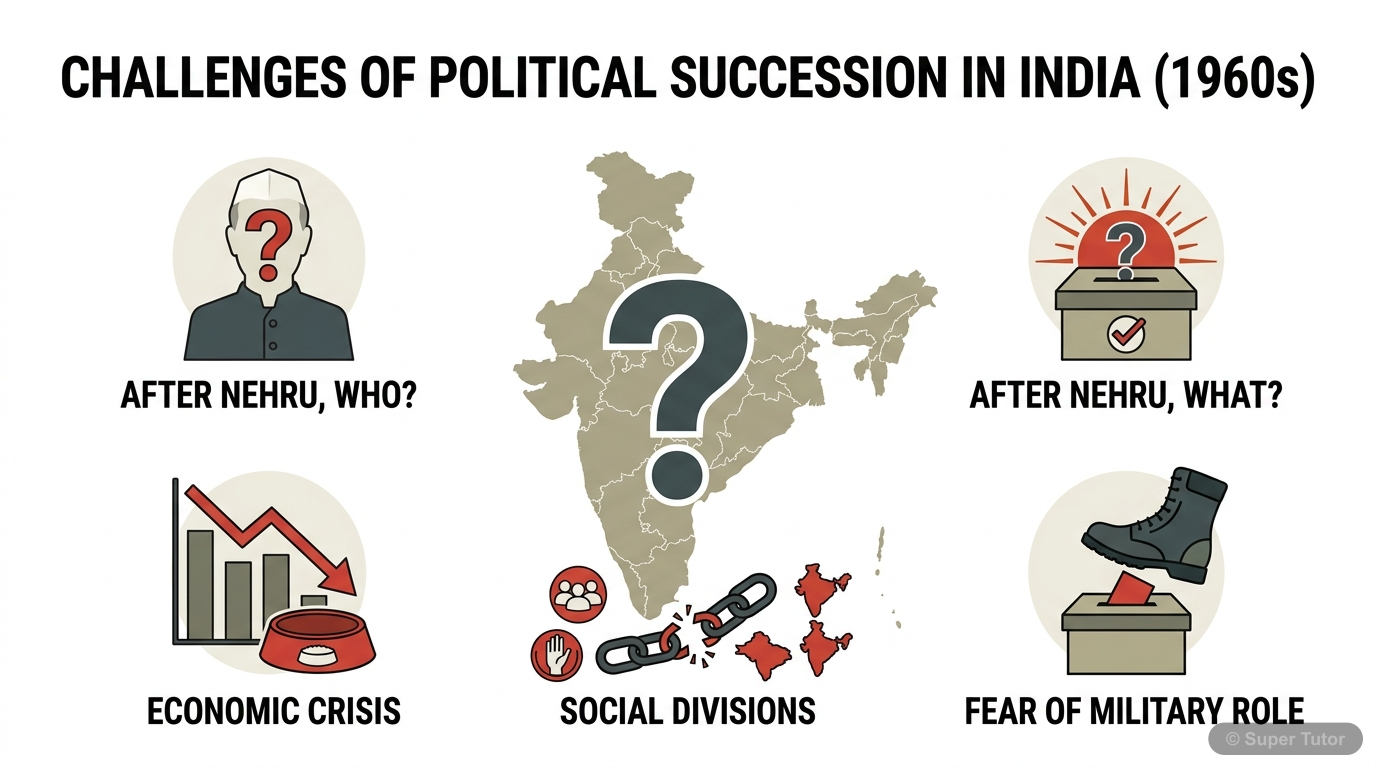
Learn better with visuals Super Tutor pairs illustrations like this with notes and quizzes for Challenges to and restoration of the congress system.
The first 6 solutions are open to read. The other 6 are free with a Super Tutor account.
EXERCISES — Challenges to and Restoration of the Congress System
1Which of these statements about the 1967 elections is/are correct?
(a) Congress won the Lok Sabha elections but lost the Assembly elections in many states.
(b) Congress lost both Lok Sabha and Assembly elections.
(c) Congress lost majority in the Lok Sabha but formed a coalition government with the support of some other parties.
(d) Congress retained power at the Centre with an increased majority.Show solution
Correct Option: (a) Congress won the Lok Sabha elections but lost the Assembly elections in many states.
Justification:
In the 1967 general elections, the Congress party managed to retain power at the Centre (Lok Sabha) but with a drastically reduced majority — it won 283 seats out of 520, which was still enough to form the government under Indira Gandhi. However, in the Assembly elections held simultaneously, Congress lost power in as many as 8 states including Bihar, Uttar Pradesh, Punjab, Haryana, Madhya Pradesh, Rajasthan, Orissa, and West Bengal. Non-Congress governments (SVD — Samyukta Vidhayak Dal coalitions) came to power in several of these states. This phenomenon is often called the 'political earthquake of 1967.' Hence option (a) is correct.
2Match the following:
(a) Syndicate — (i) An elected representative leaving the party on whose ticket s/he has been elected
(b) Defection — (ii) A catchy phrase that attracts public attention
(c) Slogan — (iii) Parties with different ideological position coming together to oppose Congress and its policies
(d) Anti-Congressism — (iv) A group of powerful and influential leaders within the CongressShow solution
Correct Matching:
| Term | Meaning |
|---|---|
| (a) Syndicate | (iv) A group of powerful and influential leaders within the Congress |
| (b) Defection | (i) An elected representative leaving the party on whose ticket s/he has been elected |
| (c) Slogan | (ii) A catchy phrase that attracts public attention |
| (d) Anti-Congressism | (iii) Parties with different ideological positions coming together to oppose Congress and its policies |
Brief Explanation:
- Syndicate referred to a group of powerful Congress leaders like K. Kamaraj, S. Nijalingappa, S.K. Patil, Atulya Ghosh, and Morarji Desai who controlled the organisational machinery of the Congress party in the 1960s.
- Defection means an elected legislator switching parties after being elected on the ticket of a particular party — a major political problem in the late 1960s.
- Slogan is a short, memorable phrase used to mobilise public opinion (e.g., 'Garibi Hatao').
- Anti-Congressism was the strategy proposed by Ram Manohar Lohia of uniting all non-Congress parties to defeat Congress, regardless of ideological differences.
3Whom would you identify with the following slogans/phrases?
(a) Jai Jawan, Jai Kisan
(b) Indira Hatao!
(c) Garibi Hatao!Show solution
(a) Jai Jawan, Jai Kisan:
This slogan is associated with Lal Bahadur Shastri, the second Prime Minister of India. He gave this slogan during the Indo-Pakistan War of 1965 to honour the soldiers (Jawan) defending the country and the farmers (Kisan) feeding the nation. It became one of the most popular and patriotic slogans in Indian political history.
(b) Indira Hatao! (Remove Indira!):
This slogan was raised by the Grand Alliance (opposition parties) during the 1971 Lok Sabha elections. The alliance of non-Congress, non-Communist parties — including the Congress (O), Jana Sangh, Swatantra Party, and Samyukta Socialist Party — used this slogan to target Indira Gandhi personally and campaign for her removal from power.
(c) Garibi Hatao! (Remove Poverty!):
This slogan is associated with Indira Gandhi and the Congress (R) party during the 1971 Lok Sabha elections. Indira Gandhi used this powerful populist slogan to appeal directly to the poor masses of India, bypassing the traditional Congress organisation (Syndicate). It proved enormously successful and helped Congress (R) win a massive majority of 352 seats in the 1971 elections.
4Which of the following statement about the Grand Alliance of 1971 is correct?
The Grand Alliance ...
(a) was formed by non-Communist, non-Congress parties.
(b) had a clear political and ideological programme.
(c) was formed by all non-Congress parties.Show solution
Correct Option: (a) was formed by non-Communist, non-Congress parties.
Justification:
The Grand Alliance of 1971 was formed by parties that were neither Communist nor Congress. It included Congress (O), Jana Sangh, Swatantra Party, Samyukta Socialist Party, and Praja Socialist Party. The Left parties (CPI, CPM) did not join this alliance — in fact, the CPI supported Indira Gandhi's Congress (R). Option (b) is incorrect because the Grand Alliance lacked a clear ideological programme; its only common agenda was opposition to Indira Gandhi ('Indira Hatao'). Option (c) is incorrect because not all non-Congress parties joined — the Left parties stayed out. Hence (a) is the correct answer.
5How should a political party resolve its internal differences? Here are some suggestions. Think of each and list out their advantages and shortcomings.
(a) Follow the footsteps of the party president
(b) Listen to the majority group
(c) Secret ballot voting on every issue
(d) Consult the senior and experienced leaders of the partyShow solution
Internal differences are natural in any democratic political party. Here is an analysis of each suggestion:
(a) Follow the footsteps of the party president:
- Advantages: Ensures unity, discipline, and a clear chain of command. Quick decision-making is possible. Prevents fragmentation.
- Shortcomings: Can lead to authoritarianism and concentration of power in one person. Dissenting voices are suppressed. The party may lose talented leaders who disagree. This is what happened in Congress under Indira Gandhi — centralisation weakened inner-party democracy.
(b) Listen to the majority group:
- Advantages: Reflects democratic principles; the larger section of the party gets its way. Builds broader consensus.
- Shortcomings: The minority group may feel alienated and may split or defect. The majority is not always right — it may take populist but wrong decisions. Minority viewpoints, which may be more principled, get ignored.
(c) Secret ballot voting on every issue:
- Advantages: Ensures free and fair expression of opinion without fear of victimisation. Every member's voice is heard equally. Promotes genuine inner-party democracy.
- Shortcomings: Time-consuming and impractical for every small issue. May create factionalism if results are repeatedly close. Confidentiality may be difficult to maintain in practice.
(d) Consult the senior and experienced leaders of the party:
- Advantages: Benefits from wisdom and experience. Helps avoid past mistakes. Respected leaders can mediate and build consensus.
- Shortcomings: Senior leaders may be out of touch with ground realities or newer challenges. It may sideline younger, dynamic leaders. Can lead to gerontocracy (rule by the old).
Conclusion: The best approach is a combination — consulting experienced leaders, followed by open discussion and, where needed, a democratic vote — to balance experience, inclusivity, and decisiveness.
6State which of these were reasons for the defeat of the Congress in 1967. Give reasons for your answer.
(a) The absence of a charismatic leader in the Congress party
(b) Split within the Congress party
(c) Increased mobilisation of regional, ethnic and communal groups
(d) Increasing unity among non-Congress parties
(e) Internal differences within the Congress partyShow solution
Analysis of each factor:
(a) The absence of a charismatic leader in the Congress party — Partially valid reason.
After the death of Jawaharlal Nehru (1964) and Lal Bahadur Shastri (1966), Indira Gandhi was a relatively new and untested Prime Minister in 1967. The Congress lacked the towering charismatic leadership it had enjoyed under Nehru. However, Indira Gandhi did provide some leadership, so this is only a partial reason.
(b) Split within the Congress party — Not a direct reason for 1967 defeat.
The formal split in Congress happened in 1969, i.e., after the 1967 elections. Therefore, this was NOT a reason for the 1967 defeat. The split was actually a consequence of the tensions that became visible after 1967.
(c) Increased mobilisation of regional, ethnic and communal groups — Valid reason.
By the mid-1960s, various social groups — regional parties (DMK in Tamil Nadu), backward castes, linguistic communities, and communal organisations — had become politically assertive. They challenged the Congress's broad coalition. The DMK's victory in Tamil Nadu in 1967 is a prime example. This is a genuine reason for Congress's decline.
(d) Increasing unity among non-Congress parties — Valid reason.
Ram Manohar Lohia's strategy of 'Anti-Congressism' — uniting all non-Congress parties regardless of ideology — proved effective in 1967. In many states, non-Congress parties formed electoral alliances (SVD coalitions) and pooled their votes against Congress, leading to its defeat in several state assemblies.
(e) Internal differences within the Congress party — Valid reason.
By 1967, the Congress was deeply divided between the old guard (Syndicate) and the younger, progressive faction. These internal tensions weakened the party's organisational effectiveness, reduced coordination during elections, and demoralised workers. This is a genuine reason for the 1967 setback.
Summary: Options (c), (d), and (e) are valid reasons. Option (a) is partially valid. Option (b) is NOT a reason for 1967 defeat as the split occurred in 1969.
Free with a Super Tutor account
Free with a Super Tutor account
Free with a Super Tutor account
'...Indira Gandhi changed the Congress into highly centralised and undemocratic party organisation, from the earlier federal, democratic and ideological formation that Nehru had led...But this... could not have happened had not Indira Gandhi changed the entire nature of politics. This new, populist politics turned political ideology... into a mere electoral discourse, use of various slogans not meant to be translated into government policies... During its great electoral victories in early 1970s, amidst the celebration, the Congress party as a political organisation died...' — SUDIPTA KAVIRAJ
(a) What according to the author is the difference between the strategies of Nehru and Indira Gandhi?
(b) Why does the author say that the Congress party 'died' in the seventies?
(c) In what way, did the change in the Congress party affect other political parties also?
Free with a Super Tutor account
Let Us Do It Together
Free with a Super Tutor account
Free with a Super Tutor account
6 more solved questions in Challenges to and restoration of the congress system
They are free with a Super Tutor account, along with practice quizzes and flashcards for this chapter. Free to start, no card needed.
Frequently Asked Questions
What are the important topics in Challenges to and restoration of the congress system for Madhya Pradesh Board Class 12 Political Science?
Are these NCERT Solutions for Challenges to and restoration of the congress system free?
How should I revise Challenges to and restoration of the congress system for the Madhya Pradesh Board Class 12 board exam?
Sources & Official References
Content is aligned to the official syllabus. Refer to the board website for the latest curriculum.
More resources for Challenges to and restoration of the congress system
Practice Quiz
Test yourself with a quick quiz
Important Questions
Exam-style questions with answers
Revision Notes
Key points for last-minute revision
Chapter Summary
Understand the chapter at a glance
Concept Maps
See how topics connect
Study Plan
Step-by-step plan for this chapter
Flashcards
Quick-fire cards for active recall
Syllabus
What topics to cover
For serious students
Get the full Challenges to and restoration of the congress system chapter — start free.
Quizzes, flashcards, an AI doubt solver and a study plan for Madhya Pradesh Board Class 12 Political Science. Free to start, no card needed.