Challenges of nation building — NCERT Solutions
Madhya Pradesh Board · Class 12 · Political Science
NCERT Solutions for Challenges of nation building, Madhya Pradesh Board Class 12 Political Science: 9 textbook questions solved step by step.
Interactive on Super Tutor
Studying Challenges of nation building? Get the full interactive chapter.
Quizzes, flashcards, AI doubt-solver and a step-by-step study plan — built for NCERT solutions and more.
Free trial, no card needed.
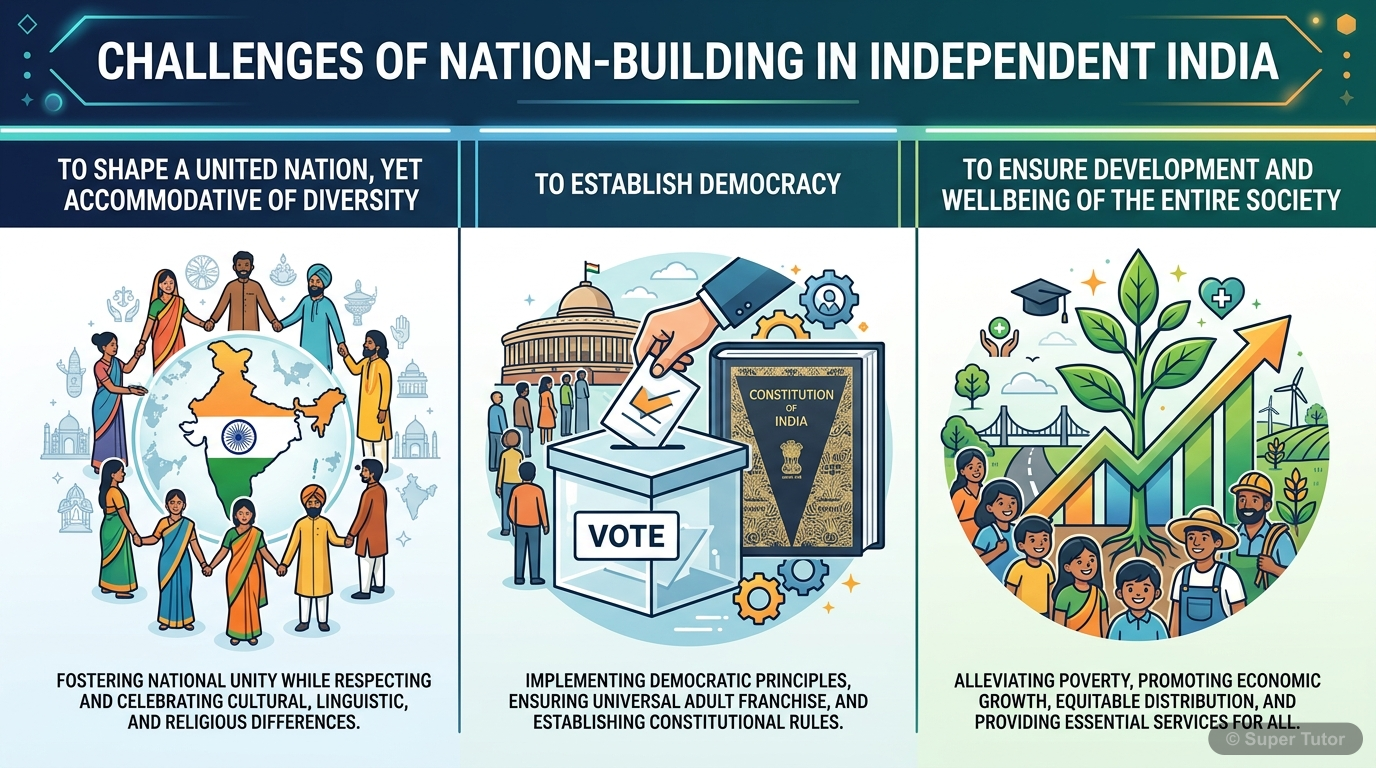
Learn better with visuals Super Tutor pairs illustrations like this with notes and quizzes for Challenges of nation building.
The first 5 solutions are open to read. The other 4 are free with a Super Tutor account.
Exercises
1Which among the following statements about the Partition is incorrect?Show solution
The incorrect statement is (d). The chapter says Partition caused a huge, unplanned transfer of population, but it was not a planned scheme. In fact, the movement of people happened through violence and compulsion, often at short notice.
2Match the principles with the instances:Show solution
The correct matching is:
- (a) Mapping of boundaries on religious grounds → (i) Pakistan and Bangladesh
- (b) Mapping of boundaries on grounds of different languages → (ii) India and Pakistan
- (c) Demarcating boundaries within a country by geographical zones → (iv) Himachal Pradesh and Uttarakhand
- (d) Demarcating boundaries within a country on administrative and political grounds → (iii) Jharkhand and Chhattisgarh
So the answer is i–a, ii–b, iii–d, iv–c.
4Here are two opinions –
Bismay: “The merger with the Indian State was an extension of democracy to the people of the Princely States.”
Inderpreet: “I am not so sure, there was force being used. Democracy comes by creating consensus.”
What is your own opinion in the light of accession of Princely States and the responses of the people in these parts?Show solution
मेरी राय में दोनों पक्षों में सच्चाई है। रियासतों का भारतीय संघ में विलय देश की एकता और लोकतंत्र की दिशा में एक जरूरी कदम था, क्योंकि अधिकतर रियासतों की जनता भारत में शामिल होना चाहती थी और वहाँ गैर-लोकतांत्रिक शासन था। इस दृष्टि से विलय लोकतंत्र का विस्तार था।
लेकिन यह भी सच है कि कुछ रियासतों, जैसे हैदराबाद और मणिपुर, के मामले में सरकार को कड़ा रुख अपनाना पड़ा और कहीं-कहीं बल का भी प्रयोग हुआ। इसलिए इसे पूरी तरह केवल स्वैच्छिक और सहमति-आधारित प्रक्रिया नहीं कहा जा सकता।
इसलिए मेरा निष्कर्ष है कि रियासतों का भारत में विलय आवश्यक और कुल मिलाकर लोकतांत्रिक था, लेकिन यह प्रक्रिया पूरी तरह शांतिपूर्ण या सर्वसम्मति से नहीं हुई।
5Read the following very different statements made in August 1947 –
“Today you have worn on your heads a crown of thorns. The seat of power is a nasty thing. You have to remain ever wakeful on that seat... you have to be more humble and forbearing...now there will be no end to your being tested.” — M.K GANDHI
“...India will awake to a life of freedom...we step out from the old to the new...we end today a period of ill fortune and India discovers herself again. The achievement we celebrate today is but a step, an opening of opportunity...” — JAWAHARLAL NEHRU
Spell out the agenda of nation building that flows from these two statements. Which one appeals more to you and why?Show solution
इन दोनों कथनों से राष्ट्र-निर्माण का एक व्यापक कार्यक्रम निकलता है।
गांधीजी के कथन से यह संदेश मिलता है कि सत्ता पाना ही पर्याप्त नहीं है। नए नेताओं को नैतिकता, विनम्रता, सतर्कता, सहिष्णुता और जन-सेवा के साथ काम करना होगा। राष्ट्र-निर्माण का अर्थ है लोगों में एकता, साम्प्रदायिक सद्भाव, और त्याग की भावना विकसित करना।
नेहरू के कथन से यह कार्यक्रम निकलता है कि स्वतंत्रता को केवल उत्सव की तरह नहीं, बल्कि अवसर की तरह लेना है। देश को आधुनिक, लोकतांत्रिक, प्रगतिशील और न्यायपूर्ण बनाना है। इसके लिए जनता के जीवन में सुधार, विकास, समानता और नई शुरुआत आवश्यक है।
मुझे नेहरू का दृष्टिकोण अधिक आकर्षक लगता है, क्योंकि वह भविष्य-उन्मुख है और देश को आगे बढ़ाने, नई संभावनाएँ खोलने और विकास करने की बात करता है।
6What are the reasons being used by Nehru for keeping India secular? Do you think these reasons were only ethical and sentimental? Or were there some prudential reasons as well?Show solution
नेहरू भारत को धर्मनिरपेक्ष इसलिए रखना चाहते थे क्योंकि भारत में अनेक धर्मों के लोग रहते थे और किसी एक धर्म को दूसरे पर श्रेष्ठ नहीं बनाया जा सकता था। उनके अनुसार:
- सभी नागरिक धर्म के आधार पर समान होने चाहिए।
- किसी धर्म या आस्था को नागरिकता की कसौटी नहीं बनाया जाना चाहिए।
- भारत को ऐसा देश होना चाहिए जहाँ सभी धर्मों के लोग सुरक्षित महसूस करें।
ये कारण केवल नैतिक और भावनात्मक नहीं थे। इनके साथ व्यावहारिक या prudential कारण भी थे:
- विभाजन के बाद सांप्रदायिक तनाव बहुत अधिक था, इसलिए धर्मनिरपेक्षता शांति बनाए रखने के लिए जरूरी थी।
- भारत में मुस्लिम और अन्य अल्पसंख्यक बड़ी संख्या में थे; उन्हें सुरक्षा और समान अधिकार देना आवश्यक था।
- यदि राज्य किसी एक धर्म का पक्ष लेता, तो राष्ट्रीय एकता को खतरा हो सकता था।
इसलिए धर्मनिरपेक्षता नैतिक आदर्श भी थी और देश की एकता व स्थिरता के लिए व्यावहारिक आवश्यकता भी।
Free with a Super Tutor account
Free with a Super Tutor account
Free with a Super Tutor account
“In the history of nation-building only the Soviet experiment bears comparison with the Indian. There too, a sense of unity had to be forged between many diverse ethnic groups, religious, linguistic communities and social classes. The scale – geographic as well as demographic – was comparably massive. The raw material the state had to work with was equally unpropitious: a people divided by faith and driven by debt and disease.” — RAMACHANDRA GUHA
Free with a Super Tutor account
4 more solved questions in Challenges of nation building
They are free with a Super Tutor account, along with practice quizzes and flashcards for this chapter. Free to start, no card needed.
Frequently Asked Questions
What are the important topics in Challenges of nation building for Madhya Pradesh Board Class 12 Political Science?
Are these NCERT Solutions for Challenges of nation building free?
How should I revise Challenges of nation building for the Madhya Pradesh Board Class 12 board exam?
Sources & Official References
Content is aligned to the official syllabus. Refer to the board website for the latest curriculum.
More resources for Challenges of nation building
Practice Quiz
Test yourself with a quick quiz
Important Questions
Exam-style questions with answers
Revision Notes
Key points for last-minute revision
Chapter Summary
Understand the chapter at a glance
Concept Maps
See how topics connect
Study Plan
Step-by-step plan for this chapter
Flashcards
Quick-fire cards for active recall
Syllabus
What topics to cover
For serious students
Get the full Challenges of nation building chapter — start free.
Quizzes, flashcards, an AI doubt solver and a study plan for Madhya Pradesh Board Class 12 Political Science. Free to start, no card needed.