The Constitution and Social Change — Chapter Summary
Madhya Pradesh Board · Class 12 · Sociology
Summary of The Constitution and Social Change for Madhya Pradesh Board Class 12 Sociology. Part of the Madhya Pradesh Board Class 12 Sociology syllabus.
Interactive on Super Tutor
Studying The Constitution and Social Change? Get the full interactive chapter.
Quizzes, flashcards, AI doubt-solver and a step-by-step study plan — built for chapter summary and more.
Free trial, no card needed.
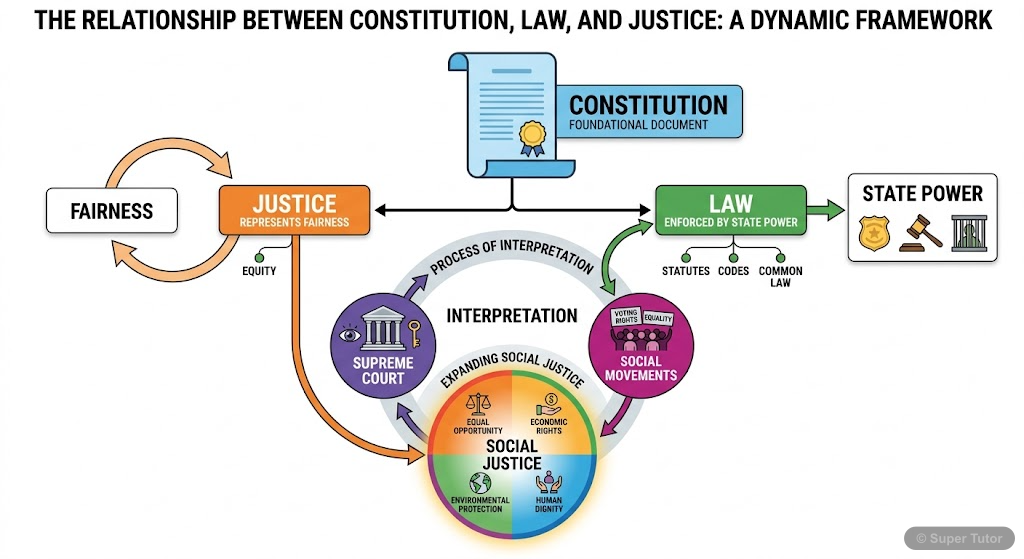
One of 11 illustrations for The Constitution and Social Change in Super Tutor — alongside flashcards, concept maps and practice questions.
Overview
The Indian Constitution acts as a foundation for social justice and democratic change. It does not only set rules for government; it also shapes how rights are understood, how local self-government works, and how social groups participate in public life. In rural India, the Constitution made Panchay
Key Concepts
The Constitution provides the basic norms
The Constitution provides the basic norms of social justice. It gives legal form to ideas of fairness, equality, and democratic participation. Social
Law has force because the state
Law has force because the state can enforce it. Justice means fairness. A legal system works through a hierarchy of authorities, and the Constitution
The Supreme Court is the highest
The Supreme Court is the highest court and the ultimate interpreter of the Constitution. It has expanded the meaning of Fundamental Rights, including
Panchayati Raj means governance by five
Panchayati Raj means governance by five individuals and represents democratic functioning at the village level. Panchayats did not originally find a m
This amendment ushered in grassroots democracy
This amendment ushered in grassroots democracy and decentralised governance. It provided a three-tier system for states with a population of over twen
Learning Objectives
- Understand how the Constitution supports social justice and democratic change
- Explain the difference between law and justice in a constitutional democracy
- Describe the role of the Supreme Court in interpreting rights and principles
- Explain the significance of the 73rd Constitutional Amendment and Panchayati Raj
- Identify the powers, reservations, and structure of Panchayati Raj Institutions
Frequently Asked Questions
What are the important topics in The Constitution and Social Change for Madhya Pradesh Board Class 12 Sociology?
How should I revise The Constitution and Social Change for the Madhya Pradesh Board Class 12 board exam?
Sources & Official References
Content is aligned to the official syllabus. Refer to the board website for the latest curriculum.
More resources for The Constitution and Social Change
Practice Quiz
Test yourself with a quick quiz
Important Questions
Exam-style questions with answers
Revision Notes
Key points for last-minute revision
Concept Maps
See how topics connect
Study Plan
Step-by-step plan for this chapter
Flashcards
Quick-fire cards for active recall
Syllabus
What topics to cover
NCERT Solutions
Every textbook question solved step by step
For serious students
Get the full The Constitution and Social Change chapter — start free.
Quizzes, flashcards, an AI doubt solver and a study plan for Madhya Pradesh Board Class 12 Sociology. Free to start, no card needed.