The Demographic Structure of the Indian Society — Chapter Summary
Madhya Pradesh Board · Class 12 · Sociology
Summary of The Demographic Structure of the Indian Society for Madhya Pradesh Board Class 12 Sociology. Demography is the systematic study of population.
Interactive on Super Tutor
Studying The Demographic Structure of the Indian Society? Get the full interactive chapter.
Quizzes, flashcards, AI doubt-solver and a step-by-step study plan — built for chapter summary and more.
Free trial, no card needed.
Learn better with visuals Super Tutor pairs illustrations like this with notes and quizzes for The Demographic Structure of the Indian Society.
Overview
Demography is the systematic study of population. It examines population size, births, deaths, migration, and the age and sex composition of people. In India, demographic patterns are important for understanding development, public policy, social change, and future needs such as education, health ca
Key Concepts
Demography is the systematic study
Demography is the systematic study of population. It studies population size, change, structure, and composition using census and survey data.
Formal demography is a largely quantitative
Formal demography is a largely quantitative field concerned with measurement and analysis of population change, with mathematical methods for forecast
Social demography focuses on the social
Social demography focuses on the social, economic, and political aspects of populations and studies the wider causes and consequences of population ch
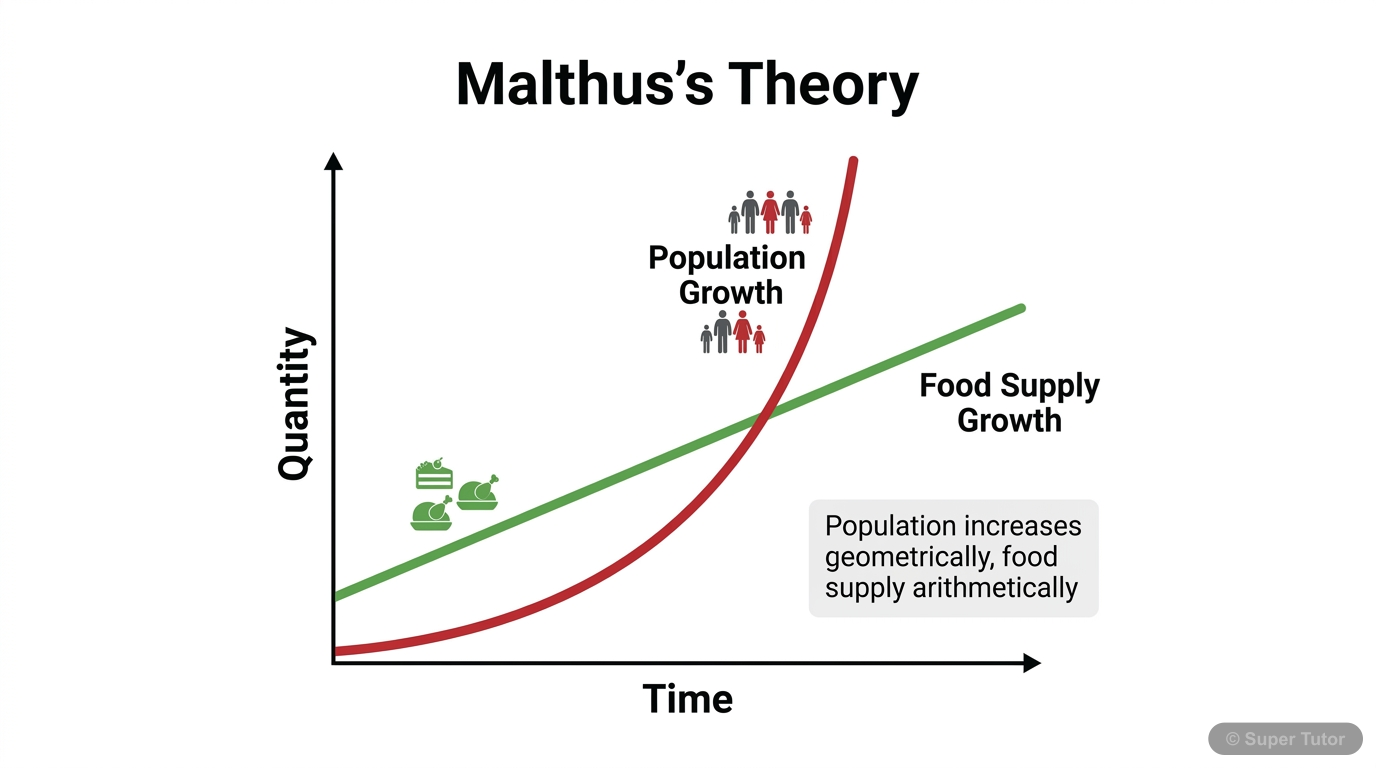
Thomas Robert Malthus argued that population
Thomas Robert Malthus argued that population grows geometrically while agricultural production grows arithmetically, so population eventually outstrip
The theory of demographic transition says
The theory of demographic transition says that population growth changes with economic development. The first stage has low growth with high birth and
Learning Objectives
- Understand the meaning and scope of demography and the difference between formal demography and social demography
- Recall the main demographic indicators such as birth rate, death rate, fertility rate, infant mortality rate, maternal mortality rate, sex ratio, and dependency ratio
- Explain the Malthusian theory of population growth and the theory of demographic transition
- Describe India’s population growth pattern from the early twentieth century to 2011
- Analyse age structure, demographic dividend, and dependency ratio in India
Frequently Asked Questions
What are the important topics in The Demographic Structure of the Indian Society for Madhya Pradesh Board Class 12 Sociology?
How should I revise The Demographic Structure of the Indian Society for the Madhya Pradesh Board Class 12 board exam?
Sources & Official References
Content is aligned to the official syllabus. Refer to the board website for the latest curriculum.
More resources for The Demographic Structure of the Indian Society
Practice Quiz
Test yourself with a quick quiz
Important Questions
Exam-style questions with answers
Revision Notes
Key points for last-minute revision
Formula Sheet
The chapter's formulas in one place
Concept Maps
See how topics connect
Study Plan
Step-by-step plan for this chapter
Flashcards
Quick-fire cards for active recall
Syllabus
What topics to cover
NCERT Solutions
Every textbook question solved step by step
For serious students
Get the full The Demographic Structure of the Indian Society chapter — start free.
Quizzes, flashcards, an AI doubt solver and a study plan for Madhya Pradesh Board Class 12 Sociology. Free to start, no card needed.