Medieval World — Flashcards
NIOS · Class 10 · Social Studies
48 flashcards for Medieval World (NIOS Class 10 Social Studies) to test yourself on key terms and facts. Sample: "What is the Medieval Period also called"
Interactive on Super Tutor
Studying Medieval World? Get the full interactive chapter.
Quizzes, flashcards, AI doubt-solver and a step-by-step study plan — built for flashcards and more.
Free trial, no card needed.
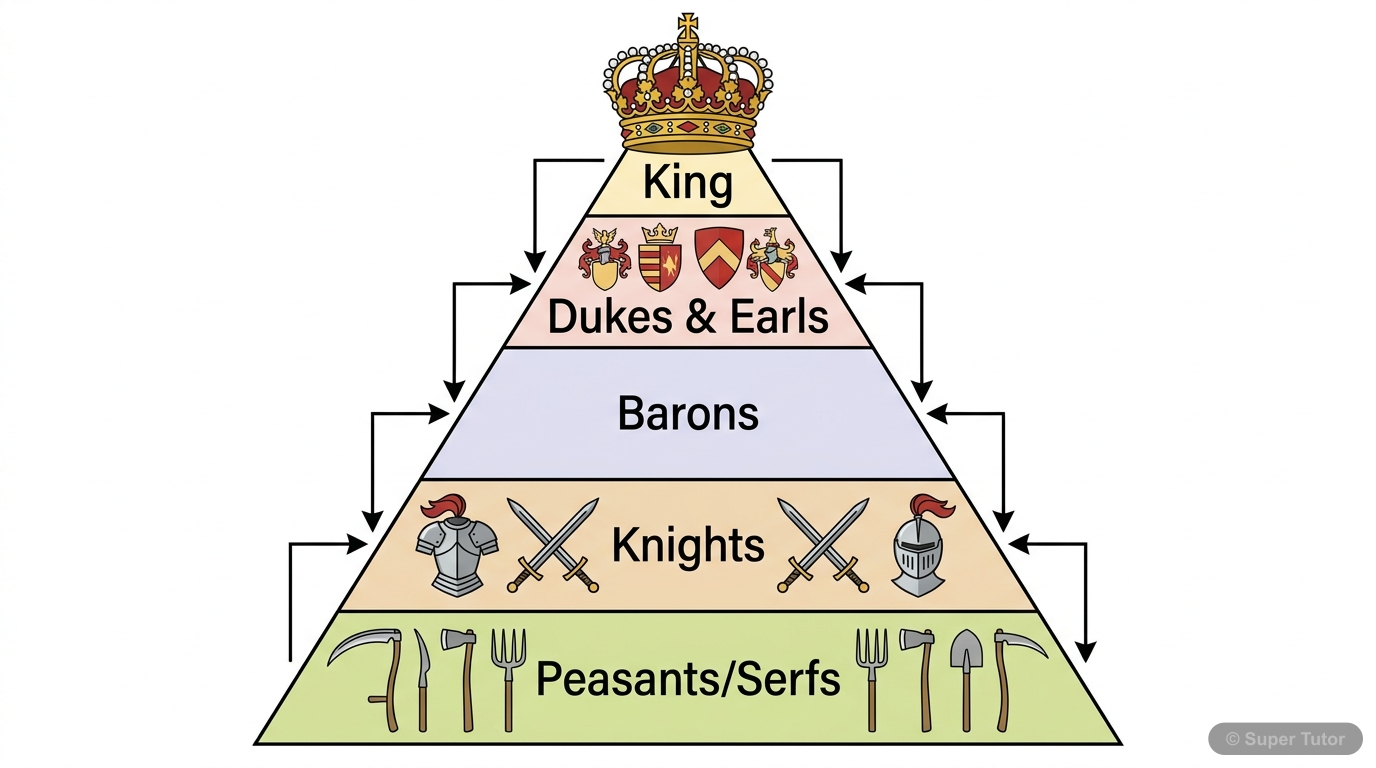
One of 9 illustrations for Medieval World in Super Tutor — alongside flashcards, concept maps and practice questions.
What is the Medieval Period also called, and why is it important?
Answer
The Medieval Period is also called the Middle Ages. It is important because it was a major stage in human history with important political, economic, social, and cultural changes in Europe, West Asia,…
Why was the term Middle Ages coined by Europeans?
Answer
The term Middle Ages was coined by Europeans in the 17th century because they saw it as a long period between the Ancient Classical Age and their own Modern Age.
What happened to the Western Roman Empire in 476 AD?
Answer
The Roman Emperor in the West was overthrown in 476 AD by Germanic tribes such as the Goths, Vandals, Visigoths, and Franks.
Who was Constantine, and what did he do in 330 AD?
Answer
Constantine was a Roman Emperor who set up the new capital of the Eastern Roman territories in Byzantine in 330 AD. The city was later named Constantinople after him.
What was the Byzantine Empire?
Answer
The Byzantine Empire was the Eastern Roman Empire that continued to exist for almost a thousand years after the Western Roman Empire collapsed in 476 AD.
What is Feudalism?
Answer
Feudalism was a hierarchical system of political, military, and economic organization in medieval Europe. Power was shared in graded levels, with the King at the top and lower lords, knights, vassals,…
Why is feudal society compared to a ladder or a flight of steps?
Answer
Feudal society is compared to a ladder because power was arranged in levels. The King stood at the top, followed by big lords, smaller lords, knights, and then the lower levels of society. Each level …
What is a vassal in the feudal system?
Answer
A vassal was a lord who owed loyalty and service to a higher lord. In return, he received protection and often land for support.
+40 more flashcards
Practise AllFrequently Asked Questions
What are the important topics in Medieval World for NIOS Class 10 Social Studies?
How many flashcards are available for Medieval World?
How should I revise Medieval World for the NIOS Class 10 board exam?
Sources & Official References
Content is aligned to the official syllabus. Refer to the board website for the latest curriculum.
More resources for Medieval World
Practice Quiz
Test yourself with a quick quiz
Important Questions
Exam-style questions with answers
Revision Notes
Key points for last-minute revision
Chapter Summary
Understand the chapter at a glance
Concept Maps
See how topics connect
Study Plan
Step-by-step plan for this chapter
Syllabus
What topics to cover
For serious students
Get the full Medieval World chapter — start free.
Quizzes, flashcards, an AI doubt solver and a study plan for NIOS Class 10 Social Studies. Free to start, no card needed.