Religious And Social Awakening In Colonial India — Flashcards
NIOS · Class 10 · Social Studies
38 flashcards for Religious And Social Awakening In Colonial India (NIOS Class 10 Social Studies) to test yourself on key terms and facts.
Interactive on Super Tutor
Studying Religious And Social Awakening In Colonial India? Get the full interactive chapter.
Quizzes, flashcards, AI doubt-solver and a step-by-step study plan — built for flashcards and more.
Free trial, no card needed.
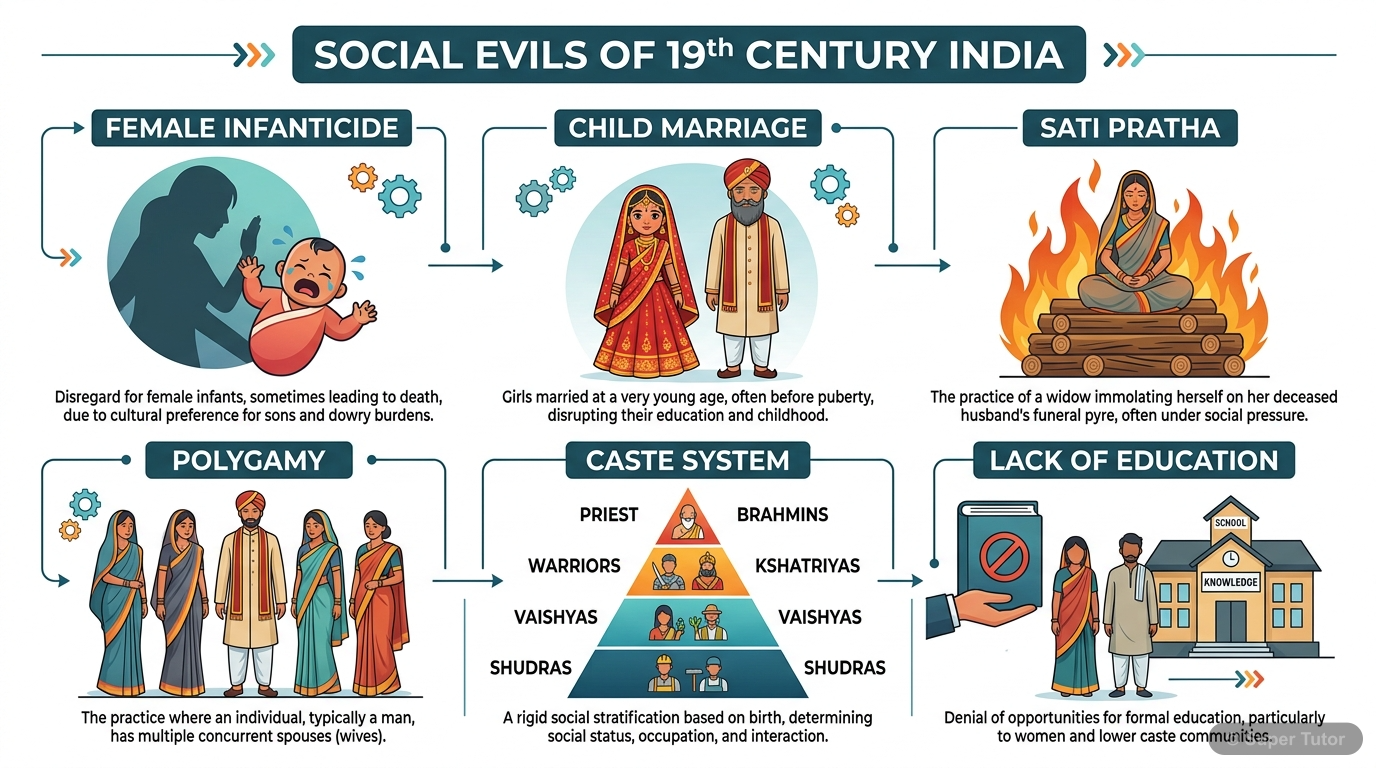
One of 4 illustrations for Religious And Social Awakening In Colonial India in Super Tutor — alongside flashcards, concept maps and practice questions.
Why did socio-religious reform movements begin in colonial India?
Answer
They began because Indian society faced serious problems such as lack of education, rigid caste practices, child marriage, sati, polygamy, and the poor condition of women. Reformers wanted a more rati…
What was the condition of education in early 19th century India?
Answer
Education was limited to a very small number of people, mainly upper-caste men. Most people were illiterate, and girls were often denied education. This lack of education helped social ignorance and b…
What is sati pratha?
Answer
Sati pratha was a social practice in which a widowed woman was forced to burn herself on her husband's funeral pyre. It was a cruel practice against women and was later made illegal.
What is polygamy in the social context of colonial India?
Answer
Polygamy means a man having more than one wife. It was an accepted norm among many castes and religions in that period, and reformers worked against it because it harmed women’s status.
How did the caste system change over time?
Answer
The caste system was originally based on occupation, but later it became hereditary. This made social mobility very difficult and created inequality and exploitation, especially for lower castes.
What is the Varna system?
Answer
The Varna system divided Hindu society into four categories: Brahmin, Kshatriya, Vaishya, and Shudra. It was originally linked to occupation, but later became rigid and hereditary.
Why did reformers oppose untouchability and caste rigidity?
Answer
They saw these practices as irrational, unscientific, and against human dignity. Such practices blocked equality, social progress, and the development of a healthy democratic society.
Who founded Brahmo Samaj and what was its main reform role?
Answer
Raja Ram Mohan Roy founded Brahmo Samaj in 1828. It worked for religious reform, opposed sati and idol worship, supported monotheism, and promoted modern education and social reform.
+30 more flashcards
Practise AllFrequently Asked Questions
What are the important topics in Religious And Social Awakening In Colonial India for NIOS Class 10 Social Studies?
How many flashcards are available for Religious And Social Awakening In Colonial India?
How should I revise Religious And Social Awakening In Colonial India for the NIOS Class 10 board exam?
Sources & Official References
Content is aligned to the official syllabus. Refer to the board website for the latest curriculum.
More resources for Religious And Social Awakening In Colonial India
Practice Quiz
Test yourself with a quick quiz
Important Questions
Exam-style questions with answers
Revision Notes
Key points for last-minute revision
Chapter Summary
Understand the chapter at a glance
Concept Maps
See how topics connect
Study Plan
Step-by-step plan for this chapter
Syllabus
What topics to cover
For serious students
Get the full Religious And Social Awakening In Colonial India chapter — start free.
Quizzes, flashcards, an AI doubt solver and a study plan for NIOS Class 10 Social Studies. Free to start, no card needed.