Physiography Of India — Flashcards
NIOS · Class 10 · Social Studies
44 flashcards for Physiography Of India (NIOS Class 10 Social Studies) to test yourself on key terms and facts.
Interactive on Super Tutor
Studying Physiography Of India? Get the full interactive chapter.
Quizzes, flashcards, AI doubt-solver and a step-by-step study plan — built for flashcards and more.
Free trial, no card needed.
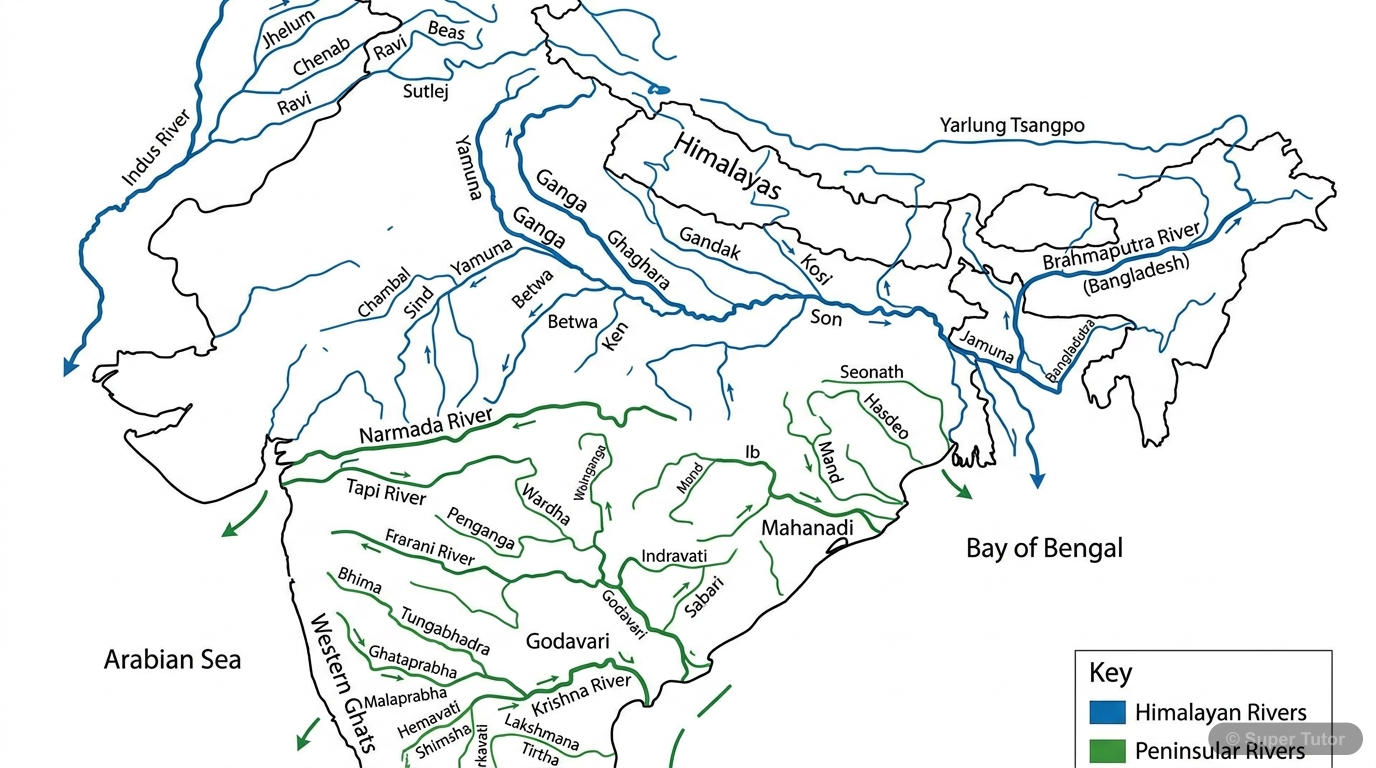
Learn better with visuals Super Tutor pairs illustrations like this with notes and quizzes for Physiography Of India.
What is the absolute location of the Indian mainland?
Answer
The Indian mainland extends between 8°4′N and 37°6′N latitudes and 68°7′E and 97°25′E longitudes. This gives India a wide north-south and east-west spread.
What is meant by absolute location and relative location?
Answer
Absolute location is given by latitude and longitude. Relative location is described in relation to other places, such as north of, south of, near, or across from.
Why is the location of a country important?
Answer
A country’s location affects its climate, vegetation, agriculture, resources, and even the way people live. It also shapes trade links and the country’s importance in the world.
Where does the Tropic of Cancer pass in India?
Answer
The Tropic of Cancer passes through the centre of the country at 23°30′N. It divides India into almost two equal parts, with North India to the north and South India to the south.
What is the Standard Meridian of India and why was it chosen?
Answer
The Standard Meridian of India is 82°30′E, which passes through Mirzapur in Uttar Pradesh. It was chosen because there is a time lag of almost two hours between Gujarat and Arunachal Pradesh, so a cen…
State two key facts about India’s size in the world.
Answer
India is the seventh largest country in the world. It has land boundaries of 15,200 km and a coastline of 7516.6 km.
What is the difference between a state and a union territory?
Answer
A state has its own government, while a union territory is directly governed by the central administration. India has 28 states and 8 union territories.
Which capitals are specially noted in India’s political geography?
Answer
New Delhi is the capital of India, while Delhi is the capital of Union Territory Delhi. Chandigarh is the capital of Punjab, the capital of Haryana, and also a Union Territory.
+36 more flashcards
Practise AllFrequently Asked Questions
What are the important topics in Physiography Of India for NIOS Class 10 Social Studies?
How many flashcards are available for Physiography Of India?
How should I revise Physiography Of India for the NIOS Class 10 board exam?
Sources & Official References
Content is aligned to the official syllabus. Refer to the board website for the latest curriculum.
More resources for Physiography Of India
Practice Quiz
Test yourself with a quick quiz
Important Questions
Exam-style questions with answers
Revision Notes
Key points for last-minute revision
Chapter Summary
Understand the chapter at a glance
Concept Maps
See how topics connect
Study Plan
Step-by-step plan for this chapter
Syllabus
What topics to cover
For serious students
Get the full Physiography Of India chapter — start free.
Quizzes, flashcards, an AI doubt solver and a study plan for NIOS Class 10 Social Studies. Free to start, no card needed.