Medieval World — Practice Quiz
NIOS · Class 10 · Social Studies
Try a 4-question quiz on Medieval World for NIOS Class 10 Social Studies: tap an answer to check it and see why. 88 questions in the full chapter test.
Interactive on Super Tutor
Studying Medieval World? Get the full interactive chapter.
Quizzes, flashcards, AI doubt-solver and a step-by-step study plan — built for practice quiz and more.
Free trial, no card needed.
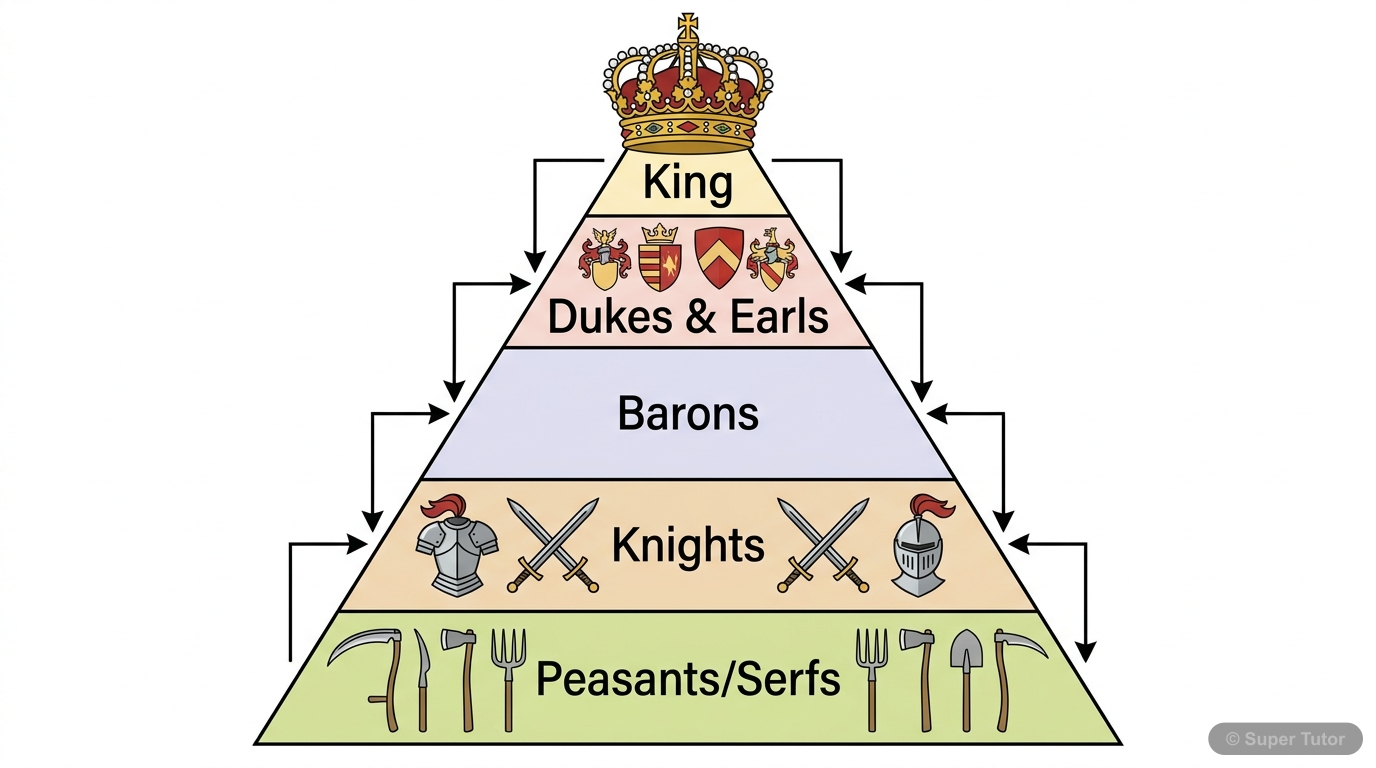
One of 9 illustrations for Medieval World in Super Tutor — alongside flashcards, concept maps and practice questions.
Quick Quiz: Medieval World
0/4Tap an answer to check it instantly. No sign-up needed for these 4.
What was the capital of the Eastern Roman Empire established by Emperor Constantine?
Which system of political and social organization dominated medieval Europe after the fall of Rome?
What were the dependent peasants of medieval Europe called?
In which year was Prophet Muhammad born?
Sample Questions
What does the word 'Islam' mean?
Show answer
Absolute submission to God
Step 1: Islam is derived from an Arabic word that has a specific meaning. Step 2: The word 'Islam' literally means absolute submission to God and adherence to faith. Step 3: This submission is complete and involves following God's commandments. Step 4: While peace, brotherhood, and salvation are important concepts in Islam, they are not the literal meaning of the word 'Islam'. Step 5: The followers of Islam are called Muslims, meaning 'those who submit to God'.
Which number system did the Arabs bring together with Greek geometry?
Show answer
Indian number system
Step 1: Arabs made significant contributions to mathematics by synthesizing existing knowledge. Step 2: They combined the geometry developed by the Greeks with the number system from India. Step 3: The Indian number system included the concept of zero and decimal notation. Step 4: This synthesis allowed Arabs to make great progress in arithmetic, geometry, and trigonometry. Step 5: The Indian numerals spread so widely through Arab influence that the West called them 'Arabic numerals', though they originated in India.
After Harsha's rule, which three major kingdoms struggled for supremacy in Northern India?
Show answer
Palas, Pratiharas, Rashtrakutas
Step 1: After King Harshavardhana's reign ended, India entered a period of political decentralization. Step 2: Between the 8th and 10th centuries, several kingdoms competed for supremacy. Step 3: The three major kingdoms in Northern India were the Palas, Pratiharas, and Rashtrakutas. Step 4: Cholas, Pandyas, and Cheras were South Indian kingdoms. Step 5: Guptas and Mauryas were earlier ancient empires, while Mughals and Sultans came later in the medieval period.
What were the territorial units assigned to military commanders in the Delhi Sultanate called?
Show answer
Iqtas
Step 1: The Delhi Sultanate introduced new administrative innovations in land revenue system. Step 2: Military commanders were assigned territorial units called 'iqtas' for their sustenance. Step 3: These iqtas were transferable and gave control over revenues, not ownership of land. Step 4: The assignees (iqtadars) used revenue to maintain themselves and their troops. Step 5: Jagirs were similar assignments in the Mughal system, while Mansabs were ranks, and Zamindaris were later revenue collection units.
+84 more questions on Medieval World (NIOS Class 10 Social Studies)
Practise AllFrequently Asked Questions
What are the important topics in Medieval World for NIOS Class 10 Social Studies?
How many practice questions are there for Medieval World?
Sources & Official References
Content is aligned to the official syllabus. Refer to the board website for the latest curriculum.
More resources for Medieval World
Important Questions
Exam-style questions with answers
Revision Notes
Key points for last-minute revision
Chapter Summary
Understand the chapter at a glance
Concept Maps
See how topics connect
Study Plan
Step-by-step plan for this chapter
Flashcards
Quick-fire cards for active recall
Syllabus
What topics to cover
For serious students
Get the full Medieval World chapter — start free.
Quizzes, flashcards, an AI doubt solver and a study plan for NIOS Class 10 Social Studies. Free to start, no card needed.