Physiography Of India — Practice Quiz
NIOS · Class 10 · Social Studies
Try a 4-question quiz on Physiography Of India for NIOS Class 10 Social Studies: tap an answer to check it and see why.
Interactive on Super Tutor
Studying Physiography Of India? Get the full interactive chapter.
Quizzes, flashcards, AI doubt-solver and a step-by-step study plan — built for practice quiz and more.
Free trial, no card needed.
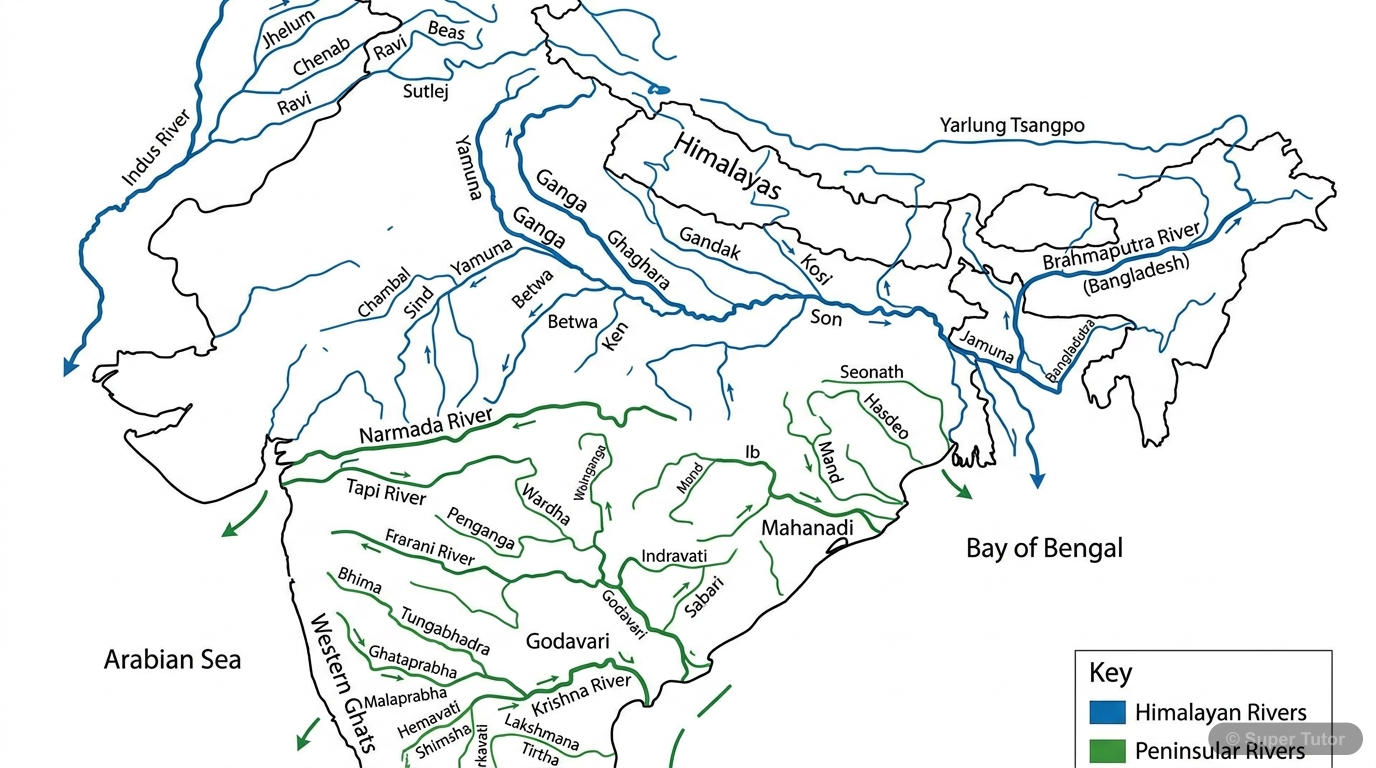
Learn better with visuals Super Tutor pairs illustrations like this with notes and quizzes for Physiography Of India.
Quick Quiz: Physiography Of India
0/4Tap an answer to check it instantly. No sign-up needed for these 4.
What is the latitudinal extent of mainland India?
Which longitude serves as the Standard Meridian of India?
How many states and union territories does India have currently?
Which is the highest peak in the Indian Himalayas?
Sample Questions
The Northern Plains are formed by the deposition of which river systems?
Show answer
Indus, Ganga, and Brahmaputra
The Northern Plains are formed by the deposition of sediments from Indus, Ganga, and Brahmaputra river systems. Step 1: These three major river systems originate from the Himalayas and carry huge amounts of sediments. Step 2: Over millions of years, these rivers deposited alluvial soil creating the fertile Northern Plains. Step 3: The Indus system forms the western plain, while Ganga-Brahmaputra system forms the eastern plain. Step 4: This alluvial deposition makes the region one of the most fertile areas in the world. Other options include peninsular rivers which don't contribute to Northern
Which river divides the Peninsular Plateau into two parts?
Show answer
Narmada
The Narmada river divides the Peninsular Plateau into two parts. Step 1: The Narmada flows east to west through central India. Step 2: It separates the Central Highlands in the north from the Deccan Plateau in the south. Step 3: The river flows between the Vindhya and Satpura mountain ranges. Step 4: This division creates distinct geographical and geological regions with different characteristics. Godavari, Krishna, and Kaveri are major peninsular rivers but they don't divide the plateau into major parts.
The Thar Desert is also known as:
Show answer
The Great Indian Desert
The Thar Desert is also known as the Great Indian Desert. Step 1: It is located in western India, mainly in Rajasthan and parts of Gujarat. Step 2: It is the ninth largest desert in the world by area. Step 3: The desert experiences arid and semi-arid climate conditions with very low rainfall (less than 150mm annually). Step 4: The name 'Great Indian Desert' reflects its significance as India's largest desert region. While it's located in Rajasthan, 'Rajasthan Desert' is not its official alternate name.
Which coastal plain is wider?
Show answer
Eastern Coastal Plain
The Eastern Coastal Plain is wider than the Western Coastal Plain. Step 1: The Eastern Coastal Plain has an average width of about 120 km along the Bay of Bengal. Step 2: The Western Coastal Plain is much narrower, only 10-20 km wide along the Arabian Sea. Step 3: This difference is due to the geological structure and the proximity of Western Ghats to the western coast. Step 4: The wider eastern plain allows for larger river deltas and more extensive agricultural activities. The Western Coastal Plain is constrained by the nearby Western Ghats mountain range.
+77 more questions on Physiography Of India (NIOS Class 10 Social Studies)
Practise AllFrequently Asked Questions
What are the important topics in Physiography Of India for NIOS Class 10 Social Studies?
How many practice questions are there for Physiography Of India?
Sources & Official References
Content is aligned to the official syllabus. Refer to the board website for the latest curriculum.
More resources for Physiography Of India
Important Questions
Exam-style questions with answers
Revision Notes
Key points for last-minute revision
Chapter Summary
Understand the chapter at a glance
Concept Maps
See how topics connect
Study Plan
Step-by-step plan for this chapter
Flashcards
Quick-fire cards for active recall
Syllabus
What topics to cover
For serious students
Get the full Physiography Of India chapter — start free.
Quizzes, flashcards, an AI doubt solver and a study plan for NIOS Class 10 Social Studies. Free to start, no card needed.