India – A Welfare State — Syllabus
NIOS · Class 10 · Social Studies
What India – A Welfare State covers in NIOS Class 10 Social Studies: 4 topics, for the 2026-27 session. Part of the NIOS Class 10 Social Studies syllabus.
Interactive on Super Tutor
Studying India – A Welfare State? Get the full interactive chapter.
Quizzes, flashcards, AI doubt-solver and a step-by-step study plan — built for syllabus and more.
Free trial, no card needed.
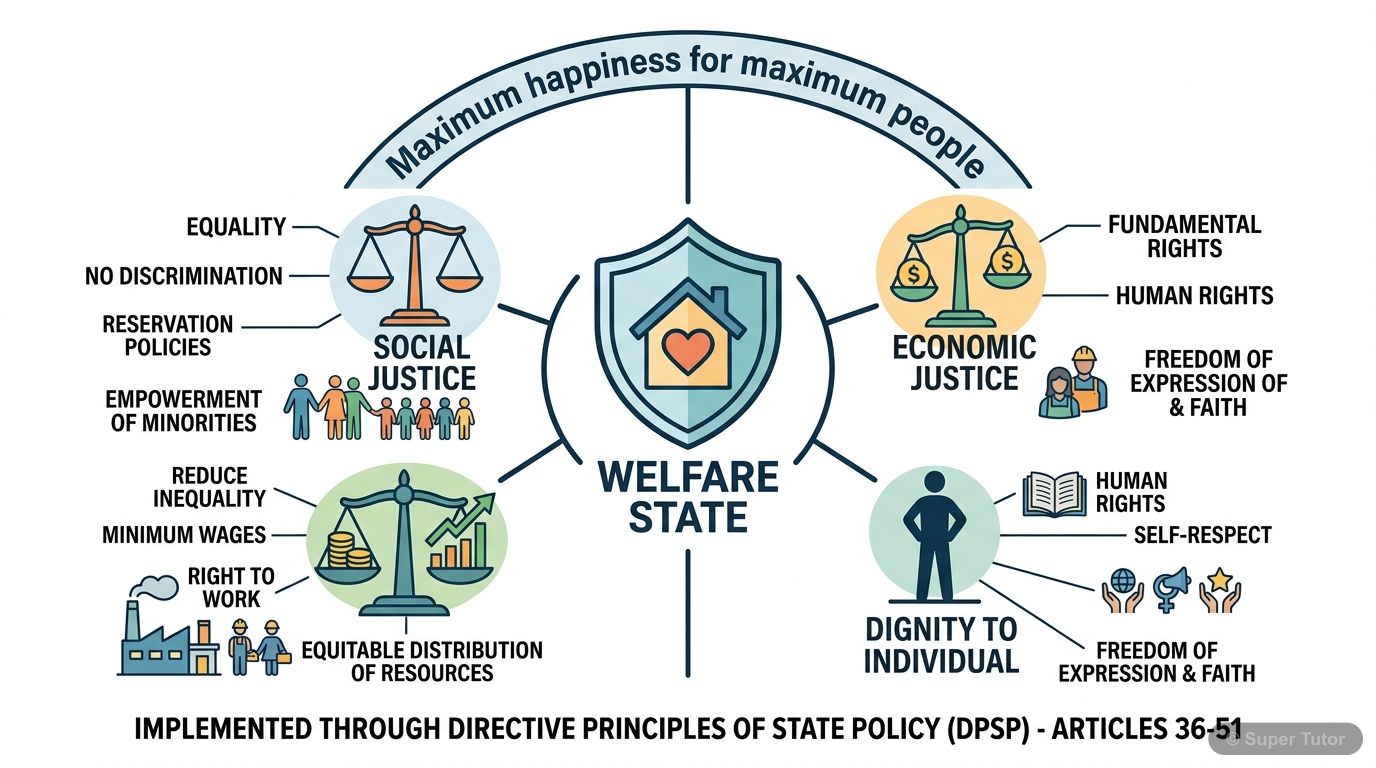
One of 2 illustrations for India – A Welfare State in Super Tutor — alongside flashcards, concept maps and practice questions.
Topics in India – A Welfare State
1. Meaning of a Welfare State
- A welfare state is a concept of government in which the state plays a key role in the protection and promotion of economic and social well-being of its citizens.
- It is based on equality of opportunity and equitable distribution of wealth.
- It also includes public responsibility for those who cannot manage the minimum needs of a good life.
2. Directive Principles of State Policy
- Two specific constitutional provisions ensure social and economic welfare: Fundamental Rights and Directive Principles.
- Fundamental Rights are primarily political rights.
- Economic and social rights were not included as Fundamental Rights because the Indian state would have failed to enforce them due to its limitations.
3. Classification of Directive Principles
- The Constitution does not classify Directive Principles under different heads; the classification is only for better understanding.
- The four broad categories are: principles promoting social and economic equality, principles related to Gandhian thought, principles related to international peace and security, and miscellaneous prin
- Principles promoting social and economic equality include: adequate means of livelihood, fair distribution of resources, preventing concentration of wealth, equal pay for equal work, compulsory and fr
4. Directive Principles and Fundamental Rights
- Directive Principles aim at establishing a welfare state, and Fundamental Rights also support this aim.
- Fundamental Rights are justiciable and enforceable, unlike Directive Principles.
- Fundamental Rights are protected by the Supreme Court and High Courts.
Key Concepts
Central concept: India as a welfare state through Constitutional provisions, Directive Principles, and welfare implementation
Work through every topic in India – A Welfare State with notes and quizzes
Start This ChapterFrequently Asked Questions
What are the important topics in India – A Welfare State for NIOS Class 10 Social Studies?
How should I revise India – A Welfare State for the NIOS Class 10 board exam?
Sources & Official References
Content is aligned to the official syllabus. Refer to the board website for the latest curriculum.
More resources for India – A Welfare State
Practice Quiz
Test yourself with a quick quiz
Important Questions
Exam-style questions with answers
Revision Notes
Key points for last-minute revision
Chapter Summary
Understand the chapter at a glance
Concept Maps
See how topics connect
Study Plan
Step-by-step plan for this chapter
Flashcards
Quick-fire cards for active recall
For serious students
Get the full India – A Welfare State chapter — start free.
Quizzes, flashcards, an AI doubt solver and a study plan for NIOS Class 10 Social Studies. Free to start, no card needed.