Communication Systems — Flashcards
NIOS · Class 12 · Physics
30 flashcards for Communication Systems (NIOS Class 12 Physics) to test yourself on key terms and facts. Sample: "State the three essential elements"
Interactive on Super Tutor
Studying Communication Systems? Get the full interactive chapter.
Quizzes, flashcards, AI doubt-solver and a step-by-step study plan — built for flashcards and more.
Free trial, no card needed.
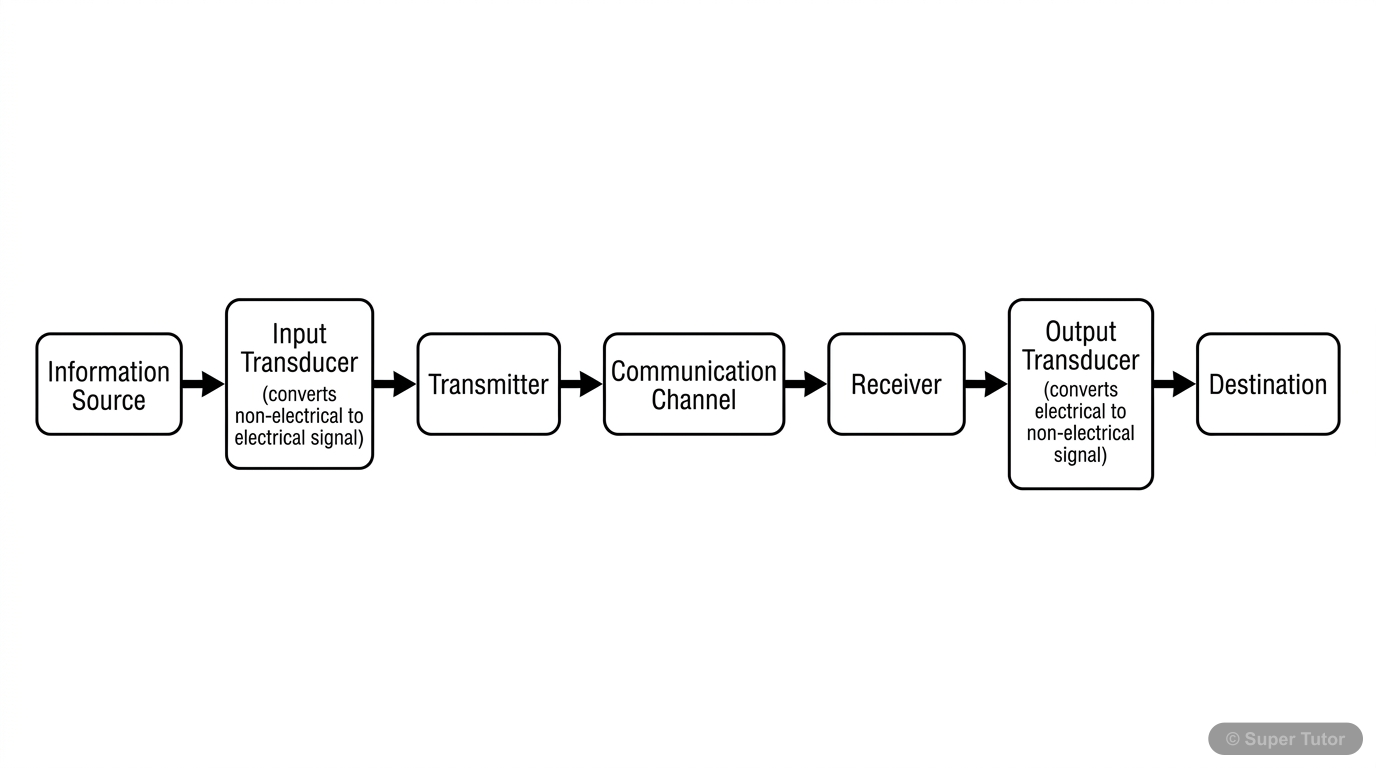
Learn better with visuals Super Tutor pairs illustrations like this with notes and quizzes for Communication Systems.
State the three essential elements of a communication system.
Answer
1. TRANSMITTER – Converts information into electrical signal and launches it. 2. MEDIUM / CHANNEL – Carries the signal over long distances (e.g., air, cable, fibre). 3. RECEIVER – Intercepts the signa…
Distinguish between Analogue and Digital signals. Give one example of each.
Answer
ANALOGUE SIGNAL: • Varies continuously with time. • Can take any value between min and max. • Example: Human speech (sound waves). DIGITAL SIGNAL: • Takes only discrete values (ON = 1, OFF = 0). • Re…
A radio wave has a frequency of 30 MHz. Calculate its wavelength in free space. (Speed of light c = 3 × 10⁸ m/s)
Answer
Given: ν = 30 MHz = 30 × 10⁶ Hz, c = 3 × 10⁸ m/s Find: Wavelength (λ) Formula: c = νλ → λ = c/ν Step 1: λ = (3 × 10⁸) / (30 × 10⁶) Step 2: λ = (3 × 10⁸) / (3 × 10⁷) Step 3: λ = 10 m Answer: λ = 10 …
What is signal bandwidth? How is it expressed differently for analogue and digital signals?
Answer
BANDWIDTH = The range of frequencies that a signal occupies. For ANALOGUE signals: • Measured in Hz (hertz) • Represents the frequency range of the signal • Example: Human speech = 200 Hz to 4000 Hz …
The VHF band covers 30 MHz to 300 MHz. Calculate the wavelength range of VHF waves in vacuum. (c = 3 × 10⁸ m/s)
Answer
Given: ν₁ = 30 MHz = 3 × 10⁷ Hz, ν₂ = 300 MHz = 3 × 10⁸ Hz Find: Wavelength range Formula: λ = c/ν For ν₁ = 30 MHz: λ₁ = (3 × 10⁸) / (3 × 10⁷) = 10 m For ν₂ = 300 MHz: λ₂ = (3 × 10⁸) / (3 × 10⁸) = …
Why is modulation necessary for long-distance signal transmission? Give TWO reasons.
Answer
Modulation is needed because low-frequency audio signals CANNOT be transmitted directly over long distances. Reasons: 1. ANTENNA SIZE PROBLEM: • Antenna size must be comparable to wavelength (λ/4). •…
State the formula for an Amplitude Modulated (AM) wave. Define the modulation index (mₐ).
Answer
AM WAVE FORMULA: v_mod(t) = V_c₀ [1 + mₐ sin(ωₐt)] sin(ωct) Where: • V_c₀ = Amplitude of carrier wave • ωc = Angular frequency of carrier • ωₐ = Angular frequency of audio (modulating) signal • mₐ = …
An AM wave has a carrier wave of amplitude 5V and the audio signal has amplitude 2V. Calculate the modulation index.
Answer
Given: V_c₀ = 5 V (carrier amplitude), V_a₀ = 2 V (audio amplitude) Find: Modulation index (mₐ) Formula: mₐ = V_a₀ / V_c₀ Step 1: mₐ = 2 / 5 Step 2: mₐ = 0.4 Answer: mₐ = 0.4 (or 40% modulation) S…
+22 more flashcards
Practise AllFrequently Asked Questions
What are the important topics in Communication Systems for NIOS Class 12 Physics?
How many flashcards are available for Communication Systems?
How should I revise Communication Systems for the NIOS Class 12 board exam?
Sources & Official References
Content is aligned to the official syllabus. Refer to the board website for the latest curriculum.
More resources for Communication Systems
Practice Quiz
Test yourself with a quick quiz
Important Questions
Exam-style questions with answers
Revision Notes
Key points for last-minute revision
Formula Sheet
The chapter's formulas in one place
Chapter Summary
Understand the chapter at a glance
Concept Maps
See how topics connect
Study Plan
Step-by-step plan for this chapter
Syllabus
What topics to cover
For serious students
Get the full Communication Systems chapter — start free.
Quizzes, flashcards, an AI doubt solver and a study plan for NIOS Class 12 Physics. Free to start, no card needed.