Communication Systems — Important Questions
NIOS · Class 12 · Physics
45 important questions from Communication Systems for NIOS Class 12 Physics, with answers. Includes multiple choice and multiple correct questions.
Interactive on Super Tutor
Studying Communication Systems? Get the full interactive chapter.
Quizzes, flashcards, AI doubt-solver and a step-by-step study plan — built for important questions and more.
Free trial, no card needed.
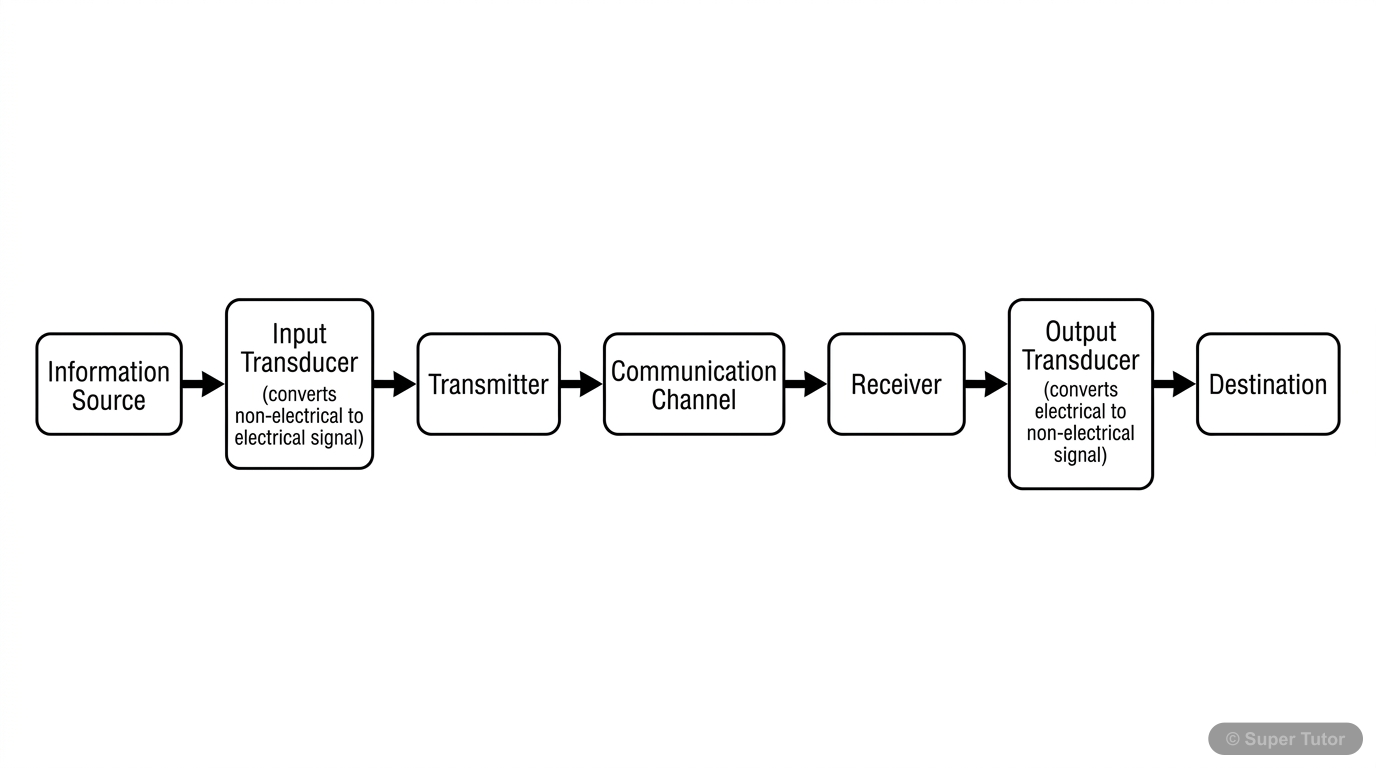
Learn better with visuals Super Tutor pairs illustrations like this with notes and quizzes for Communication Systems.
Important Questions from Communication Systems
In amplitude modulation (AM), the amplitude modulation index mₐ is defined as:
Show answer
mₐ = vao / vco
Step 1: In AM, the modulated wave is expressed as: v_mod = vco(1 + mₐ sin ωₐt) sin ωct. Step 2: The modulation index mₐ represents the ratio of the amplitude of the modulating (audio) signal to the amplitude of the carrier wave. Step 3: So mₐ = vao / vco, where vao = amplitude of audio (modulating) signal and vco = amplitude of carrier wave. Step 4: This ratio measures the 'depth' of modulation — how much the carrier amplitude is being varied by the audio signal. Step 5: If mₐ > 1, overmodulation occurs causing distortion, so mₐ ≤ 1 is desirable. The option vco/vao is the reciprocal — a common
Which of the following transmission media uses total internal reflection to guide light signals?
Show answer
Optical fibre
Step 1: Total internal reflection (TIR) occurs when light travels from a denser medium (higher refractive index n₁) to a rarer medium (lower refractive index n₂ < n₁) at an angle greater than the critical angle. Step 2: An optical fibre has a central glass core (refractive index n₁) surrounded by a cladding of slightly lower refractive index (n₂). Step 3: Light entering the core strikes the core-cladding interface at angles greater than the critical angle, and TIR keeps the light confined within the core as it travels along the fibre. Step 4: Coaxial cables use electric field confinement betwe
Sky wave propagation is used for communication in which frequency range?
Show answer
3 MHz – 30 MHz (HF)
Step 1: Recall the different modes of radio wave propagation and their associated frequency ranges. Step 2: Sky wave (ionospheric) propagation involves radio waves being launched upward, reflected by the ionosphere, and returning to distant locations on Earth. Step 3: The ionosphere (specifically the F₂ layer) reflects electromagnetic waves up to approximately 30 MHz. Waves of frequency 3–30 MHz (HF or High Frequency range, also called short waves) are ideal for this. Step 4: MF waves are absorbed by the ionosphere during daytime. VHF and UHF waves pass through the ionosphere and are not refle
In frequency modulation (FM), which parameter of the carrier wave is varied according to the modulating signal?
Show answer
Frequency
Step 1: In any modulation technique, one parameter of the high-frequency carrier wave is varied in accordance with the low-frequency modulating (audio) signal. Step 2: In Frequency Modulation (FM): the frequency of the carrier wave varies according to the instantaneous amplitude of the modulating signal, while the amplitude of the carrier wave remains constant. Step 3: When modulating signal amplitude is HIGH → carrier frequency increases. When modulating signal amplitude is LOW → carrier frequency decreases. Step 4: In contrast, Amplitude Modulation (AM) varies the amplitude, and Phase Modula
+41 more questions on Communication Systems (NIOS Class 12 Physics)
Practise AllFrequently Asked Questions
What are the important topics in Communication Systems for NIOS Class 12 Physics?
How many important questions are there in Communication Systems?
Sources & Official References
Content is aligned to the official syllabus. Refer to the board website for the latest curriculum.
More resources for Communication Systems
Practice Quiz
Test yourself with a quick quiz
Revision Notes
Key points for last-minute revision
Formula Sheet
The chapter's formulas in one place
Chapter Summary
Understand the chapter at a glance
Concept Maps
See how topics connect
Study Plan
Step-by-step plan for this chapter
Flashcards
Quick-fire cards for active recall
Syllabus
What topics to cover
For serious students
Get the full Communication Systems chapter — start free.
Quizzes, flashcards, an AI doubt solver and a study plan for NIOS Class 12 Physics. Free to start, no card needed.