Communication Systems — Syllabus
NIOS · Class 12 · Physics
What Communication Systems covers in NIOS Class 12 Physics: 4 topics, for the 2026-27 session. Part of the NIOS Class 12 Physics syllabus.
Interactive on Super Tutor
Studying Communication Systems? Get the full interactive chapter.
Quizzes, flashcards, AI doubt-solver and a step-by-step study plan — built for syllabus and more.
Free trial, no card needed.
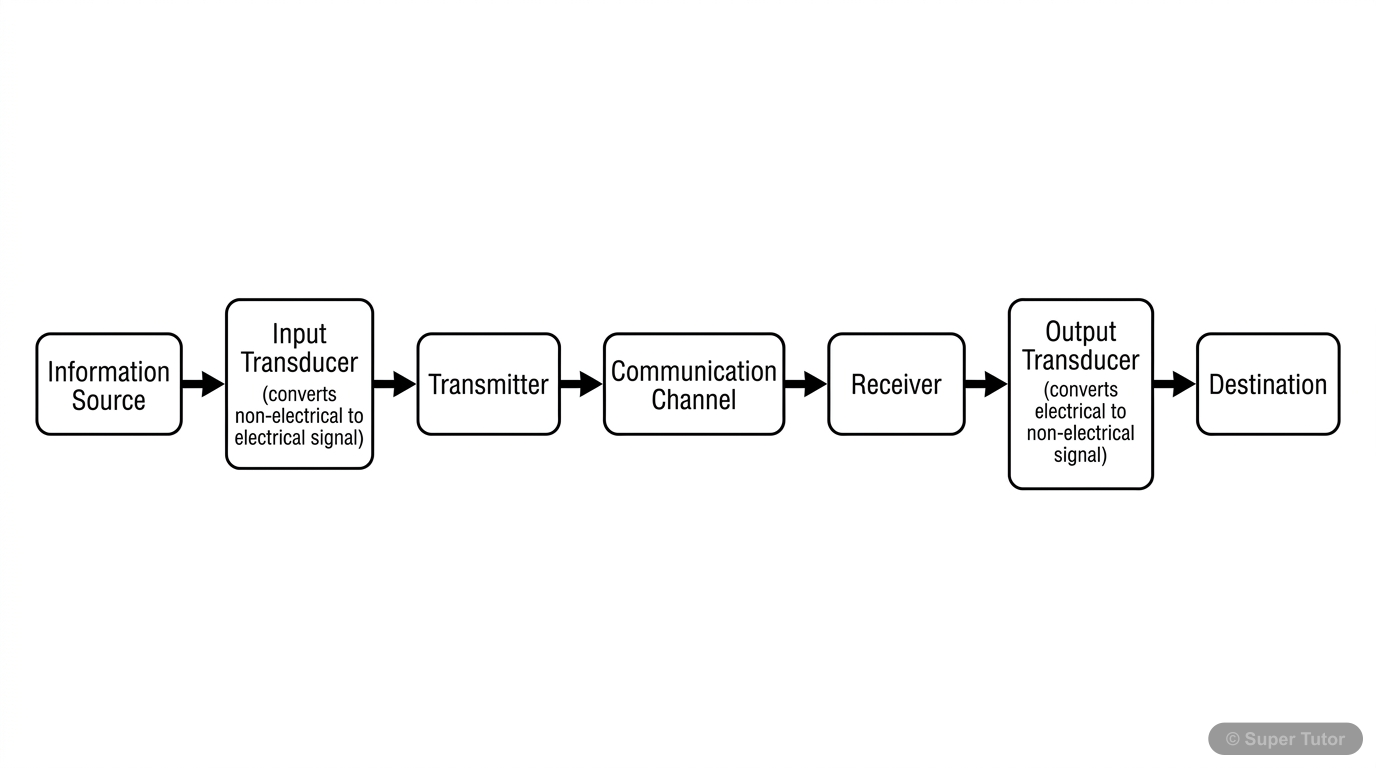
Learn better with visuals Super Tutor pairs illustrations like this with notes and quizzes for Communication Systems.
Topics in Communication Systems
Elements of a Communication System
- Every communication system has three fundamental components: Transmitter, Channel (medium), and Receiver.
- The transmitter processes and sends the signal; the channel carries it; the receiver intercepts and decodes it.
- A transducer converts one form of energy to another (e.g., microphone converts sound to electrical signal).
Analog and Digital Signals
- Analog signals vary continuously with time — they can take any value within a range (e.g., human speech, music).
- Digital signals are discrete — they exist only as specific values (0 or 1) at distinct time intervals.
- In digital format, signals are represented as a string of bits (binary digits), where each bit is either ON (1) or OFF (0).
Bandwidth of Signals and Electromagnetic Waves
- Human speech has a bandwidth of about 4 kHz (frequency range: 300 Hz to 3400 Hz for telephone).
- AM radio transmission bandwidth: approximately 10 kHz.
- FM radio transmission bandwidth: approximately 15 kHz (FM gives better quality than AM).
Radio Frequency Bands and Their Applications
- ELF (Extremely Low Frequency): < 3 kHz, wavelength > 100 km — used for mains electricity.
- VLF (Very Low Frequency): 3–30 kHz, wavelength 10–100 km — used for SONAR.
- LF (Low Frequency): 30–300 kHz, wavelength 1–10 km — marine navigation, AM Long Wave (144–351 kHz).
Key Concepts
Central concept: Communication Systems
Work through every topic in Communication Systems with notes and quizzes
Start This ChapterFrequently Asked Questions
What are the important topics in Communication Systems for NIOS Class 12 Physics?
How should I revise Communication Systems for the NIOS Class 12 board exam?
Sources & Official References
Content is aligned to the official syllabus. Refer to the board website for the latest curriculum.
More resources for Communication Systems
Practice Quiz
Test yourself with a quick quiz
Important Questions
Exam-style questions with answers
Revision Notes
Key points for last-minute revision
Formula Sheet
The chapter's formulas in one place
Chapter Summary
Understand the chapter at a glance
Concept Maps
See how topics connect
Study Plan
Step-by-step plan for this chapter
Flashcards
Quick-fire cards for active recall
For serious students
Get the full Communication Systems chapter — start free.
Quizzes, flashcards, an AI doubt solver and a study plan for NIOS Class 12 Physics. Free to start, no card needed.