Communication Systems — Study Plan
NIOS · Class 12 · Physics
A step-by-step study plan for Communication Systems, NIOS Class 12 Physics: what to learn first, what to practise and when to revise.
Interactive on Super Tutor
Studying Communication Systems? Get the full interactive chapter.
Quizzes, flashcards, AI doubt-solver and a step-by-step study plan — built for study plan and more.
Free trial, no card needed.
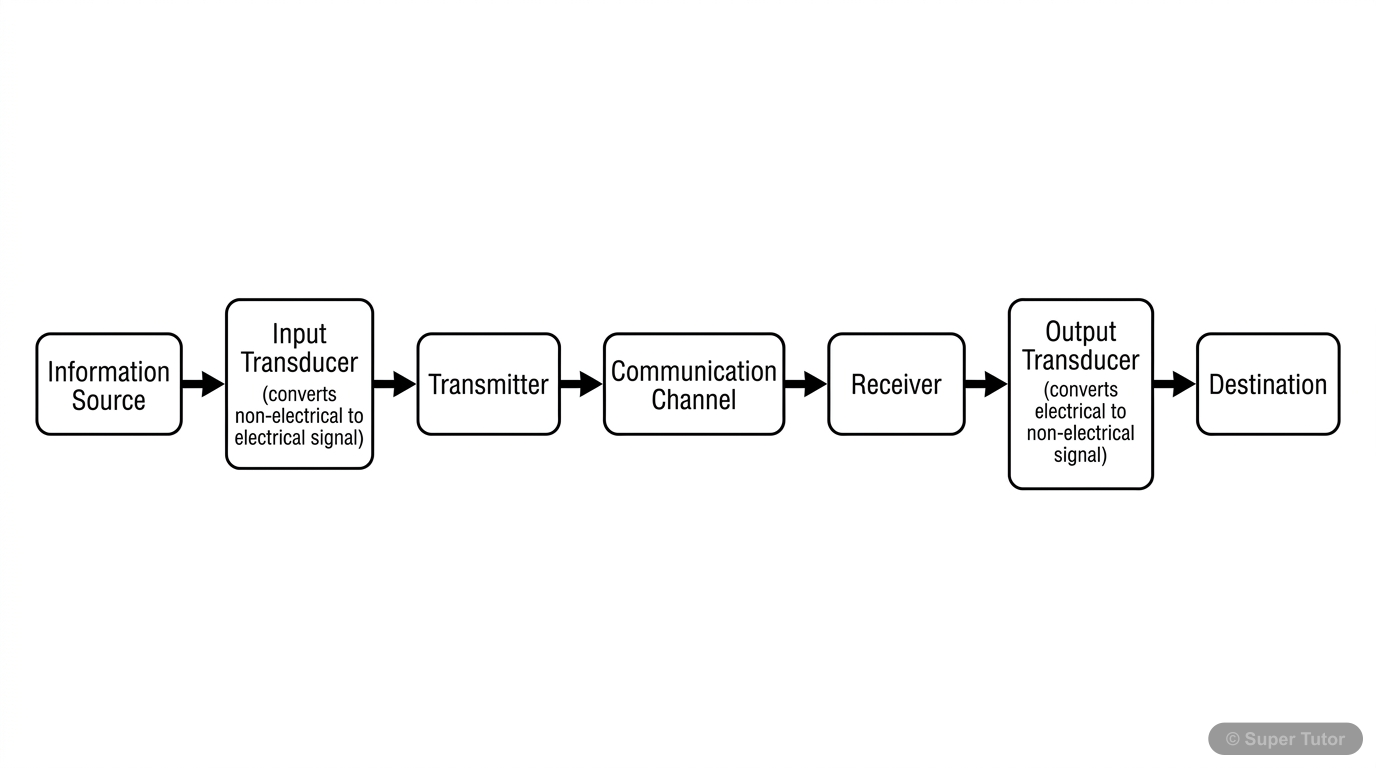
Learn better with visuals Super Tutor pairs illustrations like this with notes and quizzes for Communication Systems.
Study Plan
Learn the Theory
Read the textbook chapter carefully. Note down definitions, formulas and key ideas. Focus on: Elements of a Communication System, Analog and Digital Signals, Bandwidth of Signals and Electromagnetic Waves.
Practise
Solve the textbook exercises and extra practice questions. There are 45 questions available for this chapter.
Revise & Test
Revise key points without looking at your notes. Take a practice quiz and mark weak areas for another pass.
Spaced Revision
Come back to Communication Systems after a week. Use flashcards for quick recall and try past exam questions on this chapter.
What to Focus On
- Three essential elements: Transmitter, Channel, and Receiver
- A transducer converts one form of energy to another (e.g., microphone, loudspeaker)
- Noise is an unwanted signal that gets added during transmission and distorts the original signal
- Analogue signal: varies continuously with time, can take any value within a range
- Digital signal: takes only discrete values (0 or 1 in binary), represented as bits
- Bit: basic unit of digital information, either 0 (OFF) or 1 (ON)
- Bandwidth of analogue signal = highest frequency − lowest frequency (in Hz)
- Human speech bandwidth ≈ 4 kHz; AM radio ≈ 10 kHz; FM radio ≈ 15 kHz
- Video signal bandwidth ≈ 4.2 MHz; TV broadcast channel ≈ 6 MHz
Common Mistakes to Avoid
Any frequency can be transmitted using sky wave propagation — the ionosphere reflects all radio waves
In Amplitude Modulation, the frequency of the modulated wave changes
Modulation index (m_a) can be any value — even greater than 1 is fine
Memory Tips
Elements of a Communication System: Transmitter, Channel, Receiver
Analog vs Digital Signals
Need for Modulation — Low frequency cannot travel far; high-frequency carrier needed
Amplitude Modulation (AM) — Amplitude of carrier varies with message signal
Want a personalised study plan?
Super Tutor builds a day-by-day plan for NIOS Class 12 Physics that fits your exam date and pace.
Create My Study PlanFrequently Asked Questions
What are the important topics in Communication Systems for NIOS Class 12 Physics?
How should I revise Communication Systems for the NIOS Class 12 board exam?
Sources & Official References
Content is aligned to the official syllabus. Refer to the board website for the latest curriculum.
More resources for Communication Systems
Practice Quiz
Test yourself with a quick quiz
Important Questions
Exam-style questions with answers
Revision Notes
Key points for last-minute revision
Formula Sheet
The chapter's formulas in one place
Chapter Summary
Understand the chapter at a glance
Concept Maps
See how topics connect
Flashcards
Quick-fire cards for active recall
Syllabus
What topics to cover
For serious students
Get the full Communication Systems chapter — start free.
Quizzes, flashcards, an AI doubt solver and a study plan for NIOS Class 12 Physics. Free to start, no card needed.