Communication Systems — Chapter Summary
NIOS · Class 12 · Physics
Summary of Communication Systems for NIOS Class 12 Physics. Key concepts: Every communication system, ANALOGUE SIGNAL and Bandwidth is the range.
Interactive on Super Tutor
Studying Communication Systems? Get the full interactive chapter.
Quizzes, flashcards, AI doubt-solver and a step-by-step study plan — built for chapter summary and more.
Free trial, no card needed.
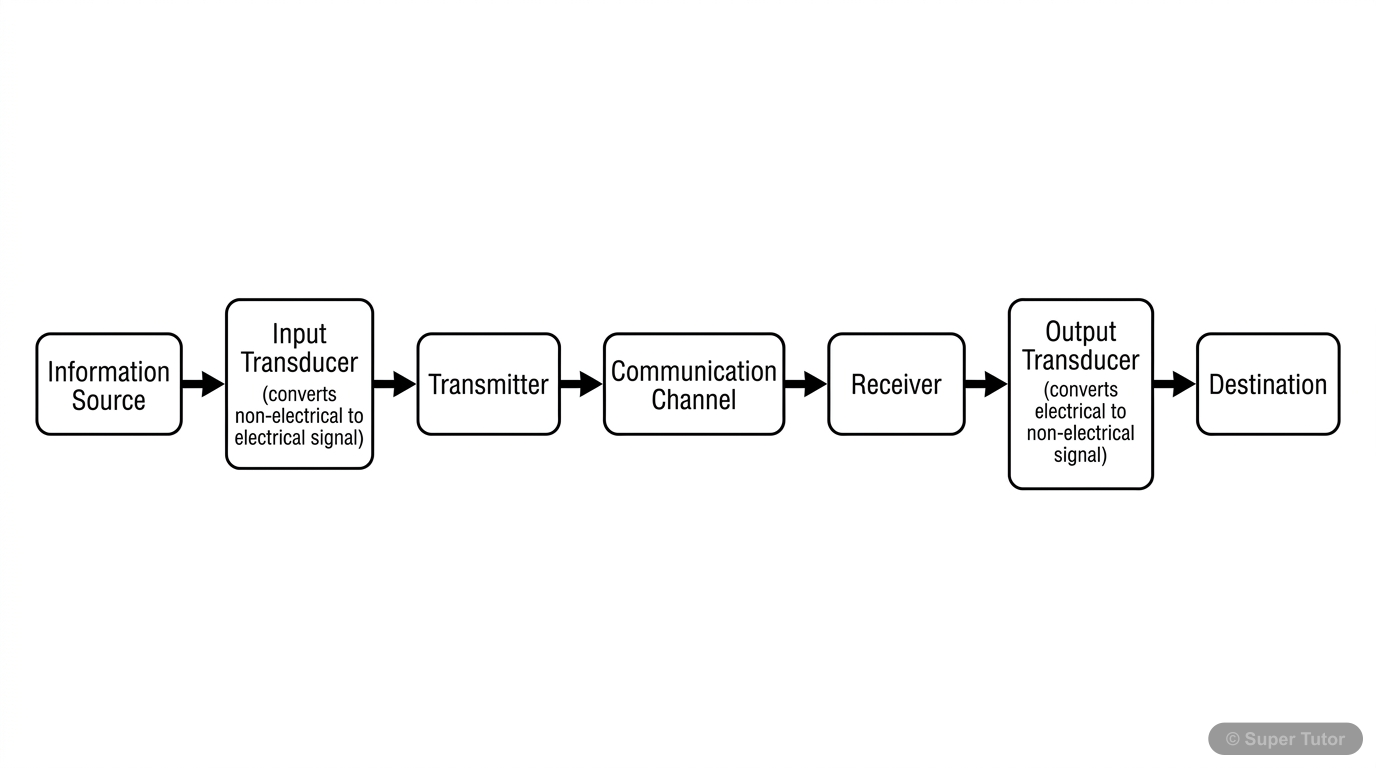
Learn better with visuals Super Tutor pairs illustrations like this with notes and quizzes for Communication Systems.
Overview
Communication Systems is one of the most fascinating chapters in Class 12 Physics because it directly connects the science you have studied — electromagnetic waves, semiconductors, and electronics — to the technology you use every day like mobile phones, radio, television, and the Internet. This cha
Key Concepts
Every communication system
Every communication system, whether a simple telephone or a complex satellite link, has three basic building blocks: 1. TRANSMITTER: Converts the inf
ANALOGUE SIGNAL
ANALOGUE SIGNAL: A signal that varies continuously with time. It can take any value between a minimum and maximum. Example: Human speech, music — the
Bandwidth is the range of frequencies
Bandwidth is the range of frequencies that a signal occupies. It is the difference between the highest and lowest frequencies in the signal. For ANAL
Electromagnetic waves are used as carriers
Electromagnetic waves are used as carriers of information in communication systems. The relationship between frequency (ν), wavelength (λ), and speed
Guided media physically connect the transmitter
Guided media physically connect the transmitter to the receiver. There are three main types: 1. TWISTED PAIR OF WIRES: - Two insulated copper wires t
Learning Objectives
- List the essential elements of a long-distance communication system (transmitter, channel, receiver)
- Distinguish between analogue and digital signals and understand the concept of bandwidth
- Explain how electromagnetic waves act as carriers of information and identify different frequency bands
- Describe the three modes of radio wave propagation: ground wave, sky wave, and space wave
- Understand the principle and working of optical fibre communication (total internal reflection)
Frequently Asked Questions
What are the important topics in Communication Systems for NIOS Class 12 Physics?
How should I revise Communication Systems for the NIOS Class 12 board exam?
Sources & Official References
Content is aligned to the official syllabus. Refer to the board website for the latest curriculum.
More resources for Communication Systems
Practice Quiz
Test yourself with a quick quiz
Important Questions
Exam-style questions with answers
Revision Notes
Key points for last-minute revision
Formula Sheet
The chapter's formulas in one place
Concept Maps
See how topics connect
Study Plan
Step-by-step plan for this chapter
Flashcards
Quick-fire cards for active recall
Syllabus
What topics to cover
For serious students
Get the full Communication Systems chapter — start free.
Quizzes, flashcards, an AI doubt solver and a study plan for NIOS Class 12 Physics. Free to start, no card needed.