Biodiversity and Conservation
CBSE · Class 12 · Biology
NCERT Solutions for Biodiversity and Conservation — CBSE Class 12 Biology.
Interactive on Super Tutor
Studying Biodiversity and Conservation? Get the full interactive chapter.
Quizzes, flashcards, AI doubt-solver and a step-by-step study plan — built for ncert solutions and more.
1,000+ Class 12 students started this chapter today
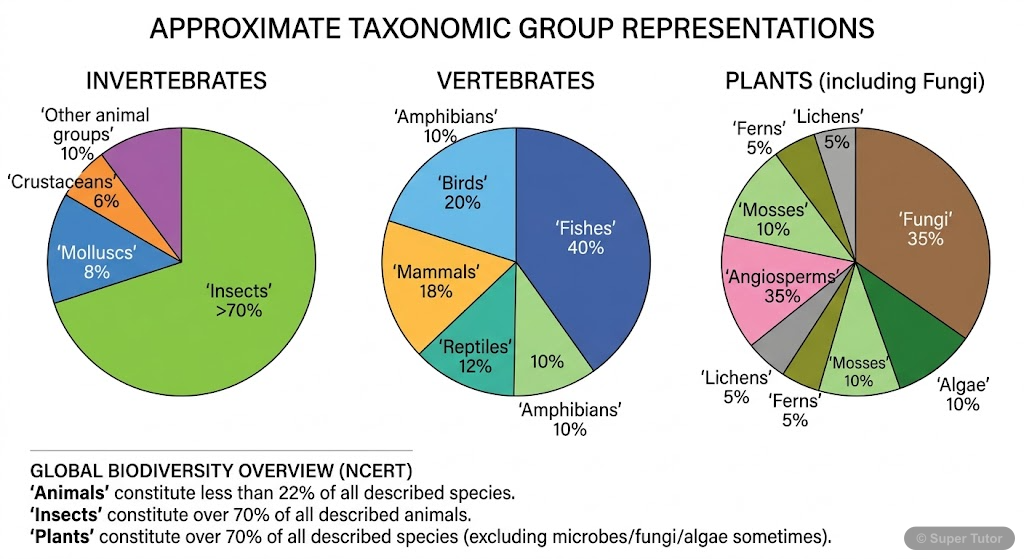
This is just one of 10+ visuals inside Super Tutor's Biodiversity and Conservation chapter
Explore the full set5 worked solutions below. Unlock all 10 free in Super Tutor
EXERCISES
1Name the three important components of biodiversity.Show solution
1. Genetic diversity
2. Species diversity
3. Ecological diversity
Not sure why a step works? check your working in Super Tutor
2How do ecologists estimate the total number of species present in the world?Show solution
Not sure why a step works? check your working in Super Tutor
3Give three hypotheses for explaining why tropics show greatest levels of species richness.Show solution
1. More evolutionary time: Tropics were not disturbed by frequent glaciations, so species had a long time to diversify.
2. More constant climate: Tropical environments are less seasonal and more predictable, which promotes niche specialisation and hence more species.
3. More solar energy: Greater solar energy leads to higher productivity, which indirectly supports greater diversity.
Not sure why a step works? check your working in Super Tutor
4What is the significance of the slope of regression in a species – area relationship?Show solution
It shows how rapidly species richness increases with area.
- For most regions and taxa, ** is 0.1 to 0.2.
- For very large areas like continents, the slope is much steeper, = 0.6 to 1.2.
A steeper slope** means species richness increases much more rapidly with increase in area.
Not sure why a step works? check your working in Super Tutor
5What are the major causes of species losses in a geographical region?Show solution
1. Habitat loss and fragmentation
2. Over-exploitation
3. Alien species invasions
4. Co-extinctions
Not sure why a step works? check your working in Super Tutor
5 more solved questions in Biodiversity and Conservation
Every remaining exercise is solved step by step in Super Tutor, plus practice quizzes and flashcards for this chapter. Free to start.
Stuck on a step?
Ask Super Tutor AI to explain any solution on this page in a simpler way — free, 24x7.
Ask a Doubt FreeFrequently Asked Questions
What are the important topics in Biodiversity and Conservation for CBSE Class 12 Biology?
How to score full marks in Biodiversity and Conservation — CBSE Class 12 Biology?
Where can I get free NCERT Solutions for Biodiversity and Conservation Class 12 Biology?
Sources & Official References
- NCERT Official — ncert.nic.in
- CBSE Academic — cbseacademic.nic.in
- CBSE Official — cbse.gov.in
- National Education Policy 2020 — education.gov.in
Content is aligned to the official syllabus. Refer to the board website for the latest curriculum.
More resources for Biodiversity and Conservation
Practice Quiz
Test yourself with a quick quiz
Important Questions
Practice with board exam-style questions
Revision Notes
Key points for last-minute revision
Formula Sheet
All formulas in one place
Chapter Summary
Understand the chapter at a glance
Concept Maps
See how topics connect visually
Study Plan
Step-by-step plan to ace this chapter
Flashcards
Quick-fire cards for active recall
Syllabus
What topics to cover
For serious students
Get the full Biodiversity and Conservation chapter — for free.
Quizzes, flashcards, AI doubt-solver and a step-by-step study plan for CBSE Class 12 Biology.