Principles of Inheritance and Variation
CBSE · Class 12 · Biology
NCERT Solutions for Principles of Inheritance and Variation — CBSE Class 12 Biology.
Interactive on Super Tutor
Studying Principles of Inheritance and Variation? Get the full interactive chapter.
Quizzes, flashcards, AI doubt-solver and a step-by-step study plan — built for ncert solutions and more.
1,000+ Class 12 students started this chapter today
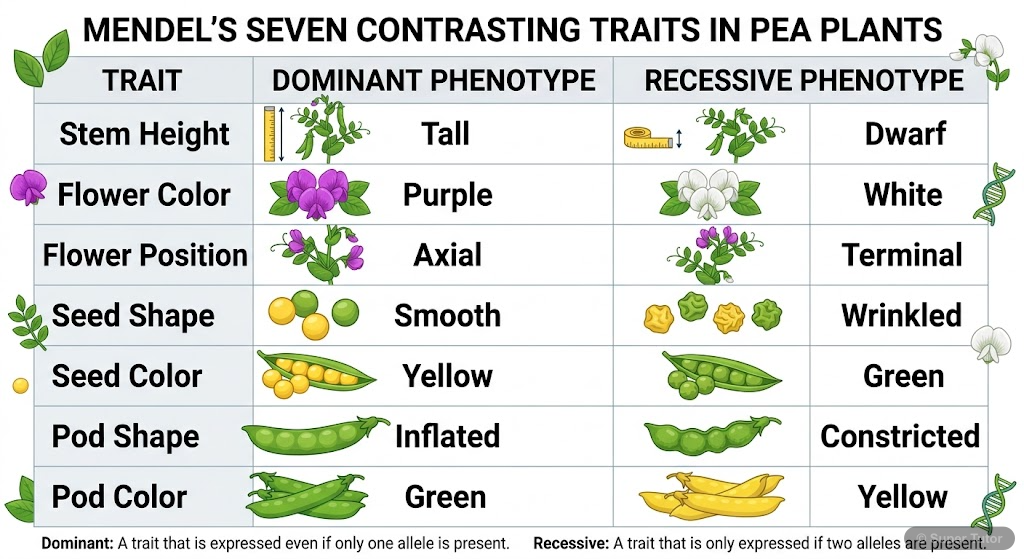
Learn better with visuals Super Tutor has hundreds of illustrations like this across every chapter — all free to try.
Get started10 worked solutions below. Unlock all 19 free in Super Tutor
EXERCISES
1Mention the advantages of selecting pea plant for experiment by Mendel.Show solution
- It had many clear contrasting traits such as tall/dwarf, round/wrinkled, yellow/green, etc.
- It was a true-breeding plant, so stable traits were available for experiments.
- It is naturally self-pollinating, but can also be cross-pollinated easily by Mendel.
- It had a short life cycle, so successive generations could be studied quickly.
- It produced a large number of offspring, giving reliable statistical results.
Not sure why a step works? check your working in Super Tutor
2(a)Dominance and RecessiveShow solution
Recessive: The allele whose effect is masked in a heterozygote and is expressed only in the homozygous condition is recessive.
For example, in pea plant height, T (tall) is dominant over t (dwarf).
Not sure why a step works? check your working in Super Tutor
2(b)Homozygous and HeterozygousShow solution
Heterozygous: A condition in which the two alleles of a gene are dissimilar. Example: Tt.
Not sure why a step works? check your working in Super Tutor
2(c)Monohybrid and Dihybrid.Show solution
Dihybrid cross: A cross involving two pairs of contrasting traits.
Example: TT × tt is a monohybrid cross, while RRYY × rryy is a dihybrid cross.
Not sure why a step works? check your working in Super Tutor
3A diploid organism is heterozygous for 4 loci, how many types of gametes can be produced?Show solution
So, 16 types of gametes can be produced.
Not sure why a step works? check your working in Super Tutor
4Explain the Law of Dominance using a monohybrid cross.Show solution
- Parental cross: TT × tt
- Gametes formed: T and t
- F genotype: Tt
- F phenotype: all tall
This shows that in a heterozygous pair, one factor dominates the other. Here T is dominant over t. When F plants are selfed:
- F genotypes: 1 TT : 2 Tt : 1 tt
- F phenotypes: 3 tall : 1 dwarf
Thus, the recessive trait appears only when it becomes homozygous, while the dominant trait appears in the heterozygous condition.
Not sure why a step works? check your working in Super Tutor
5Define and design a test-cross.Show solution
For example, a tall plant of unknown genotype may be crossed with a dwarf plant (tt) to determine whether the tall plant is TT or Tt.
Design:
- If the unknown tall plant is TT: cross TT × tt gives all tall offspring.
- If the unknown tall plant is Tt: cross Tt × tt gives 1 tall : 1 dwarf offspring.
So, by examining the offspring, the genotype of the dominant individual can be identified.
Not sure why a step works? check your working in Super Tutor
6Using a Punnett Square, workout the distribution of phenotypic features in the first filial generation after a cross between a homozygous female and a heterozygous male for a single locus.Show solution
Example: tt × Tt
Gametes:
- Female produces only t
- Male produces T and t
Punnett square gives offspring:
- Tt = tall
- tt = dwarf
So the phenotypic distribution is:
- 1 tall : 1 dwarf
- i.e., 50% tall and 50% dwarf
If the dominant allele is not specified, this is the standard expected distribution for a test cross.
Not sure why a step works? check your working in Super Tutor
7When a cross in made between tall plant with yellow seeds (TtYy) and tall plant with green seed (Ttyy), what proportions of phenotype in the offspring could be expected to beShow solution
For height:
- Tt × Tt gives 3 tall : 1 dwarf
For seed colour:
- Yy × yy gives 1 yellow : 1 green
Combine the two results:
- Tall yellow =
- Tall green =
- Dwarf yellow =
- Dwarf green =
So the phenotypic ratio is 3 : 3 : 1 : 1.
Hence:
- tall and green = 3/8
- dwarf and green = 1/8
This option is not among the book’s printed options, so the computed answer is given.
Not sure why a step works? check your working in Super Tutor
8Two heterozygous parents are crossed. If the two loci are linked what would be the distribution of phenotypic features in F₁ generation for a dihybrid cross?Show solution
So, unlike an unlinked dihybrid cross which gives 9:3:3:1, linkage produces a deviation from independent assortment.
The offspring show more parental combinations and fewer recombinants. If linkage is very strong, the parental types may greatly outnumber the non-parental types.
Therefore, the distribution in F progeny of such a dihybrid cross would not be 9:3:3:1; it would be dominated by the parental phenotypes.
Not sure why a step works? check your working in Super Tutor
9 more solved questions in Principles of Inheritance and Variation
Every remaining exercise is solved step by step in Super Tutor, plus practice quizzes and flashcards for this chapter. Free to start.
Stuck on a step?
Ask Super Tutor AI to explain any solution on this page in a simpler way — free, 24x7.
Ask a Doubt FreeFrequently Asked Questions
What are the important topics in Principles of Inheritance and Variation for CBSE Class 12 Biology?
How to score full marks in Principles of Inheritance and Variation — CBSE Class 12 Biology?
Where can I get free NCERT Solutions for Principles of Inheritance and Variation Class 12 Biology?
Sources & Official References
- NCERT Official — ncert.nic.in
- CBSE Academic — cbseacademic.nic.in
- CBSE Official — cbse.gov.in
- National Education Policy 2020 — education.gov.in
Content is aligned to the official syllabus. Refer to the board website for the latest curriculum.
More resources for Principles of Inheritance and Variation
Practice Quiz
Test yourself with a quick quiz
Important Questions
Practice with board exam-style questions
Revision Notes
Key points for last-minute revision
Formula Sheet
All formulas in one place
Chapter Summary
Understand the chapter at a glance
Concept Maps
See how topics connect visually
Study Plan
Step-by-step plan to ace this chapter
Flashcards
Quick-fire cards for active recall
Syllabus
What topics to cover
For serious students
Get the full Principles of Inheritance and Variation chapter — for free.
Quizzes, flashcards, AI doubt-solver and a step-by-step study plan for CBSE Class 12 Biology.