Ecosystem — NCERT Solutions
CBSE · Class 12 · Biology
NCERT Solutions for Ecosystem, CBSE Class 12 Biology: 20 textbook questions solved step by step. Covers Exercises.
Interactive on Super Tutor
Studying Ecosystem? Get the full interactive chapter.
Quizzes, flashcards, AI doubt-solver and a step-by-step study plan — built for NCERT solutions and more.
Free trial, no card needed.
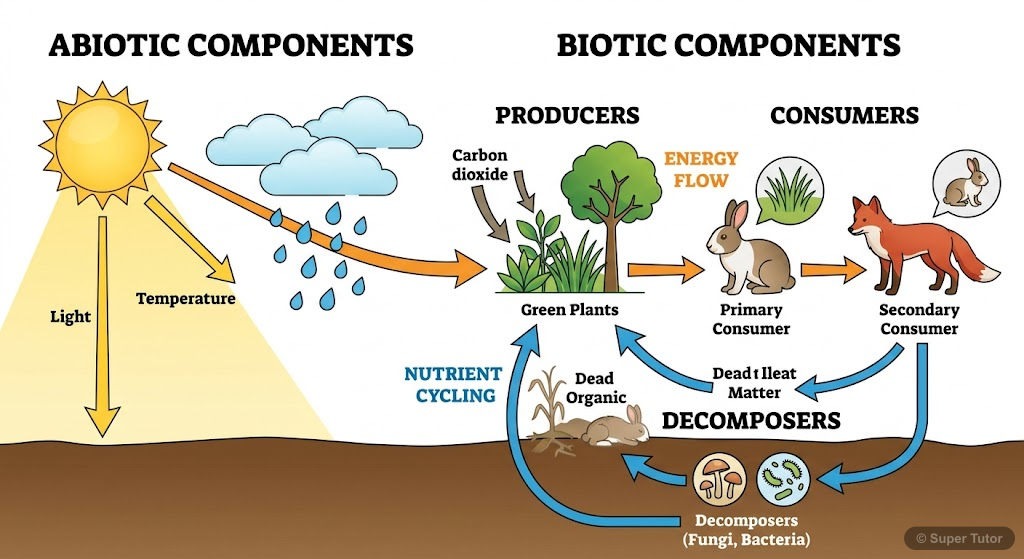
One of 18 illustrations for Ecosystem in Super Tutor — alongside flashcards, concept maps and practice questions.
See them allThe first 10 solutions are open to read. The other 10 are free with a Super Tutor account. Unlock all 20 free in Super Tutor
Exercises
1(a)Plants are called as _______ because they fix carbon dioxide.Show solution
Plants are called producers because they fix carbon dioxide and synthesize organic food by photosynthesis.
Not sure why a step works? check your working in Super Tutor
1(b)In an ecosystem dominated by trees, the pyramid (of numbers) is _______ type.Show solution
In an ecosystem dominated by trees, the number of producers is very small compared with the large number of herbivores and other organisms depending on them, so the pyramid of numbers is inverted.
Not sure why a step works? check your working in Super Tutor
1(c)In aquatic ecosystems, the limiting factor for the productivity is______.Show solution
In aquatic ecosystems, the limiting factor for productivity is light available for photosynthesis.
Not sure why a step works? check your working in Super Tutor
1(d)Common detritivores in our ecosystem are______.Show solution
Common detritivores in our ecosystem are earthworms.
Not sure why a step works? check your working in Super Tutor
1(e)The major reservoir of carbon on earth is______.Show solution
The major reservoir of carbon on Earth is the oceans.
Not sure why a step works? check your working in Super Tutor
2Which one of the following has the largest population in a food chain?- (a) Producers
- (b) Primary consumers
- (c) Secondary consumers
- (d) Decomposers
Show solution
- (a) Producers
- (b) Primary consumers
- (c) Secondary consumers
- (d) Decomposers
The largest population in a food chain is generally at the base in terms of total organisms involved in breaking down dead matter; among the given options, decomposers have the largest population.
Not sure why a step works? check your working in Super Tutor
3The second trophic level in a lake is- (a) Phytoplankton
- (b) Zooplankton
- (c) Benthos
- (d) Fishes
Show solution
- (a) Phytoplankton
- (b) Zooplankton
- (c) Benthos
- (d) Fishes
In a lake, the first trophic level is phytoplankton (producers), so the second trophic level is zooplankton (primary consumers).
Not sure why a step works? check your working in Super Tutor
4Secondary producers are- (a) Herbivores
- (b) Producers
- (c) Carnivores
- (d) None of the above
Show solution
- (a) Herbivores
- (b) Producers
- (c) Carnivores
- (d) None of the above
Secondary producers are not herbivores, producers, or carnivores. Therefore the correct choice is None of the above.
Not sure why a step works? check your working in Super Tutor
5What is the percentage of photosynthetically active radiation (PAR) in the incident solar radiation?- (a) 100%
- (b) 50 %
- (c) 1-5%
- (d) 2-10%
Show solution
- (a) 100%
- (b) 50 %
- (c) 1-5%
- (d) 2-10%
Plants capture only 2–10% of the incident PAR.
Not sure why a step works? check your working in Super Tutor
6(a)Distinguish between(a) Grazing food chain and detritus food chain
(b) Production and decomposition
(c) Upright and inverted pyramid
(d) Food chain and Food web
(e) Litter and detritus
(f) Primary and secondary productivity
Show solution
(a) Grazing food chain and detritus food chain
(b) Production and decomposition
(c) Upright and inverted pyramid
(d) Food chain and Food web
(e) Litter and detritus
(f) Primary and secondary productivity
| Grazing food chain | Detritus food chain |
|---|---|
| Begins with living green plants (producers). | Begins with dead organic matter (detritus). |
| Energy flows from producers → herbivores → carnivores. | Energy flows from detritus → decomposers/saprotrophs → other organisms. |
| Common in aquatic ecosystems as the major conduit for energy flow. | More important in terrestrial ecosystems, where a larger fraction of energy flows through it. |
| Example: grass → deer → tiger. | Example: dead leaves → fungi/bacteria → detritivores. |
Not sure why a step works? check your working in Super Tutor
(a) Grazing food chain and detritus food chain
(b) Production and decomposition
(c) Upright and inverted pyramid
(d) Food chain and Food web
(e) Litter and detritus
(f) Primary and secondary productivity
Free with a Super Tutor account
(a) Grazing food chain and detritus food chain
(b) Production and decomposition
(c) Upright and inverted pyramid
(d) Food chain and Food web
(e) Litter and detritus
(f) Primary and secondary productivity
Free with a Super Tutor account
(a) Grazing food chain and detritus food chain
(b) Production and decomposition
(c) Upright and inverted pyramid
(d) Food chain and Food web
(e) Litter and detritus
(f) Primary and secondary productivity
Free with a Super Tutor account
(a) Grazing food chain and detritus food chain
(b) Production and decomposition
(c) Upright and inverted pyramid
(d) Food chain and Food web
(e) Litter and detritus
(f) Primary and secondary productivity
Free with a Super Tutor account
(a) Grazing food chain and detritus food chain
(b) Production and decomposition
(c) Upright and inverted pyramid
(d) Food chain and Food web
(e) Litter and detritus
(f) Primary and secondary productivity
Free with a Super Tutor account
Free with a Super Tutor account
Free with a Super Tutor account
Free with a Super Tutor account
Free with a Super Tutor account
Free with a Super Tutor account
10 more solved questions in Ecosystem
They are free with a Super Tutor account, along with practice quizzes and flashcards for this chapter. Free to start, no card needed.
Frequently Asked Questions
What are the important topics in Ecosystem for CBSE Class 12 Biology?
Are these NCERT Solutions for Ecosystem free?
How should I revise Ecosystem for the CBSE Class 12 board exam?
Sources & Official References
- NCERT Official — ncert.nic.in
- CBSE Academic — cbseacademic.nic.in
- CBSE Official — cbse.gov.in
- National Education Policy 2020 — education.gov.in
Content is aligned to the official syllabus. Refer to the board website for the latest curriculum.
More resources for Ecosystem
Practice Quiz
Test yourself with a quick quiz
Important Questions
Exam-style questions with answers
Revision Notes
Key points for last-minute revision
Chapter Summary
Understand the chapter at a glance
Concept Maps
See how topics connect
Study Plan
Step-by-step plan for this chapter
Flashcards
Quick-fire cards for active recall
Syllabus
What topics to cover
For serious students
Get the full Ecosystem chapter — start free.
Quizzes, flashcards, an AI doubt solver and a study plan for CBSE Class 12 Biology. Free to start, no card needed.