Biotechnology and its Applications
CBSE · Class 12 · Biology
NCERT Solutions for Biotechnology and its Applications — CBSE Class 12 Biology.
Interactive on Super Tutor
Studying Biotechnology and its Applications? Get the full interactive chapter.
Quizzes, flashcards, AI doubt-solver and a step-by-step study plan — built for ncert solutions and more.
1,000+ Class 12 students started this chapter today
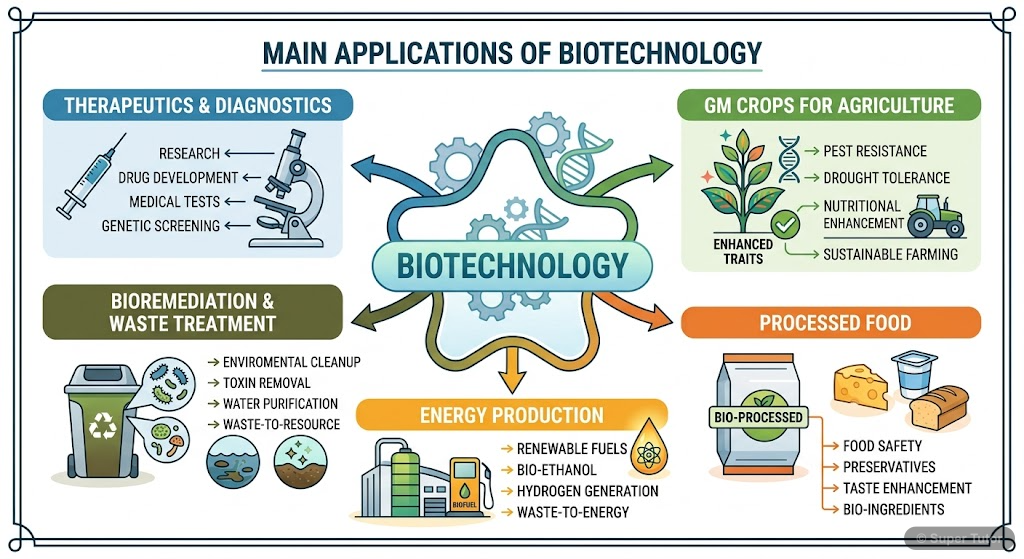
Super Tutor has 12+ illustrations like this for Biotechnology and its Applications alone — flashcards, concept maps, and step-by-step visuals.
See them all7 worked solutions below. Unlock all 13 free in Super Tutor
EXERCISES
1Which part of the plant is best suited for making virus-free plants and why?Show solution
Not sure why a step works? check your working in Super Tutor
2What is the major advantage of producing plants by micropropagation?Show solution
Not sure why a step works? check your working in Super Tutor
3Find out what the various components of the medium used for propagation of an explant *in vitro* are?Show solution
Not sure why a step works? check your working in Super Tutor
4Crystals of Bt toxin produced by some bacteria do not kill the bacteria themselves because –Show solution
Not sure why a step works? check your working in Super Tutor
5What are transgenic bacteria? Illustrate using any one example.Show solution
Not sure why a step works? check your working in Super Tutor
6Compare and contrast the advantages and disadvantages of production of genetically modified crops.Show solution
- They can be made tolerant to abiotic stresses like cold, drought, salt and heat.
- They reduce dependence on chemical pesticides because pest-resistant varieties can be made.
- They help in reducing post-harvest losses.
- They can show better mineral use efficiency, preventing early exhaustion of soil fertility.
- They can have enhanced nutritional value, for example golden rice enriched with vitamin A.
- They can be tailored to provide starches, fuels and pharmaceuticals for industry.
Disadvantages / concerns:
- They may have unpredictable effects when introduced into the ecosystem.
- Their use raises ethical issues and concerns about safety.
- There are concerns related to patents and biopiracy, where companies may exploit biological resources and traditional knowledge without proper permission or compensation.
Not sure why a step works? check your working in Super Tutor
7What are Cry proteins? Name an organism that produce it. How has man exploited this protein to his benefit?Show solution
Not sure why a step works? check your working in Super Tutor
6 more solved questions in Biotechnology and its Applications
Every remaining exercise is solved step by step in Super Tutor, plus practice quizzes and flashcards for this chapter. Free to start.
Stuck on a step?
Ask Super Tutor AI to explain any solution on this page in a simpler way — free, 24x7.
Ask a Doubt FreeFrequently Asked Questions
What are the important topics in Biotechnology and its Applications for CBSE Class 12 Biology?
How to score full marks in Biotechnology and its Applications — CBSE Class 12 Biology?
Where can I get free NCERT Solutions for Biotechnology and its Applications Class 12 Biology?
Sources & Official References
- NCERT Official — ncert.nic.in
- CBSE Academic — cbseacademic.nic.in
- CBSE Official — cbse.gov.in
- National Education Policy 2020 — education.gov.in
Content is aligned to the official syllabus. Refer to the board website for the latest curriculum.
More resources for Biotechnology and its Applications
Practice Quiz
Test yourself with a quick quiz
Important Questions
Practice with board exam-style questions
Revision Notes
Key points for last-minute revision
Formula Sheet
All formulas in one place
Chapter Summary
Understand the chapter at a glance
Concept Maps
See how topics connect visually
Study Plan
Step-by-step plan to ace this chapter
Flashcards
Quick-fire cards for active recall
Syllabus
What topics to cover
For serious students
Get the full Biotechnology and its Applications chapter — for free.
Quizzes, flashcards, AI doubt-solver and a step-by-step study plan for CBSE Class 12 Biology.