Biotechnology : Principles and Processes
CBSE · Class 12 · Biology
NCERT Solutions for Biotechnology : Principles and Processes — CBSE Class 12 Biology.
Interactive on Super Tutor
Studying Biotechnology : Principles and Processes? Get the full interactive chapter.
Quizzes, flashcards, AI doubt-solver and a step-by-step study plan — built for ncert solutions and more.
1,000+ Class 12 students started this chapter today
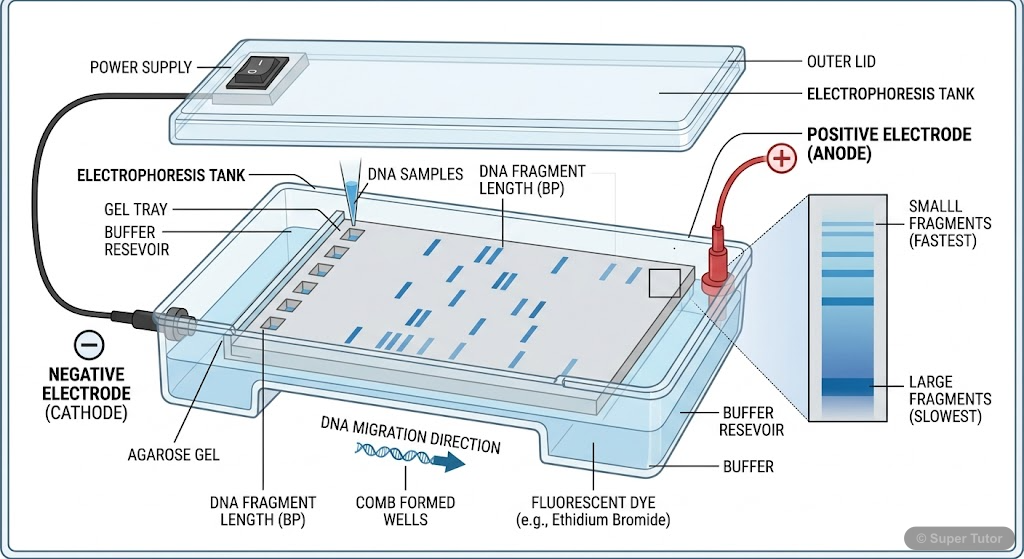
Learn better with visuals Super Tutor has hundreds of illustrations like this across every chapter — all free to try.
Get started6 worked solutions below. Unlock all 12 free in Super Tutor
EXERCISES
1Can you list 10 recombinant proteins which are used in medical practice? Find out where they are used as therapeutics (use the internet).Show solution
Not sure why a step works? check your working in Super Tutor
2Make a chart (with diagrammatic representation) showing a restriction enzyme, the substrate DNA on which it acts, the site at which it cuts DNA and the product it produces.Show solution
Not sure why a step works? check your working in Super Tutor
3From what you have learnt, can you tell whether enzymes are bigger or DNA is bigger in molecular size? How did you know?Show solution
Not sure why a step works? check your working in Super Tutor
4What would be the molar concentration of human DNA in a human cell? Consult your teacher.Show solution
Not sure why a step works? check your working in Super Tutor
5Do eukaryotic cells have restriction endonucleases? Justify your answer.Show solution
Not sure why a step works? check your working in Super Tutor
6Besides better aeration and mixing properties, what other advantages do stirred tank bioreactors have over shake flasks?Show solution
- They provide optimum growth conditions such as temperature, pH, substrate, salts, vitamins, and oxygen.
- They have systems for foam control, temperature control, pH control, and sampling ports.
- They allow large-scale culture and hence produce larger biomass and higher yields of the desired product.
- The culture can be maintained in the log/exponential phase by continuous addition of fresh medium and removal of used medium.
- They are suitable for processing large volumes of culture, unlike shake flasks.
So, stirred tank bioreactors are more efficient and controllable for industrial production.
Not sure why a step works? check your working in Super Tutor
6 more solved questions in Biotechnology : Principles and Processes
Every remaining exercise is solved step by step in Super Tutor, plus practice quizzes and flashcards for this chapter. Free to start.
Stuck on a step?
Ask Super Tutor AI to explain any solution on this page in a simpler way — free, 24x7.
Ask a Doubt FreeFrequently Asked Questions
What are the important topics in Biotechnology : Principles and Processes for CBSE Class 12 Biology?
How to score full marks in Biotechnology : Principles and Processes — CBSE Class 12 Biology?
Where can I get free NCERT Solutions for Biotechnology : Principles and Processes Class 12 Biology?
Sources & Official References
- NCERT Official — ncert.nic.in
- CBSE Academic — cbseacademic.nic.in
- CBSE Official — cbse.gov.in
- National Education Policy 2020 — education.gov.in
Content is aligned to the official syllabus. Refer to the board website for the latest curriculum.
More resources for Biotechnology : Principles and Processes
Practice Quiz
Test yourself with a quick quiz
Important Questions
Practice with board exam-style questions
Revision Notes
Key points for last-minute revision
Formula Sheet
All formulas in one place
Chapter Summary
Understand the chapter at a glance
Concept Maps
See how topics connect visually
Study Plan
Step-by-step plan to ace this chapter
Flashcards
Quick-fire cards for active recall
Syllabus
What topics to cover
For serious students
Get the full Biotechnology : Principles and Processes chapter — for free.
Quizzes, flashcards, AI doubt-solver and a step-by-step study plan for CBSE Class 12 Biology.