Stem Cell Culture and Organ Culture — Chapter Summary
CBSE · Class 12 · Biotechnology
Summary of Stem Cell Culture and Organ Culture for CBSE Class 12 Biotechnology. Part of the CBSE Class 12 Biotechnology syllabus.
Interactive on Super Tutor
Studying Stem Cell Culture and Organ Culture? Get the full interactive chapter.
Quizzes, flashcards, AI doubt-solver and a step-by-step study plan — built for chapter summary and more.
Free trial, no card needed.
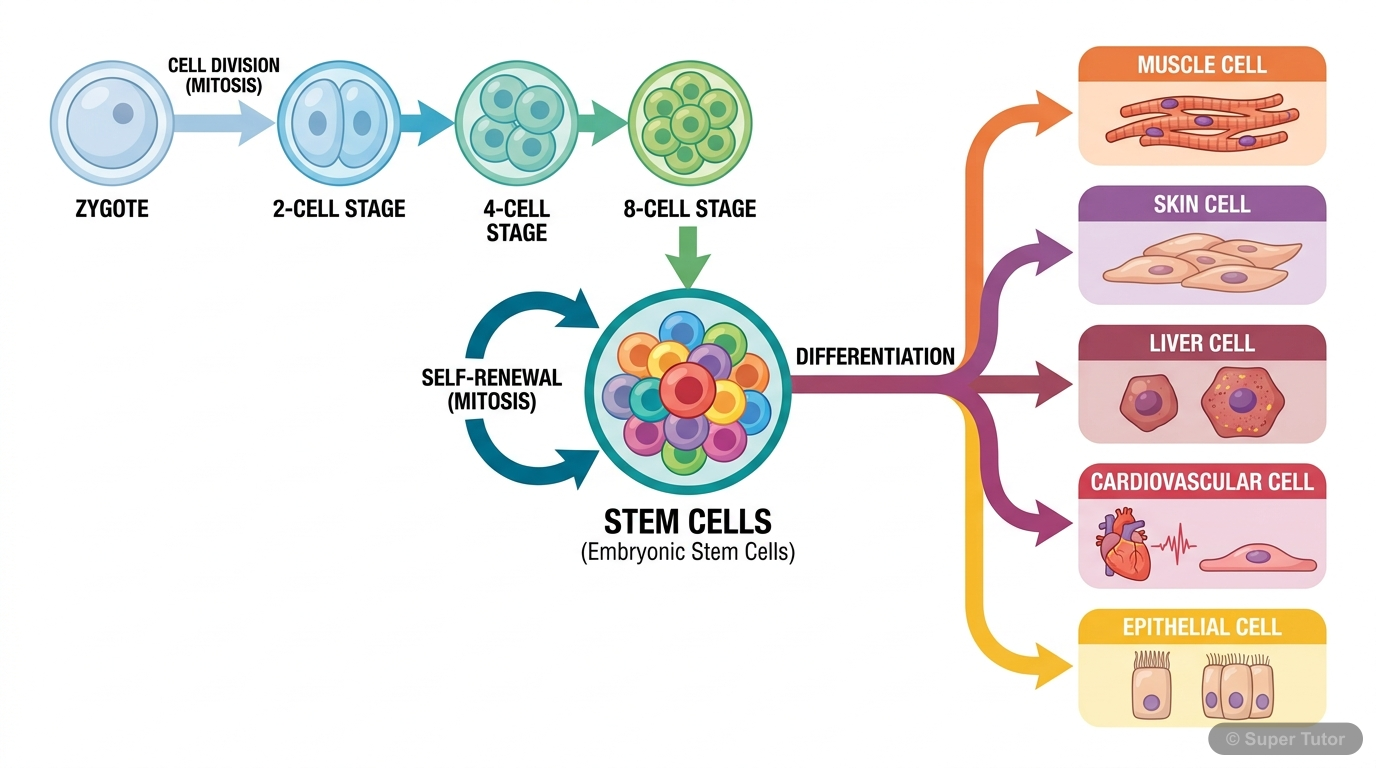
One of 14 illustrations for Stem Cell Culture and Organ Culture in Super Tutor — alongside flashcards, concept maps and practice questions.
See them allOverview
Stem cells are non-specialised, immature cells with self-renewal and the ability to differentiate into specialised cell types. They are important in development, disease study, regenerative medicine, and drug testing. Organ culture is the in vitro development of a part or whole organ while preservin
Key Concepts
Stem cells are non
Stem cells are non-specialised cells with the inherent property of self-renewal through mitotic cell division and the ability to differentiate into a
Embryonic stem cells are self
Embryonic stem cells are self-reproducing pluripotent cells, possibly immortal, present in the inner cell mass or epiblast of the blastocyst after aro
Fetal stem cells are derived from
Fetal stem cells are derived from the fetus, which is the name used after the eighth week of development. They can be isolated from fetal blood, bone
Adult stem cells
Adult stem cells, also called somatic or mature stem cells, are present in mature body tissues, umbilical cord, and placenta after birth. They are und
Hematopoietic stem cells are found
Hematopoietic stem cells are found in bone marrow and also in fetal blood and fetal bone marrow. They give rise to RBCs, monocytes, neutrophils, acido
Learning Objectives
- Understand the meaning and properties of stem cells
- Classify stem cells based on source and potency
- Recognise embryonic, fetal, adult, hematopoietic, and mesenchymal stem cells
- Differentiate totipotent, pluripotent, multipotent, and unipotent stem cells
- Explain stem cell plasticity and major therapeutic uses
Frequently Asked Questions
What are the important topics in Stem Cell Culture and Organ Culture for CBSE Class 12 Biotechnology?
How should I revise Stem Cell Culture and Organ Culture for the CBSE Class 12 board exam?
Sources & Official References
- NCERT Official — ncert.nic.in
- CBSE Academic — cbseacademic.nic.in
- CBSE Official — cbse.gov.in
- National Education Policy 2020 — education.gov.in
Content is aligned to the official syllabus. Refer to the board website for the latest curriculum.
More resources for Stem Cell Culture and Organ Culture
Practice Quiz
Test yourself with a quick quiz
Important Questions
Exam-style questions with answers
Revision Notes
Key points for last-minute revision
Concept Maps
See how topics connect
Study Plan
Step-by-step plan for this chapter
Flashcards
Quick-fire cards for active recall
Syllabus
What topics to cover
NCERT Solutions
Every textbook question solved step by step
For serious students
Get the full Stem Cell Culture and Organ Culture chapter — start free.
Quizzes, flashcards, an AI doubt solver and a study plan for CBSE Class 12 Biotechnology. Free to start, no card needed.