Stem Cell Culture and Organ Culture
CBSE · Class 12 · Biotechnology
NCERT Solutions for Stem Cell Culture and Organ Culture — CBSE Class 12 Biotechnology.
Interactive on Super Tutor
Studying Stem Cell Culture and Organ Culture? Get the full interactive chapter.
Quizzes, flashcards, AI doubt-solver and a step-by-step study plan — built for ncert solutions and more.
1,000+ Class 12 students started this chapter today

Learn better with visuals Super Tutor has hundreds of illustrations like this across every chapter — all free to try.
Get startedEXERCISES
1Briefly describe the stem cells and their properties.Show solution
Answer:
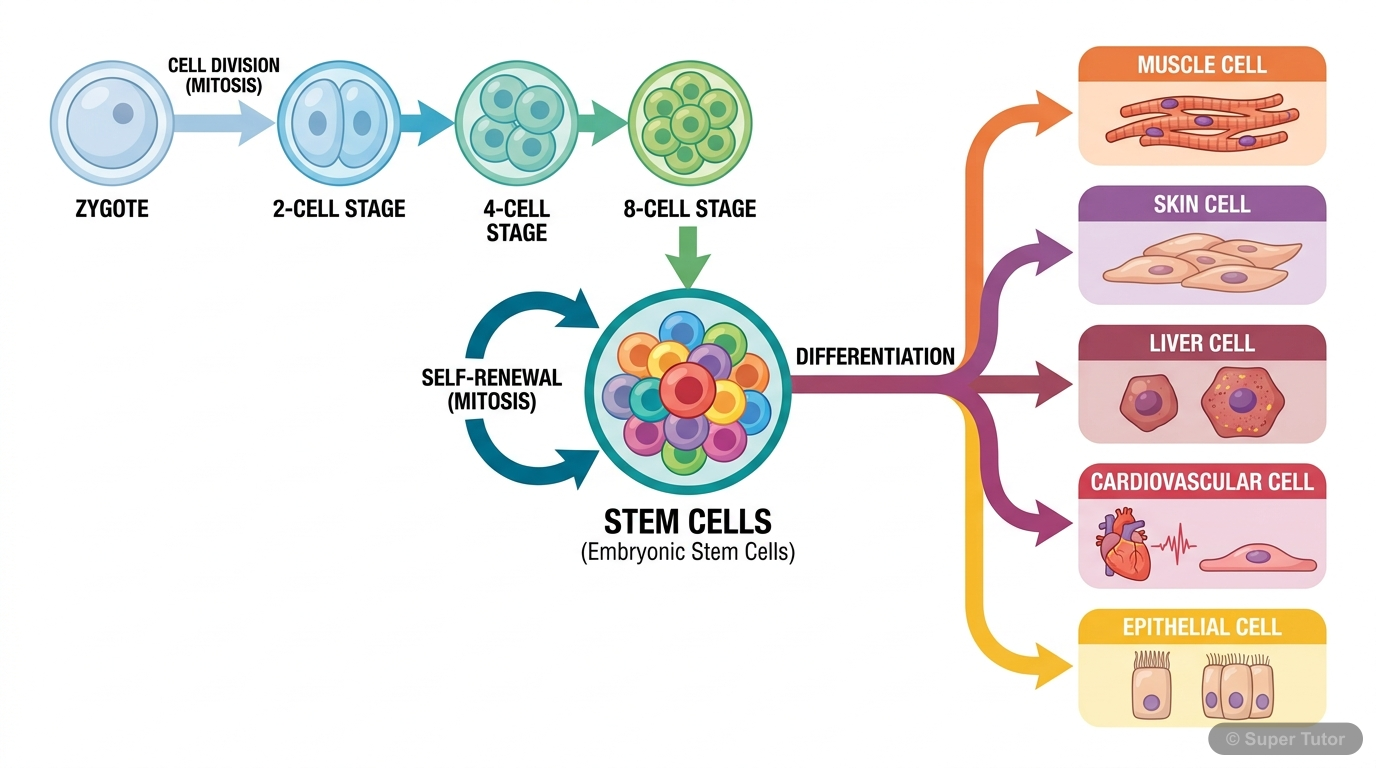
Stem cells are unspecialised (undifferentiated) cells found in multicellular organisms that have two fundamental properties:
1. Self-renewal: They can divide repeatedly through mitosis to produce more stem cells, maintaining the stem cell pool throughout the life of an organism.
2. Potency (Differentiation): They have the ability to differentiate into various specialised cell types under appropriate physiological or experimental conditions.
Key Properties of Stem Cells:
- They are unspecialised and do not perform any specific tissue function.
- They can undergo numerous mitotic cycles.
- They can give rise to specialised cells such as muscle cells, nerve cells, blood cells, etc.
- They exhibit asymmetric replication — one daughter cell remains a stem cell while the other differentiates.
- They exhibit stochastic differentiation — two stem cells may randomly differentiate into different cell types.
- They are classified on the basis of potency (totipotent, pluripotent, multipotent, unipotent) and source (embryonic or adult).
- They have therapeutic potential in treating diseases like cancer, Type 1 diabetes, Parkinson's disease, cardiac diseases, and neurological disorders.
2Differentiate totipotent, pluripotent and multipotent stem cells.Show solution
| Feature | Totipotent Stem Cells | Pluripotent Stem Cells | Multipotent Stem Cells |
|---|---|---|---|
| Definition | Can differentiate into all cell types of an organism, including extra-embryonic tissues. | Can differentiate into almost all cell types of the embryo, but not extra-embryonic support tissues. | Can differentiate into a closely related family of cells. |
| Potential | Highest (most potent) | Very high | Limited |
| Examples | Fertilised egg (zygote), cells of morula stage | Embryonic stem cells (ESCs) from inner cell mass of blastocyst | Haematopoietic stem cells (HSCs), neural stem cells |
| Extra-embryonic tissue formation | Yes | No | No |
| Stage of occurrence | Early embryo (zygote to morula) | Blastocyst (inner cell mass) | Adult tissues / foetal tissues |
Summary:
\text{Totipotent} > \text{Pluripotent} > \text{Multipotent}
(in terms of differentiation potential)
3What are embryonic stem cells and how do they differ from adult stem cells?Show solution
Embryonic Stem Cells (ESCs):
- Also called early stem cells.
- They are present in the inner cell mass (ICM) of a blastocyst (an early-stage embryo, approximately 4–5 days after fertilisation).
- They are pluripotent — capable of differentiating into almost all cell types of the body except extra-embryonic tissues.
- They have a very high proliferative capacity.
Adult Stem Cells:
- Also called mature stem cells.
- They are undifferentiated totipotent or multipotent cells found in specific mature body tissues.
- They are also found in the umbilical cord and placenta after birth.
- Sources include bone marrow, adipose tissue, brain, liver, skin, etc.
- They are generally multipotent — can differentiate into a limited range of cell types related to the tissue of origin.
Differences:
| Feature | Embryonic Stem Cells | Adult Stem Cells |
|---|---|---|
| Source | Inner cell mass of blastocyst | Mature body tissues, umbilical cord, placenta |
| Potency | Pluripotent | Totipotent or Multipotent |
| Differentiation range | Almost all cell types | Limited (related cell types) |
| Proliferative capacity | Very high | Relatively lower |
| Ethical concerns | Yes (involves embryo destruction) | Fewer ethical concerns |
4Describe some applications of stem cells.Show solution
Applications of Stem Cells:
1. Treatment of Cancer: Haematopoietic stem cell transplantation (bone marrow transplant) is used to treat leukaemia and other blood cancers.
2. Type 1 Diabetes Mellitus: Stem cells can be differentiated into insulin-producing beta cells of the pancreas, offering a potential cure for Type 1 diabetes.
3. Parkinson's Disease: Stem cells can be used to generate dopamine-producing neurons to replace the lost neurons in Parkinson's disease.
4. Cardiac Diseases: Stem cells can differentiate into cardiomyocytes (heart muscle cells) to repair damaged heart tissue after a heart attack.
5. Neurological Disorders: Stem cells can regenerate damaged nerve tissue in conditions like Alzheimer's disease, spinal cord injuries, and multiple sclerosis.
6. Spinal Cord Injuries: Stem cells can potentially regenerate damaged spinal cord neurons and restore lost functions.
7. Drug Testing and Development: Stem cells provide human cell models for testing new drugs, reducing the need for animal testing.
8. Understanding Developmental Biology: Embryonic stem cells help scientists study early human development and the causes of birth defects.
9. Regenerative Medicine: Stem cells are used to grow tissues and organs in the laboratory for transplantation (tissue engineering).
5What parameters should be monitored during stem cell culture?Show solution
Parameters to be monitored during stem cell culture:
1. Temperature: Maintained at C (physiological temperature) to mimic in vivo conditions.
2. pH: The culture medium pH should be maintained around 7.2–7.4. pH indicators (e.g., phenol red) in the medium help monitor this.
3. CO₂ levels: A CO₂ atmosphere is maintained in the incubator to regulate the bicarbonate buffering system and maintain pH.
4. Osmolality: The osmotic pressure of the culture medium must be maintained to prevent cell shrinkage or swelling.
5. Nutrient levels: Adequate supply of glucose, amino acids, vitamins, and growth factors must be ensured.
6. Sterility: Contamination by bacteria, fungi, or mycoplasma must be monitored regularly.
7. Cell morphology: Regular microscopic observation to check cell shape, size, and colony formation.
8. Cell viability: Assessed using dyes like Trypan Blue (live cells exclude the dye).
9. Cell density/confluency: Cells should be sub-cultured (passaged) before reaching 100% confluency to prevent contact inhibition.
10. Expression of pluripotency markers: Markers such as Oct-4, Sox-2, Nanog, and SSEA-4 should be monitored to confirm that stem cells retain their undifferentiated state.
11. Growth factors and cytokines: Levels of LIF (Leukaemia Inhibitory Factor) or other factors that maintain stemness must be monitored.
6What is organ culture?Show solution
Definition:
Organ culture is defined as the development of a part of an organ or the whole organ itself from tissue culture techniques in an *in vitro* system, such that the three-dimensional architecture and the functional characteristics of the organ are maintained.
Key Points:
- In organ culture, the structural integrity of the organ or tissue is preserved.
- The cells within the organ maintain their natural spatial relationships and interactions.
- It allows the study of the behaviour of integrated tissues rather than isolated cells.
- Organ culture systems provide conditions for nutrient and gas exchange, growth, and differentiation similar to *in vivo* conditions.
- It is used to study developmental biology, drug responses, and biochemical functions of organs.
Example: Culturing a whole embryonic organ (e.g., embryonic kidney or limb bud) on a semi-solid medium to study its development *in vitro*.
7Describe the main characteristics of organ culture.Show solution
Main Characteristics of Organ Culture:
1. Structural Integrity:
- The three-dimensional (3D) architecture of the organ or tissue is maintained.
- The natural spatial arrangement and cell-to-cell interactions are preserved.
- This is the most important advantage over monolayer cell culture.
2. Nutrient and Gas Exchange:
- Adequate supply of nutrients (glucose, amino acids, vitamins) and gases (O₂ and CO₂) must be ensured.
- Since the tissue is in 3D form, diffusion of nutrients and gases to the inner cells is a challenge and must be carefully managed.
- The culture medium and gas phase are regularly monitored.
3. Growth and Differentiation:
- Cells within the organ culture can continue to grow and differentiate in a manner similar to *in vivo* conditions.
- The organ retains its ability to respond to hormones, growth factors, and other signals.
- Differentiation of specific cell types within the organ can be studied.
4. Maintenance of Functional Characteristics:
- The biochemical and physiological functions of the organ are maintained.
- This allows comparison of *in vitro* organ behaviour with *in vivo* organ behaviour.
5. Integration of Cell Types:
- Multiple cell types present in the organ interact with each other, providing a more realistic model than single-cell-type cultures.
8Discuss the various types of organ culture.Show solution
Types of Organ Culture:
1. Whole Embryo Culture:
- In this type, the entire embryo is cultured *in vitro*.
- It is used to study embryonic development, organogenesis, and the effects of teratogens (agents causing birth defects).
- The embryo is maintained in a culture medium that supports its growth and development.
- It helps in understanding the developmental biology of the whole organism.
- Example: Culturing rat or mouse embryos at specific developmental stages.
2. Histotypic Culture:
- In this type, cells are cultured in three-dimensional (3D) structures to recreate the histological (tissue-level) architecture.
- Cells are grown on scaffolds, gels, or in rotating bioreactors to form tissue-like structures.
- It allows cells to interact in 3D as they would in a real tissue.
- Example: Growing cells on collagen gels or in spinner flasks to form 3D aggregates.
- It is used to study tissue-level responses to drugs and other stimuli.
3. Organotypic Culture:
- In this type, different types of cells from a specific organ are combined and cultured together to recreate the organ-level architecture and function.
- It is more complex than histotypic culture as it involves multiple cell types interacting together.
- It closely mimics the *in vivo* organ environment.
- Example: Skin organotypic culture (combining keratinocytes and fibroblasts to recreate skin layers); retinal organotypic culture.
- It is used to study organ-specific functions, disease models, and drug testing.
9What are the advantages of organ culture over cell culture?Show solution
Advantages of Organ Culture over Cell Culture:
1. Three-Dimensional Architecture:
- Organ culture maintains the 3D structure of the tissue/organ, whereas cell culture grows cells as a 2D monolayer.
- The 3D structure allows more realistic cell-to-cell and cell-to-matrix interactions.
2. Structural Integrity:
- The natural organisation and spatial arrangement of different cell types within the organ is preserved.
- This is not possible in conventional cell culture where cells are dissociated.
3. Study of Integrated Tissue Behaviour:
- Organ culture allows the study of the behaviour of integrated tissues (multiple interacting cell types) rather than isolated individual cells.
- This provides more physiologically relevant data.
4. Mimics In Vivo Conditions:
- The biochemical and functional characteristics of the organ *in vitro* closely resemble those *in vivo*.
- Drug responses, hormone effects, and developmental processes can be studied more accurately.
5. Study of Developmental Biology:
- Organ culture helps in understanding organogenesis, tissue interactions, and developmental processes that cannot be studied in simple cell culture.
6. Better Disease Modelling:
- Organ cultures provide better models for studying diseases and testing therapeutic interventions.
Note: Despite these advantages, organ cultures are more challenging to prepare, more expensive, and show more variability than cell cultures.
10Describe the applications of organ culture.Show solution
Applications of Organ Culture:
1. Study of Developmental Biology:
- Organ culture is used to study organogenesis (formation of organs) and the interactions between different tissues during development.
- Whole embryo culture helps in understanding the developmental stages of an organism.
2. Understanding Biochemical and Functional Characteristics:
- It helps to understand the biochemical functions of an organ or tissue *in vitro* and compare them with *in vivo* functions.
3. Drug Testing and Toxicology:
- Organ cultures serve as models for testing the efficacy and toxicity of new drugs.
- They reduce the need for animal testing and provide more human-relevant data.
4. Study of Disease Mechanisms:
- Organ cultures can be used to model diseases (e.g., cancer, infections) and study the mechanisms of disease progression.
5. Study of Tissue Interactions:
- Organ culture helps in understanding how different cell types within an organ interact with each other and with the extracellular matrix.
6. Regenerative Medicine and Tissue Engineering:
- Organ culture techniques are used to grow tissues and organs for potential transplantation.
- 3D bioprinting and organoids are advanced applications of organ culture.
7. Teratology Studies:
- Whole embryo culture is used to study the effects of teratogenic agents (chemicals, drugs, radiation) on embryonic development.
8. Virology and Microbiology:
- Organ cultures can be used to study viral infections and the response of tissues to pathogens.
9. Endocrinology:
- The response of organs to hormones can be studied in organ culture systems.
11Describe the various support systems used in organ culture.Show solution
Support Systems Used in Organ Culture:
1. Plasma Clot Method:
- The organ fragment is placed on a clot made of plasma (usually chick plasma) and embryo extract.
- The clot provides a semi-solid support that holds the tissue in place.
- Nutrients diffuse from the medium into the tissue.
- This is one of the oldest methods used in organ culture.
2. Agar/Gel Substrate:
- Agar or other gel-based substrates (e.g., collagen gel, Matrigel) are used as a support.
- The organ fragment is placed on top of the gel.
- The gel provides mechanical support and allows diffusion of nutrients.
3. Raft/Grid Method (Trowell's Method):
- A metal grid or raft (made of stainless steel mesh or lens paper) is placed at the liquid-gas interface in a culture dish.
- The organ fragment is placed on the grid/raft so that its lower surface is in contact with the medium and its upper surface is exposed to the gas phase (air or CO₂/O₂ mixture).
- This ensures adequate oxygenation and nutrient supply.
- This is one of the most widely used methods.
4. Roller Tube Method:
- The organ fragment is placed in a tube that rotates slowly.
- The rotation alternately exposes the tissue to the medium and the gas phase, ensuring good nutrient and gas exchange.
5. Scaffold-Based Systems:
- Three-dimensional scaffolds made of biodegradable polymers (e.g., PLGA, collagen) are used to support organ culture.
- Cells grow within the scaffold, maintaining 3D architecture.
- Used in tissue engineering applications.
6. Microfluidic Systems (Organs-on-Chips):
- Miniaturised devices with microchannels that mimic the microenvironment of organs.
- Allow precise control of fluid flow, nutrient supply, and mechanical forces.
- Used for advanced organ culture and drug testing.
7. Hanging Drop Method:
- Cells or tissue fragments are cultured in hanging drops of medium.
- Gravity causes cells to aggregate at the bottom of the drop, forming 3D spheroids.
8. Magnetic Levitation:
- Cells are labelled with magnetic nanoparticles and levitated using magnets.
- Cells aggregate and form 3D structures in the levitated state.
12Stem cells are present in:
(a) unicellular organisms
(b) multicellular organisms
(c) non-living things
(d) virusesShow solution
Justification:
Stem cells are unspecialised cells that can self-renew and differentiate into various specialised cell types. They are found in multicellular organisms (both animals and plants), where they are needed to generate and replenish the many different specialised cell types that make up the organism's tissues and organs. Unicellular organisms, non-living things, and viruses do not possess stem cells.
13Differentiation potential of stem cells specifies:
(a) Stochastic differentiation
(b) Asymmetric replication
(c) Potency
(d) Self-renewalShow solution
Justification:
The term potency refers to the differentiation potential of stem cells — i.e., the range of cell types into which a stem cell can differentiate. Based on potency, stem cells are classified as totipotent, pluripotent, multipotent, or unipotent. Self-renewal refers to the ability to divide and produce more stem cells, while stochastic differentiation and asymmetric replication are mechanisms of stem cell division, not measures of differentiation potential.
14Which of the following cells is a multipotent cell?
(a) T-cell
(b) B-cell
(c) HSC
(d) MonocytesShow solution
Justification:
Haematopoietic Stem Cells (HSCs) are classic examples of multipotent stem cells. They are found in the bone marrow and can differentiate into all types of blood cells — red blood cells, white blood cells (including T-cells, B-cells, monocytes), and platelets. T-cells, B-cells, and monocytes are already differentiated (specialised) cells, not stem cells.
15A stem cell is:
(a) a cell out of which the stem of the tree is made up of
(b) a part of the tissue that forms the outer layer of the skin in human beings.
(c) it is a cell that can divide and give rise to specialised cells.
(d) a type of specialised cellShow solution
Justification:
A stem cell is an unspecialised cell that has the ability to self-renew (divide repeatedly) and differentiate (give rise to specialised cell types). It is not related to the stem of a tree, is not a specialised cell itself, and is not restricted to the outer layer of skin. Option (c) correctly captures the defining property of stem cells.
16__________ can be cured with stem cells.
(a) Spinal cord injuries
(b) Type 1 diabetes
(c) Both (a) and (b)
(d) None of theseShow solution
Justification:
Stem cells have therapeutic potential for both spinal cord injuries (by regenerating damaged neurons and nerve tissue) and Type 1 diabetes (by differentiating into insulin-producing beta cells of the pancreas). Both conditions are among the important applications of stem cell therapy mentioned in the chapter.
17The stem cells may be obtained from sources such as:
(a) Bone marrow
(b) Umbilical cord blood
(c) Adipose tissue
(d) All of theseShow solution
Justification:
Adult stem cells can be obtained from multiple sources in the body:
- Bone marrow — a rich source of haematopoietic stem cells (HSCs) and mesenchymal stem cells.
- Umbilical cord blood — contains haematopoietic stem cells collected at birth.
- Adipose tissue (fat tissue) — contains mesenchymal stem cells.
All three are well-established sources of stem cells used in research and therapy.
18Assertion: Embryonic stem cells can give rise to different cell types.
Reason: Embryonic stem cells are pluripotent.
(a) Both assertion and reason are true and the reason is the correct explanation of the assertion.
(b) Both assertion and reason are true but the reason is not the correct explanation of the assertion.
(c) Assertion is true but reason is false.
(d) Both assertion and reason are false.Show solution
Justification:
The Assertion is true — embryonic stem cells (ESCs) can indeed give rise to different cell types of the body.
The Reason is also true — ESCs are pluripotent, meaning they have the potential to differentiate into almost all cell types of the embryo.
Furthermore, the reason correctly explains the assertion: it is precisely because ESCs are pluripotent that they can give rise to different cell types. Hence, option (a) is correct.
19Assertion: Stem cells are undifferentiated and found in multicellular organisms, and undergo numerous mitotic cycles.
Reason: Stem cells have 'self-renewal' feature and do not exhibit 'cellular potency'.
(a) Both assertion and reason are true and the reason is the correct explanation of the assertion.
(b) Both assertion and reason are true but the reason is not the correct explanation of the assertion.
(c) Assertion is true but reason is false.
(d) Both assertion and reason are false.Show solution
Justification:
The Assertion is true — stem cells are indeed undifferentiated cells found in multicellular organisms, and they can undergo numerous mitotic cycles (self-renewal).
The Reason is false — while it is correct that stem cells have the 'self-renewal' feature, the statement that they "do not exhibit cellular potency" is incorrect. Stem cells most certainly exhibit cellular potency — in fact, potency (the ability to differentiate into various specialised cell types) is one of the two defining properties of stem cells (the other being self-renewal). Stem cells are classified as totipotent, pluripotent, multipotent, or unipotent based on their potency.
Therefore, the assertion is true but the reason is false — option (c) is correct.
Stuck on a step?
Ask Super Tutor AI to explain any solution on this page in a simpler way — free, 24x7.
Ask a Doubt FreeFrequently Asked Questions
What are the important topics in Stem Cell Culture and Organ Culture for CBSE Class 12 Biotechnology?
How to score full marks in Stem Cell Culture and Organ Culture — CBSE Class 12 Biotechnology?
Where can I get free NCERT Solutions for Stem Cell Culture and Organ Culture Class 12 Biotechnology?
Sources & Official References
- NCERT Official — ncert.nic.in
- CBSE Academic — cbseacademic.nic.in
- CBSE Official — cbse.gov.in
- National Education Policy 2020 — education.gov.in
Content is aligned to the official syllabus. Refer to the board website for the latest curriculum.
More resources for Stem Cell Culture and Organ Culture
Important Questions
Practice with board exam-style questions
Syllabus
What topics to cover
Revision Notes
Key points for last-minute revision
Study Plan
Step-by-step plan to ace this chapter
Flashcards
Quick-fire cards for active recall
Formula Sheet
All formulas in one place
Chapter Summary
Understand the chapter at a glance
Practice Quiz
Test yourself with a quick quiz
Concept Maps
See how topics connect visually
For serious students
Get the full Stem Cell Culture and Organ Culture chapter — for free.
Quizzes, flashcards, AI doubt-solver and a step-by-step study plan for CBSE Class 12 Biotechnology.