Host–Vector System — Chapter Summary
CBSE · Class 12 · Biotechnology
Summary of Host–Vector System for CBSE Class 12 Biotechnology. Part of the CBSE Class 12 Biotechnology syllabus.
Interactive on Super Tutor
Studying Host–Vector System? Get the full interactive chapter.
Quizzes, flashcards, AI doubt-solver and a step-by-step study plan — built for chapter summary and more.
Free trial, no card needed.
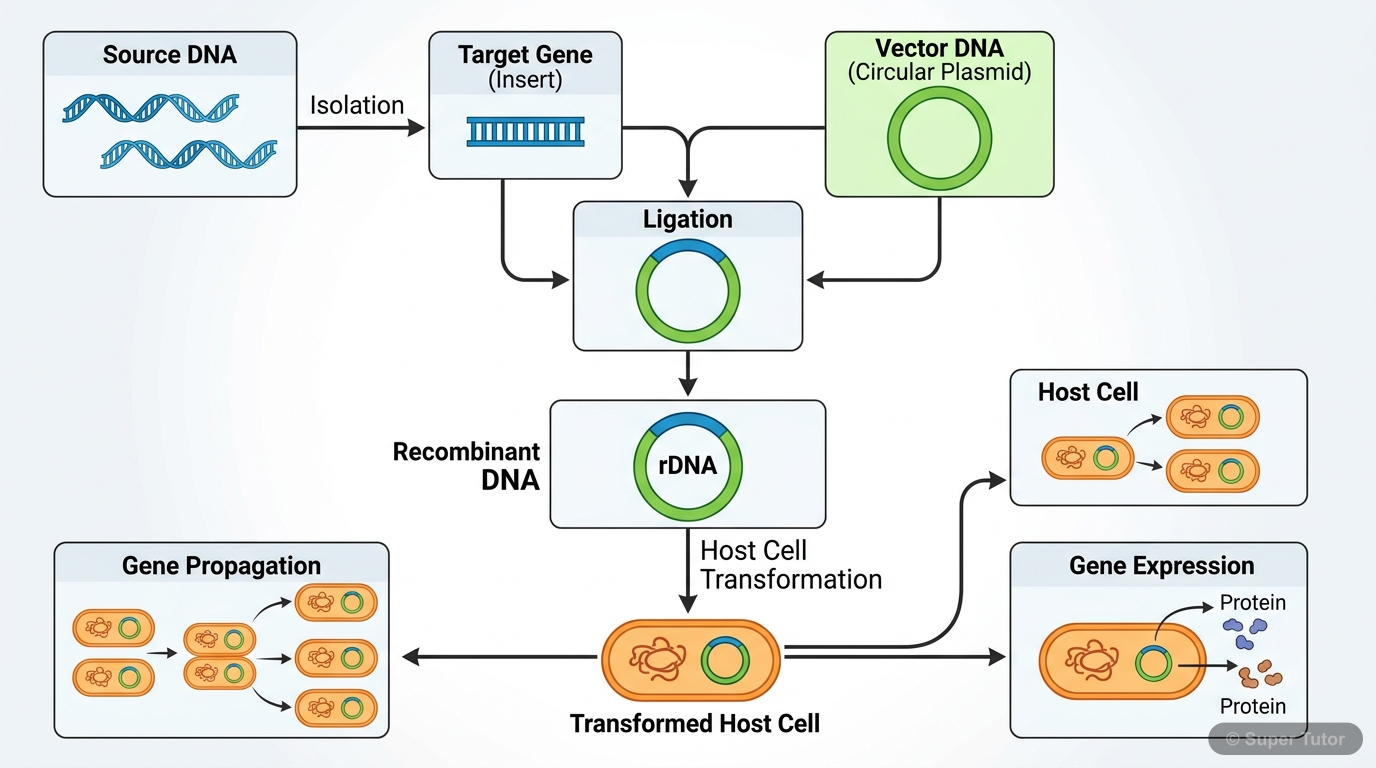
Learn better with visuals Super Tutor pairs illustrations like this with notes and quizzes for Host–Vector System.
Get startedOverview
The host–vector system is the basic framework of recombinant DNA technology. A vector carries the desired DNA fragment, called the insert, into a compatible host. The host then provides the cellular machinery needed for replication and expression of the recombinant DNA. Together, the host and vector
Key Concepts
A host is the organism into
A host is the organism into which recombinant DNA is introduced. It supports replication and expression of the inserted gene. E. coli is the most exte
A vector is a DNA molecule
A vector is a DNA molecule capable of self-replication inside a host cell. It must be small, carry the insert, contain an origin of replication, have
Plasmids are circular
Plasmids are circular, double-stranded, extra-chromosomal DNA molecules capable of autonomous replication. Some integrate into chromosomes and are cal
pBR313 was an original plasmid vector
pBR313 was an original plasmid vector of 9 kb with tetR and ampR markers and several unique restriction sites. pBR322 was developed by deleting most n
pUC19 is an improved plasmid cloning
pUC19 is an improved plasmid cloning vector with ori, ampR, and a multiple cloning site. It also contains part of the lacZ gene, which allows blue/whi
Learning Objectives
- Understand the role of host and vector in recombinant DNA technology
- Identify the qualities of a good cloning vector
- Describe major prokaryotic and eukaryotic hosts used in gene cloning
- Differentiate between plasmid, bacteriophage, cosmid, phasmid, and artificial chromosome vectors
- Explain the structural and functional features of important vectors such as pBR322, pUC19, λ phage vectors, M13 vectors, YAC, BAC, and PAC
Frequently Asked Questions
What are the important topics in Host–Vector System for CBSE Class 12 Biotechnology?
How should I revise Host–Vector System for the CBSE Class 12 board exam?
Sources & Official References
- NCERT Official — ncert.nic.in
- CBSE Academic — cbseacademic.nic.in
- CBSE Official — cbse.gov.in
- National Education Policy 2020 — education.gov.in
Content is aligned to the official syllabus. Refer to the board website for the latest curriculum.
More resources for Host–Vector System
Practice Quiz
Test yourself with a quick quiz
Important Questions
Exam-style questions with answers
Revision Notes
Key points for last-minute revision
Concept Maps
See how topics connect
Study Plan
Step-by-step plan for this chapter
Flashcards
Quick-fire cards for active recall
Syllabus
What topics to cover
NCERT Solutions
Every textbook question solved step by step
For serious students
Get the full Host–Vector System chapter — start free.
Quizzes, flashcards, an AI doubt solver and a study plan for CBSE Class 12 Biotechnology. Free to start, no card needed.