Animal Cell Culture — Chapter Summary
CBSE · Class 12 · Biotechnology
Summary of Animal Cell Culture for CBSE Class 12 Biotechnology. Part of the CBSE Class 12 Biotechnology syllabus.
Interactive on Super Tutor
Studying Animal Cell Culture? Get the full interactive chapter.
Quizzes, flashcards, AI doubt-solver and a step-by-step study plan — built for chapter summary and more.
Free trial, no card needed.
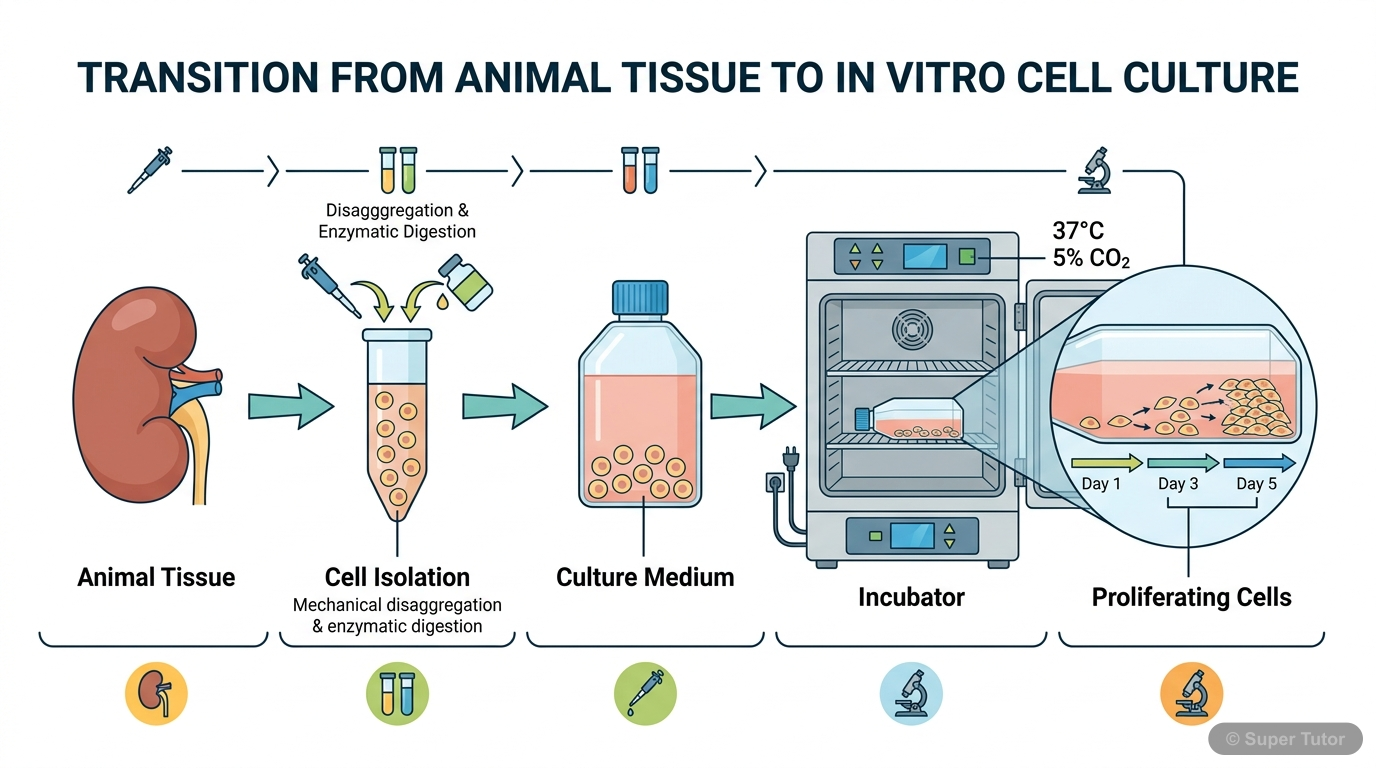
Learn better with visuals Super Tutor pairs illustrations like this with notes and quizzes for Animal Cell Culture.
Get startedOverview
Animal cell culture is the in vitro maintenance and proliferation of animal cells outside the living organism when supplied with suitable nutrients and growth conditions. It is used to study cell growth, differentiation, product formation, viral research, vaccine production, and the manufacture of i
Key Concepts
Animal cell culture is the
Animal cell culture is the in vitro maintenance and proliferation of cells outside the living organism, provided that proper nutrients and growth cond
A clone is a homogeneous population
A clone is a homogeneous population of cells derived from a single parental cell. All cells in a clonal population are genetically identical.
Important milestones include balanced salt solution
Important milestones include balanced salt solution by Sydney Ringer, frog embryo nerve fibre growth by Ross Harrison, aseptic tissue culture by Alexi
Henrietta Lacks was diagnosed with terminal
Henrietta Lacks was diagnosed with terminal cervical cancer in 1951. George Gey took cells from her cervix without permission, and the resulting HeLa
Culture media supply nutrients
Culture media supply nutrients, vitamins, amino acids, glucose, inorganic salts, serum, hormones, and growth factors. Natural media contain biological
Learning Objectives
- Understand the meaning and scope of animal cell culture.
- Identify the historical milestones in animal tissue culture.
- Describe the types of culture media and their components.
- Explain the physical conditions needed for successful cell growth.
- Distinguish between primary, secondary, finite, and continuous cell lines.
Frequently Asked Questions
What are the important topics in Animal Cell Culture for CBSE Class 12 Biotechnology?
How should I revise Animal Cell Culture for the CBSE Class 12 board exam?
Sources & Official References
- NCERT Official — ncert.nic.in
- CBSE Academic — cbseacademic.nic.in
- CBSE Official — cbse.gov.in
- National Education Policy 2020 — education.gov.in
Content is aligned to the official syllabus. Refer to the board website for the latest curriculum.
More resources for Animal Cell Culture
Practice Quiz
Test yourself with a quick quiz
Important Questions
Exam-style questions with answers
Revision Notes
Key points for last-minute revision
Concept Maps
See how topics connect
Study Plan
Step-by-step plan for this chapter
Flashcards
Quick-fire cards for active recall
Syllabus
What topics to cover
NCERT Solutions
Every textbook question solved step by step
For serious students
Get the full Animal Cell Culture chapter — start free.
Quizzes, flashcards, an AI doubt solver and a study plan for CBSE Class 12 Biotechnology. Free to start, no card needed.