Applications of Recombinant DNA Technology — Chapter Summary
CBSE · Class 12 · Biotechnology
Summary of Applications of Recombinant DNA Technology for CBSE Class 12 Biotechnology. Part of the CBSE Class 12 Biotechnology syllabus.
Interactive on Super Tutor
Studying Applications of Recombinant DNA Technology? Get the full interactive chapter.
Quizzes, flashcards, AI doubt-solver and a step-by-step study plan — built for chapter summary and more.
Free trial, no card needed.
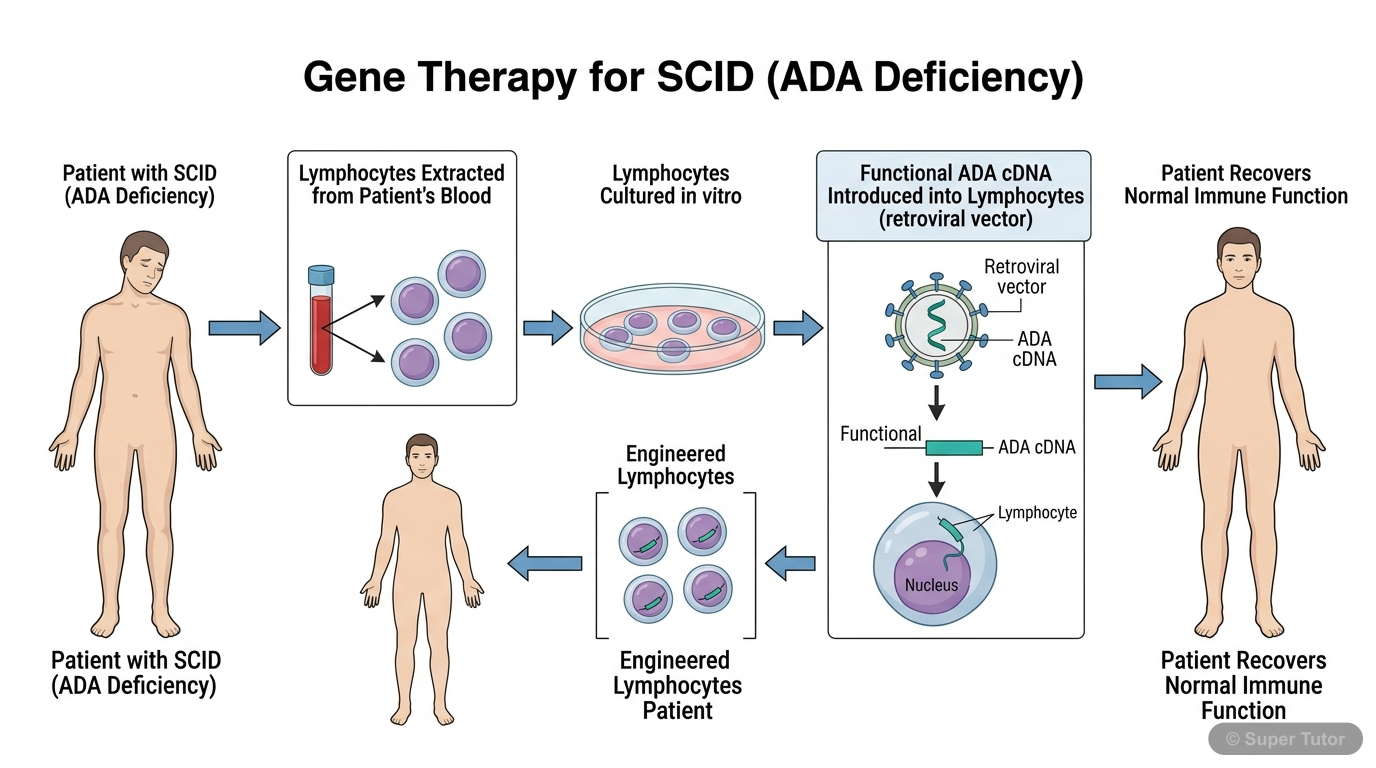
One of 28 illustrations for Applications of Recombinant DNA Technology in Super Tutor — alongside flashcards, concept maps and practice questions.
See them allOverview
Recombinant DNA technology has transformed medicine, agriculture, and biological research. Its major applications include DNA fingerprinting for identification, transgenic organisms for useful traits and industrial production, gene therapy for correcting defective genes, recombinant vaccines for saf
Key Concepts
DNA fingerprinting compares inherited DNA variations
DNA fingerprinting compares inherited DNA variations to identify individuals. It was developed by Sir Alec Jeffreys in 1984 at the University of Leice
More than 90% of the human
More than 90% of the human genome is non-coding DNA. VNTRs are repeated DNA sequences that vary in number from person to person. Microsatellites have
Transgenic organisms carry a foreign gene
Transgenic organisms carry a foreign gene introduced by genetic engineering. The first GMO was a bacterium made by Herbert Boyer and Stanley Cohen in
Transgenic plants are created by vector
Transgenic plants are created by vector-mediated or direct gene transfer. Agrobacterium tumefaciens naturally transfers DNA into plant genomes and is
Common methods include DNA pronuclear microinjection
Common methods include DNA pronuclear microinjection, embryonic stem cell-mediated gene transfer, and retrovirus-mediated gene transfer. Transgenic an
Learning Objectives
- Understand the principle and uses of DNA fingerprinting
- Explain how transgenic plants and animals are created and used
- Describe gene therapy and its major approaches
- Recognise the main types of recombinant vaccines
- Identify important therapeutic products made using recombinant DNA technology
Frequently Asked Questions
What are the important topics in Applications of Recombinant DNA Technology for CBSE Class 12 Biotechnology?
How should I revise Applications of Recombinant DNA Technology for the CBSE Class 12 board exam?
Sources & Official References
- NCERT Official — ncert.nic.in
- CBSE Academic — cbseacademic.nic.in
- CBSE Official — cbse.gov.in
- National Education Policy 2020 — education.gov.in
Content is aligned to the official syllabus. Refer to the board website for the latest curriculum.
More resources for Applications of Recombinant DNA Technology
Practice Quiz
Test yourself with a quick quiz
Important Questions
Exam-style questions with answers
Revision Notes
Key points for last-minute revision
Concept Maps
See how topics connect
Study Plan
Step-by-step plan for this chapter
Flashcards
Quick-fire cards for active recall
Syllabus
What topics to cover
NCERT Solutions
Every textbook question solved step by step
For serious students
Get the full Applications of Recombinant DNA Technology chapter — start free.
Quizzes, flashcards, an AI doubt solver and a study plan for CBSE Class 12 Biotechnology. Free to start, no card needed.