Chapter 13 of 13
NCERT Solutions

Entrepreneurship

CBSE · Class 12 · Biotechnology

NCERT Solutions for Entrepreneurship — CBSE Class 12 Biotechnology.

5 concepts

Interactive on Super Tutor

Studying Entrepreneurship? Get the full interactive chapter.

Quizzes, flashcards, AI doubt-solver and a step-by-step study plan — built for ncert solutions and more.

1,000+ Class 12 students started this chapter today

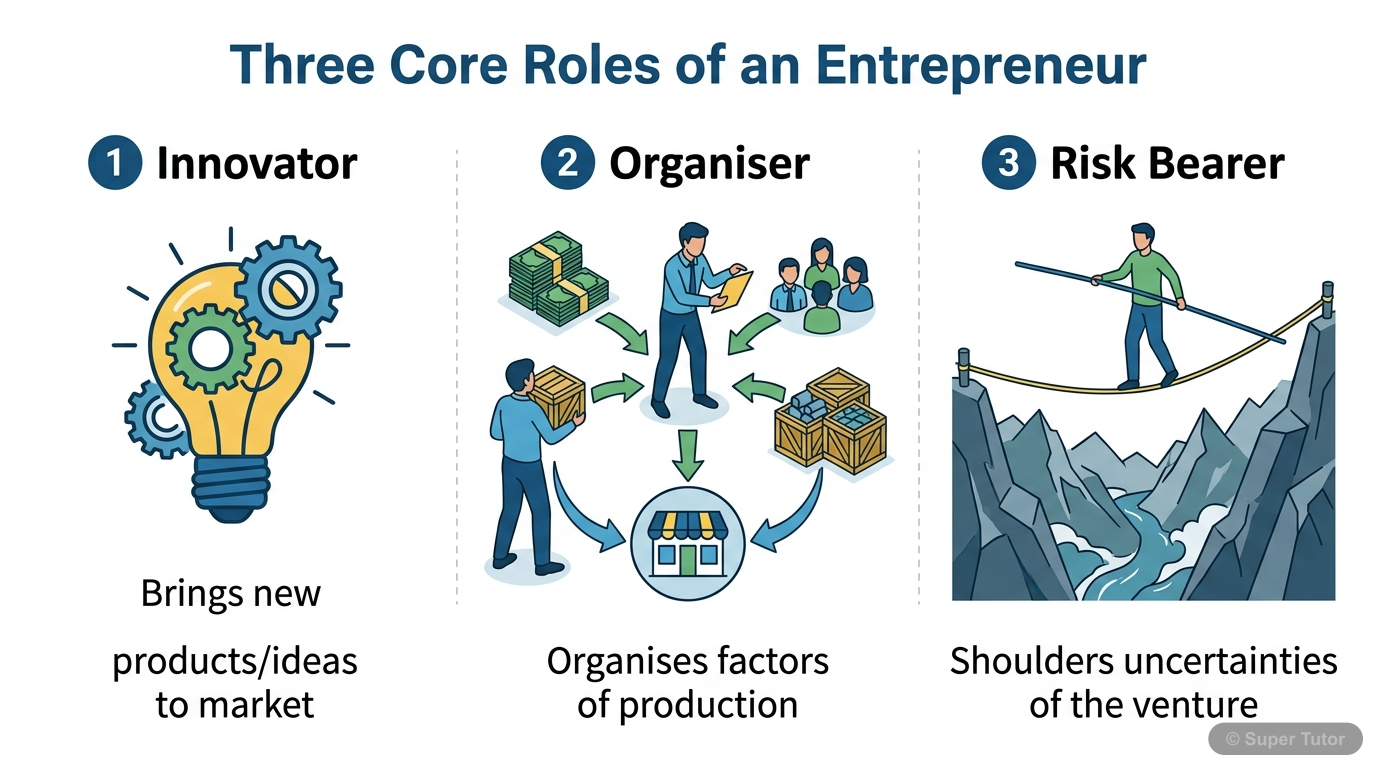
An infographic illustrating the three prominent roles of an entrepreneur: innovator, organiser, and risk bearer, with brief descriptions for each.
Super Tutor

This is just one of 12+ visuals inside Super Tutor's Entrepreneurship chapter

Explore the full set
21 Questions Solved · 1 Section

EXERCISES

1Define the term 'entrepreneurship'. Describe its importance.Show solution
Definition of Entrepreneurship:

Entrepreneurship is the process by which an individual (called an entrepreneur) identifies a business opportunity, organises the necessary resources (capital, labour, raw materials, technology), and undertakes the risk of starting and managing a new enterprise with the aim of earning profit and creating value.

Importance of Entrepreneurship:

1. Economic Growth: Entrepreneurship drives economic development by increasing production, trade, and GDP of a nation. Countries like the USA and Japan have grown significantly due to entrepreneurial activity.

2. Employment Generation: New enterprises create jobs, thereby reducing unemployment and improving the standard of living.

3. Wealth Creation: Entrepreneurs generate wealth not only for themselves but also for society through taxes, wages, and community development.

4. Innovation and Technology: Entrepreneurs introduce new products, services, and processes, fostering innovation and technological advancement.

5. Balanced Regional Development: Entrepreneurship helps in spreading industrial activity to rural and underdeveloped areas, reducing regional imbalances.

6. Utilisation of Resources: Entrepreneurs mobilise idle savings and natural resources, putting them to productive use.

7. Improvement in Living Standards: By producing better goods and services at competitive prices, entrepreneurs raise the quality of life of consumers.

8. Export Promotion: Entrepreneurial ventures contribute to foreign exchange earnings through exports, strengthening the national economy.

Conclusion: Entrepreneurship is widely regarded as the best way to augment the growth of an economy and plays a pivotal role in the socio-economic development of a nation.
2What are the qualities of an entrepreneur?Show solution
An entrepreneur is distinguished by a unique set of qualities that enable them to identify opportunities, manage resources, and bear risks. The key qualities are:

1. Initiative: An entrepreneur proactively takes the first step to start a venture without waiting to be directed. They are self-starters who act on opportunities.

2. Knowledge and Skill: A successful entrepreneur possesses relevant technical knowledge and managerial skills required to run the enterprise effectively.

3. Risk-Taking Ability: Entrepreneurs are willing to take calculated risks. They understand that business involves uncertainty and are prepared to face potential losses.

4. Adaptability: They are flexible and can adjust their strategies and operations in response to changing market conditions, technology, or customer needs.

5. Self-Confidence: Entrepreneurs believe in their own abilities and decisions. This confidence helps them motivate their team and persist through challenges.

6. Wealth Creator: Entrepreneurs generate economic value by combining resources efficiently, creating wealth for themselves, employees, and society.

7. Innovativeness: They constantly look for new and better ways of doing things — introducing new products, services, or processes.

8. Leadership: Entrepreneurs inspire and guide their team towards achieving organisational goals.

9. Decision-Making Ability: They can make timely and sound decisions even under conditions of uncertainty.

10. Perseverance: They do not give up easily in the face of failure and continue to strive towards their goals.

Conclusion: These qualities collectively enable an entrepreneur to successfully identify opportunities, mobilise resources, and build a sustainable enterprise.
3Differentiate between entrepreneur and intrapreneur.Show solution
Difference between Entrepreneur and Intrapreneur:

| Basis | Entrepreneur | Intrapreneur |
|---|---|---|
| Definition | A person who starts and manages their own new business venture. | An employee within an organisation who promotes innovation and new ideas. |
| Ownership | Owns the enterprise they create. | Does not own the organisation; works as an employee. |
| Risk | Bears the full financial and personal risk of the venture. | The risk is borne by the organisation, not the individual. |
| Resources | Arranges their own capital and resources. | Uses the resources of the organisation. |
| Independence | Works independently; is their own boss. | Works within the structure and hierarchy of an existing organisation. |
| Objective | To earn profit and create a successful business. | To bring innovation and improvement within the existing organisation. |
| Reward | Profits of the business are the reward. | Salary, bonus, or recognition from the organisation. |
| Failure | Failure leads to personal financial loss. | Failure is absorbed by the organisation. |

Conclusion: While both entrepreneurs and intrapreneurs are innovators and drivers of growth, the key distinction lies in ownership, risk, and the environment in which they operate. An entrepreneur creates a new enterprise, whereas an intrapreneur innovates within an existing one.
4What are the steps of preparing a feasibility report?Show solution
A feasibility report is a document that evaluates the viability of a proposed business idea before committing resources to it. The steps involved in preparing a feasibility report are:

Step 1: Preliminary Analysis
- Identify the business idea and conduct an initial screening.
- Assess whether the idea has potential and whether it is worth pursuing further.

Step 2: Market Feasibility
- Analyse the target market, customer needs, and demand for the product/service.
- Study competitors, market size, and market trends.
- Determine the potential market share.

Step 3: Technical/Operational Feasibility
- Evaluate the technical requirements such as technology, equipment, raw materials, and production processes.
- Assess whether the required technology and expertise are available.

Step 4: Financial Feasibility
- Estimate the total cost of the project (capital investment and operating costs).
- Project revenues, profits, and cash flows.
- Calculate the break-even point and return on investment (ROI).
- Identify sources of funding.

Step 5: Legal and Regulatory Feasibility
- Identify all legal requirements, licences, permits, and regulations applicable to the business.
- Assess compliance with environmental, labour, and industry-specific laws.

Step 6: Organisational Feasibility
- Evaluate the management team's capability and the organisational structure needed.
- Identify key personnel and their roles.

Step 7: Conclusion and Recommendation
- Summarise the findings of all the above analyses.
- Provide a clear recommendation on whether the venture should proceed, be modified, or be abandoned.

Conclusion: A well-prepared feasibility report minimises the risk of failure by providing a comprehensive assessment of all aspects of the proposed venture before investment is made.
5Define a 'start-up'. What are the sources of funds for a new venture?Show solution
Definition of a Start-up:

A start-up is a newly established business entity that is working towards innovation or improvement of existing products, services, and processes, and has the potential to generate employment and create wealth. An entity formed by splitting up or reconstruction of an existing business shall NOT be considered a start-up.

Key features of a start-up:
- It must be innovative.
- It should have potential for employment generation and wealth creation.
- It is typically in its early stages of operation.

Sources of Funds for a New Venture:

There are seven major sources of funds for starting a new venture:

1. Personal Investment (Bootstrapping): The entrepreneur uses their own savings or personal assets to fund the business. This is the most common initial source.

2. Venture Capital: Venture capitalists are professional investors who provide large amounts of capital to high-growth potential start-ups in exchange for equity (ownership stake).

3. Angel Investors: Wealthy individuals (angels) who invest their personal funds in early-stage start-ups, usually in exchange for equity. They also provide mentorship and business expertise.

4. Business Incubators: Organisations that support early-stage companies by providing resources such as office space, mentoring, networking, and sometimes seed funding.

5. Government Grants and Subsidies: Governments offer financial assistance in the form of grants, subsidies, and schemes (e.g., Startup India) to encourage entrepreneurship, especially in priority sectors.

6. Bank Loans: Commercial banks and financial institutions provide loans to entrepreneurs against collateral or business plans. These are debt-based sources of funding.

7. Seed Capital Assistance: Initial financial assistance provided to entrepreneurs at the very beginning (seed stage) of the venture to help them get started before other funding becomes available.

Conclusion: A new venture can tap into multiple sources of funding depending on its stage of development, the amount required, and the willingness of the entrepreneur to share ownership or take on debt.
6Elaborate the significance of a Biotechnology Entrepreneur.Show solution
Significance of a Biotechnology Entrepreneur:

A Biotechnology Entrepreneur is an individual who combines scientific knowledge in biotechnology with business acumen to create, develop, and sustain enterprises based on biotechnological innovations. Their significance can be elaborated as follows:

1. Driving Innovation: Biotechnology entrepreneurs translate cutting-edge scientific research (from laboratories) into commercially viable products and services such as new drugs, vaccines, diagnostic kits, genetically improved crops, and biofuels.

2. Healthcare Advancement: They play a crucial role in developing life-saving medicines, therapies (e.g., recombinant insulin, monoclonal antibodies), and diagnostics, thereby improving public health outcomes.

3. Agricultural Development: Biotech entrepreneurs develop genetically modified (GM) crops with higher yield, pest resistance, and nutritional value, contributing to food security.

4. Economic Growth: By establishing biotech companies, they contribute to GDP growth, attract foreign investment, and generate revenue through exports of biotech products.

5. Employment Generation: Biotech enterprises create highly skilled jobs for scientists, researchers, technicians, and business professionals.

6. Environmental Sustainability: Biotech entrepreneurs develop eco-friendly solutions such as bioremediation, biodegradable plastics, and bio-based fuels, helping address environmental challenges.

7. Bridging Science and Commerce: They act as a critical link between publicly funded research institutions and the market, ensuring that scientific discoveries reach the end user.

8. Protection of Intellectual Property: Biotech entrepreneurs understand and utilise IPR (patents, trademarks, trade secrets) to protect their innovations, ensuring a competitive advantage and return on R&D investment.

9. National Competitiveness: Countries with strong biotech entrepreneurship (e.g., USA, India) gain a competitive edge in global markets for pharmaceuticals, agriculture, and industrial biotechnology.

Conclusion: Biotechnology entrepreneurs are vital agents of change who harness the power of biology to solve real-world problems, creating both economic and social value.
7Identify the similarities and differences between General Entrepreneur and Biotechnology Entrepreneur.Show solution
Similarities between General Entrepreneur and Biotechnology Entrepreneur:

1. Both identify opportunities and take risks to start and manage a business venture.
2. Both require strong leadership, decision-making, and organisational skills.
3. Both need to arrange capital and manage financial resources.
4. Both aim to generate profit and create wealth.
5. Both need to develop a business plan, marketing strategy, and understand legal frameworks.
6. Both contribute to employment generation and economic growth.
7. Both must adapt to changing market conditions and competition.

Differences between General Entrepreneur and Biotechnology Entrepreneur:

| Basis | General Entrepreneur | Biotechnology Entrepreneur |
|---|---|---|
| Domain | Operates in any sector (retail, manufacturing, services, etc.) | Specifically operates in the field of biotechnology and life sciences. |
| Knowledge Required | General business and management knowledge. | Deep scientific knowledge in biology, genetics, biochemistry, along with business skills. |
| Product/Service | Wide range of products and services. | Products based on biological systems (drugs, vaccines, GM crops, diagnostics, etc.). |
| R&D Investment | R&D may or may not be central to the business. | R&D is the core and most critical activity; requires heavy investment. |
| Regulatory Environment | General business regulations apply. | Subject to stringent regulatory approvals (e.g., drug approvals by CDSCO, FDA). |
| IPR Importance | IPR is important but may not be central. | IPR (especially patents) is absolutely critical to protect innovations. |
| Time to Market | Generally shorter gestation period. | Very long gestation period due to research, trials, and regulatory approvals. |
| Risk Level | Business and financial risk. | High scientific, financial, and regulatory risk. |
| Capital Requirement | Varies widely; can be low. | Typically requires very large capital investment for research and infrastructure. |

Conclusion: While both types of entrepreneurs share core entrepreneurial traits, the biotechnology entrepreneur operates in a uniquely complex environment that demands scientific expertise, heavy R&D investment, and navigation of strict regulatory and IPR frameworks.
8Explain the process of starting a Biotech Enterprise.Show solution
Process of Starting a Biotech Enterprise:

Starting a biotechnology enterprise is a complex process that requires the integration of scientific knowledge and business strategy. There are six critical steps involved:

Step 1: Need Assessment
- Identify a genuine problem or unmet need in healthcare, agriculture, environment, or industry that biotechnology can address.
- Conduct market research to assess the demand, competition, and commercial viability of the proposed solution.
- This step ensures that the enterprise is built around a real-world need.

Step 2: Identification of Founders and Key Personnel
- Assemble a founding team with complementary skills — scientific expertise (biologists, biochemists, geneticists) and business expertise (management, finance, marketing).
- Identify key personnel such as Chief Scientific Officer (CSO), Chief Executive Officer (CEO), and other specialists.
- A strong team is critical for the success of a biotech enterprise.

Step 3: Getting a Legal Expert
- Engage a legal expert specialising in biotechnology and intellectual property law.
- The legal expert helps in filing patents, protecting trade secrets, drafting contracts, and ensuring compliance with regulatory requirements.
- This step is crucial given the complex IPR and regulatory landscape of biotechnology.

Step 4: Incorporate the Company as a Limited Company
- Register the enterprise as a legal entity (e.g., Private Limited Company) under the relevant laws.
- Incorporation provides legal identity, limits personal liability of founders, and makes it easier to raise funds from investors.
- Decide on the ownership structure and shareholding pattern.

Step 5: Design a Marketing and Business Strategy
- Develop a comprehensive business plan that includes the value proposition, target market, pricing strategy, distribution channels, and competitive analysis.
- Identify potential customers, partners, and investors.
- Plan for regulatory approvals required to bring the product to market.

Step 6: Focus on Technology Development
- Invest in research and development (R&D) to develop, test, and refine the biotechnological product or process.
- Conduct laboratory research, preclinical studies, and clinical trials (for medical products).
- Seek regulatory approvals from relevant authorities before commercialisation.
- Continuously innovate to stay ahead of competition.

Conclusion: Starting a biotech enterprise is a systematic and rigorous process. Success depends on a clear identification of need, a strong team, robust legal protection, sound business strategy, and relentless focus on technology development.
9Explain the concept of IPR and aspect of IPR in Biotechnology.Show solution
Concept of Intellectual Property Rights (IPR):

Intellectual Property Rights (IPR) are legal rights granted to creators and inventors over their intellectual creations — products of the mind such as inventions, literary works, designs, symbols, and names. IPR gives the creator exclusive rights to use, sell, or license their creation for a specified period, preventing others from using it without permission.

IPR serves to:
- Reward innovation and creativity.
- Encourage investment in research and development.
- Promote disclosure of knowledge to the public.
- Provide a competitive advantage to the creator.

Aspects of IPR in Biotechnology:

The following forms of IPR are particularly relevant in the field of biotechnology:

1. Patent:
- A patent grants the inventor an exclusive right to make, use, and sell an invention for a specified period (usually 20 years).
- In biotechnology, patents can be granted for new microorganisms, recombinant DNA techniques, genetically modified organisms, novel drugs, diagnostic methods, and biotechnological processes.
- Three central criteria for grant of a patent: Novelty (must be new), Non-obviousness (must not be obvious to experts), and Utility (must have practical use).

2. Plant Breeder's Rights and Farmer's Variety Act:
- Protects the rights of plant breeders who develop new plant varieties.
- Also recognises and protects the rights of farmers who have traditionally conserved and developed plant varieties (Farmer's Variety).
- In India, this is governed by the Protection of Plant Varieties and Farmers' Rights Act, 2001.

3. Trademark:
- A trademark is a distinctive sign (name, logo, symbol) that identifies the products or services of a particular enterprise.
- In biotechnology, trademarks protect the brand identity of biotech products (e.g., a specific brand of a biopharmaceutical).

4. Copyright:
- Copyright protects original literary, artistic, and scientific works.
- In biotechnology, copyright can protect research publications, software used in bioinformatics, databases of genetic sequences, and laboratory manuals.

5. Trade Secrets:
- Trade secrets are confidential business information that provides a competitive advantage (e.g., a proprietary fermentation process or a unique formulation).
- Unlike patents, trade secrets are not publicly disclosed and can be protected indefinitely as long as they remain secret.
- Non-disclosure agreements (NDAs) are commonly used to protect trade secrets.

Conclusion: IPR is the backbone of the biotechnology industry. It protects the enormous investments made in R&D, encourages innovation, and ensures that inventors and companies can commercially benefit from their discoveries.
10Explain the role of IPR in Biotechnology Enterprise.Show solution
Role of IPR in Biotechnology Enterprise:

Intellectual Property Rights (IPR) play a central and indispensable role in the functioning and success of a biotechnology enterprise. The key roles are:

1. Protection of Innovations:
- Biotech enterprises invest heavily in R&D to develop new products and processes. IPR, especially patents, protects these innovations from being copied or used by competitors without permission.
- This protection gives the enterprise a period of exclusivity to recoup its investment.

2. Attracting Investment:
- Strong IPR protection makes a biotech enterprise more attractive to investors (venture capitalists, angel investors).
- Investors are more willing to fund a company whose core technology is legally protected, as it reduces the risk of competition eroding returns.

3. Revenue Generation through Licensing:
- A biotech enterprise can license its patented technology to other companies in exchange for royalties, creating an additional revenue stream without manufacturing the product itself.

4. Competitive Advantage:
- IPR provides a legal monopoly over the innovation for a specified period, giving the enterprise a significant competitive advantage in the market.

5. Encouraging R&D:
- The assurance that innovations will be protected encourages biotech companies to continuously invest in research and development, driving further innovation.

6. Valuation of the Enterprise:
- Patents, trademarks, and other IP assets contribute significantly to the valuation of a biotech company. A strong IP portfolio can make the company more valuable for mergers, acquisitions, or public offerings.

7. Prevention of Biopiracy:
- IPR mechanisms such as Geographical Indications (GIs) and the Traditional Knowledge Digital Library (TKDL) help prevent biopiracy — the unauthorised commercial exploitation of traditional biological knowledge and resources.

8. Market Exclusivity for New Drugs:
- For pharmaceutical biotech companies, patents on new drugs provide market exclusivity, allowing them to set prices that cover development costs and generate profit before generic competitors enter the market.

9. Brand Building through Trademarks:
- Trademarks protect the brand identity of biotech products, helping build consumer trust and loyalty.

Conclusion: IPR is not merely a legal formality for biotech enterprises — it is a strategic business tool that protects innovation, attracts capital, generates revenue, and sustains the competitive position of the enterprise in the global market.
11What are the three central criteria for grant of Patents of any scientific inventions?Show solution
Three Central Criteria for Grant of a Patent:

For any scientific invention to be granted a patent, it must satisfy the following three essential criteria:

1. Novelty:
- The invention must be new — it should not have been previously known, used, or published anywhere in the world.
- It must not form part of the existing state of knowledge (prior art).
- Example: A newly discovered gene sequence or a new drug molecule that has never been described before.

2. Non-obviousness (Inventive Step):
- The invention must not be obvious to a person having ordinary skill in the relevant field of science or technology.
- It must involve an inventive step — something that goes beyond what is already known and would not be an obvious next step for an expert.
- Example: A novel method of using a known enzyme in a completely new and unexpected application.

3. Utility (Industrial Applicability):
- The invention must have a practical use — it must be capable of being used in some industry or have a specific, credible, and substantial utility.
- An invention that has no practical application cannot be patented.
- Example: A new biotechnological process for producing insulin must demonstrate that it can be practically used to manufacture insulin for medical purposes.

Conclusion: An invention must satisfy all three criteria — novelty, non-obviousness, and utility — simultaneously to be eligible for patent protection. If any one criterion is not met, the patent application will be rejected.
12'Angel' usually provide what type of financing?
(a) Debt
(b) Equity
(c) Stock Sales
(d) None of the above
Show solution
Correct Answer: (b) Equity

Justification: Angel investors are wealthy individuals who invest their personal funds in early-stage start-ups in exchange for an equity stake (ownership share) in the company. They do not typically provide loans (debt) but rather become part-owners of the business in return for their investment. They also often provide mentorship and business guidance along with the capital.
13A patent is granted for a specified amount of time because of the assumption:
(a) That during this time, the firm will cover its development costs
(b) That firm will earn a sufficient profit during this period
(c) To limit the monopoly of the firm
(d) That it will stimulate the idea and development of a better product
Show solution
Correct Answer: (d) That it will stimulate the idea and development of a better product

Justification: A patent is granted for a limited period (typically 20 years) based on the assumption that the temporary monopoly will incentivise the inventor to innovate, and that the time-limited protection will ultimately stimulate others to develop improved or alternative products once the patent expires. This balances the reward for innovation with the public interest in free access to knowledge.
14A short-term, internal source of funds can be obtained by reducing all of the following EXCEPT ___________.
(a) short-term assets
(b) cash
(c) fixed assets
(d) Inventory
Show solution
Correct Answer: (c) fixed assets

Justification: Short-term internal sources of funds are generated by reducing current (short-term) assets such as cash, inventory, and other short-term assets to free up working capital. Fixed assets (such as land, buildings, and machinery) are long-term assets and are NOT a short-term internal source of funds. Reducing fixed assets would be a long-term measure, not a short-term one.
15A typical researcher entrepreneur usually ___________.
(a) is highly creative and enjoys the process of research
(b) does not encourage change
(c) is not willing to take risk
(d) dislikes change
Show solution
Correct Answer: (a) is highly creative and enjoys the process of research

Justification: A researcher entrepreneur (such as a biotechnology entrepreneur) is characterised by high creativity, intellectual curiosity, and a passion for the research process. They are driven by the desire to discover, innovate, and solve problems through scientific inquiry. Options (b), (c), and (d) are contrary to the nature of an entrepreneur, who must embrace change and be willing to take risks.
16Which of the following elements is NOT an important element of the financial data and projections section of a business plan?
(a) SWOT analysis
(b) Projected income statements
(c) Break-even analysis
(d) Cost controls
Show solution
Correct Answer: (a) SWOT analysis

Justification: The financial data and projections section of a business plan includes elements such as projected income statements, break-even analysis, cash flow projections, and cost controls — all of which are financial in nature. SWOT analysis (Strengths, Weaknesses, Opportunities, Threats) is a strategic management tool that belongs to the market analysis or strategic analysis section of a business plan, NOT the financial data section.
17Which of the following cannot be covered under the copyright protection?
(a) Computer software
(b) Computer hardware
(c) Poems and songs
(d) Models and sculpture
Show solution
Correct Answer: (b) Computer hardware

Justification: Copyright protection covers original creative and intellectual works such as literary works (poems, songs), artistic works (models, sculptures), and software (computer programs). Computer hardware is a physical, tangible product and cannot be protected by copyright. Hardware inventions may be protected by patents, not copyright.
18Which of the following is false?
(a) A business plan is often prepared by an existing company to ensure that growth is properly managed.
(b) A business plan is usually not required when obtaining finance for a startup.
(c) If a business plan is completed for a start-up, it may help the entrepreneur avoid costly mistakes.
(d) All of the above.
Show solution
Correct Answer: (b) A business plan is usually not required when obtaining finance for a startup.

Justification: Statement (b) is false because a business plan is almost always required when seeking finance for a start-up. Investors, banks, and venture capitalists demand a detailed business plan before committing funds, as it demonstrates the viability of the venture and the entrepreneur's preparedness. Statements (a) and (c) are true — existing companies do prepare business plans for growth management, and a business plan does help start-ups avoid costly mistakes.
19Which of the statements is/are true with respect to entrepreneurship?
(i) Entrepreneur is an individual who undertakes an activity foreseeing business opportunity.
(ii) He/She organises resources needed for starting the enterprise and also bears the risk involved in the process.
(iii) There are three prominent roles that an entrepreneur fulfils that of an innovator, organiser and a risk bearer.

Options:
(a) Only (i)
(b) Only (i) and (ii)
(c) Only (i) and (iii)
(d) (i), (ii) and (iii) are true
Show solution
Correct Answer: (d) (i), (ii) and (iii) are true

Justification: All three statements are correct:
- Statement (i) is true: An entrepreneur is indeed an individual who identifies and acts upon business opportunities.
- Statement (ii) is true: An entrepreneur organises the necessary resources (capital, labour, technology) and bears the associated risks.
- Statement (iii) is true: The three prominent roles of an entrepreneur are that of an innovator (introduces new ideas), an organiser (combines resources efficiently), and a risk bearer (accepts financial and personal risk).

Therefore, all three statements are true, making option (d) the correct answer.
20Seed capital assistance is _______________.
(a) a long-term assistance.
(b) initial assistance
(c) a help for the purchase of seeds.
(d) a short-term assistance.
Show solution
Correct Answer: (b) initial assistance

Justification: Seed capital refers to the initial funding provided to an entrepreneur at the very beginning (seed stage) of a new venture, before the business has generated any revenue. It is used to cover early expenses such as research, product development, and market analysis. It is called 'seed' capital because it is the first financial input that helps the business idea 'germinate' and grow. It is not specifically for purchasing seeds (agricultural), nor is it simply classified as short-term or long-term — it is specifically initial assistance.
21Which one of the following is a pioneering initiative of India to prevent misappropriation of country's traditional medicinal knowledge at International Patent Offices?
(a) Traditional Knowledge Digital Library (TKDL)
(b) National Digital Library of India (NDLI)
(c) Digital Library of Open Access Books (DOAB)
(d) Universal Digital Library
Show solution
Correct Answer: (a) Traditional Knowledge Digital Library (TKDL)

Justification: The Traditional Knowledge Digital Library (TKDL) is a pioneering initiative of the Government of India established to prevent the misappropriation (biopiracy) of India's traditional medicinal knowledge at International Patent Offices. It is a comprehensive database of traditional knowledge documented in multiple languages and made accessible to patent examiners worldwide. Its establishment was inspired by India's successful effort to revoke the patent granted on the wound-healing properties of turmeric at the USPTO. The other options (NDLI, DOAB, Universal Digital Library) are general digital libraries and are not specifically aimed at protecting traditional medicinal knowledge.

Stuck on a step?

Ask Super Tutor AI to explain any solution on this page in a simpler way — free, 24x7.

Ask a Doubt Free

Frequently Asked Questions

What are the important topics in Entrepreneurship for CBSE Class 12 Biotechnology?
Key topics in Entrepreneurship include Entrepreneurship in Biotechnology - Key Concepts Overview, Entrepreneurship Chapter Overview, Entrepreneurship Concept Overview. These are the concepts CBSE Class 12 examiners draw on most — study them first, then practise related questions.
How to score full marks in Entrepreneurship — CBSE Class 12 Biotechnology?
Start by understanding all key concepts. Practise previous year questions from this chapter. Revise formulas and definitions regularly. Use flashcards for quick revision before the exam.
Where can I get free NCERT Solutions for Entrepreneurship Class 12 Biotechnology?
This page has free step-by-step NCERT Solutions for every exercise question in Entrepreneurship (CBSE Class 12 Biotechnology) — written the way examiners award marks: given, formula, working, answer.

Sources & Official References

Content is aligned to the official syllabus. Refer to the board website for the latest curriculum.

For serious students

Get the full Entrepreneurship chapter — for free.

Quizzes, flashcards, AI doubt-solver and a step-by-step study plan for CBSE Class 12 Biotechnology.