Bioremediation
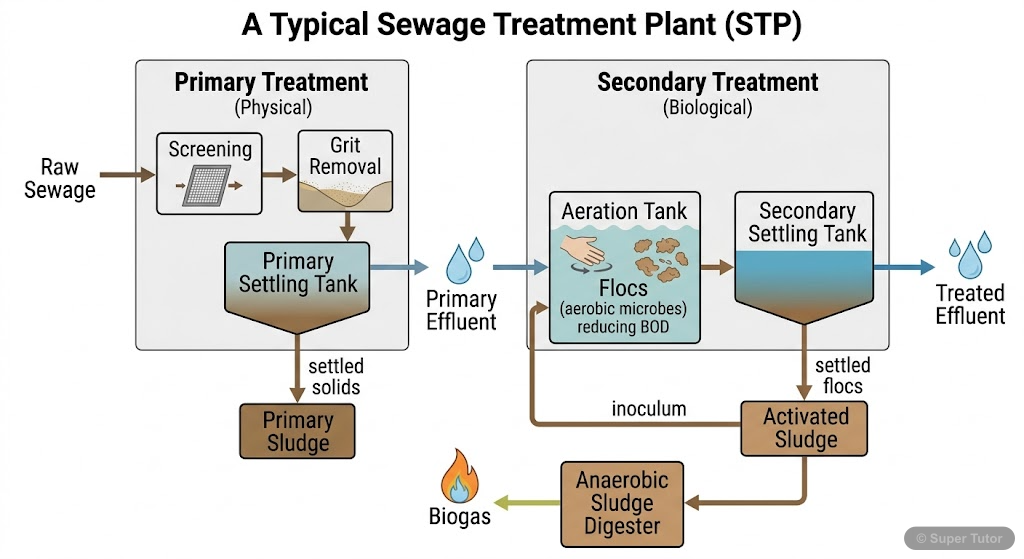
CBSE · Class 12 · Biotechnology
NCERT Solutions for Bioremediation — CBSE Class 12 Biotechnology.
Interactive on Super Tutor
Studying Bioremediation? Get the full interactive chapter.
Quizzes, flashcards, AI doubt-solver and a step-by-step study plan — built for ncert solutions and more.
1,000+ Class 12 students started this chapter today

Super Tutor has 22+ illustrations like this for Bioremediation alone — flashcards, concept maps, and step-by-step visuals.
See them allEXERCISES
1Which microorganisms are used in sewage water treatment and what is their role?Show solution
Concept: Secondary (biological) treatment of sewage relies on microorganisms to degrade organic matter.
Answer:
The following microorganisms are used in sewage water treatment:
1. Bacteria (aerobic): e.g., *Pseudomonas*, *Bacillus*, *Nitrosomonas*, *Nitrobacter* — They decompose dissolved organic matter by oxidation, thereby reducing BOD. Nitrifying bacteria convert ammonia to nitrites and nitrates.
2. Anaerobic bacteria: e.g., *Methanobacterium*, *Clostridium* — Present in anaerobic sludge digesters; they break down organic sludge and produce biogas (methane + CO₂).
3. Fungi: Help in decomposition of complex organic molecules.
4. Algae: In oxidation ponds, algae produce oxygen through photosynthesis, which supports aerobic bacterial activity.
5. Protozoa: Consume bacteria and suspended organic particles, helping to clarify the effluent.
Role Summary:
- Aerobic microbes reduce BOD by oxidising organic matter.
- Anaerobic microbes digest sludge and produce biogas (energy recovery).
- Together they convert harmful organic waste into simpler, harmless inorganic compounds (CO₂, H₂O, NO₃⁻, PO₄³⁻).
Conclusion: Microorganisms are the key biological agents that purify sewage water, making it safe for discharge into water bodies.
2Explain as to how biological oxygen demand represents the condition of sewage water?Show solution
Concept: Biological Oxygen Demand (BOD) is the amount of dissolved oxygen (in mg/L) consumed by microorganisms while decomposing organic matter in a given volume of water at a specific temperature over a fixed period (usually 5 days at 20°C).
Explanation:
- When sewage water contains high organic matter, aerobic microorganisms multiply rapidly and consume more dissolved oxygen to decompose the organic waste.
- This leads to a high BOD value, indicating heavily polluted water.
- Conversely, clean water has very little organic matter; microorganisms consume less oxygen, resulting in a low BOD value.
Interpretation:
| BOD Value | Condition of Water |
|---|---|
| Low (< 2 mg/L) | Clean, unpolluted water |
| Moderate (2–8 mg/L) | Moderately polluted |
| High (> 8 mg/L) | Heavily polluted / sewage water |
Conclusion: BOD is a reliable indicator of the degree of organic pollution in sewage water — higher the BOD, greater the pollution and poorer the water quality.
3How does any toxic substance get biomagnified among organisms? Explain in brief.Show solution
Concept: Biomagnification (Biological Magnification) is the progressive increase in the concentration of a toxic, non-biodegradable substance at successive trophic levels of a food chain.
Mechanism:
1. Entry: Toxic substances (e.g., pesticides like DDT) are released into the environment and enter water or soil.
2. Absorption by producers: Aquatic plants or phytoplankton absorb small amounts of the toxin. Since the substance is non-biodegradable, it accumulates in their tissues.
3. Transfer to primary consumers: Small organisms (zooplankton, insects) consume large quantities of producers, so the toxin concentration in their body becomes higher than in producers.
4. Transfer to higher trophic levels: Small fish eat zooplankton → large fish eat small fish → birds/humans eat large fish. At each step, the organism consumes many individuals of the lower trophic level, so the toxin concentration multiplies at each level.
Example (DDT in aquatic food chain):
Conclusion: Because toxic substances are fat-soluble and non-biodegradable, they accumulate in fatty tissues and are not excreted. Their concentration increases at each trophic level — this is biomagnification. Top predators (including humans) suffer the most.
4What are xenobiotic compounds? How do these compounds affect the productivity of soil?Show solution
Definition of Xenobiotic Compounds:
Xenobiotic compounds are synthetic, man-made chemical substances that are foreign to a biological system or to the natural environment. They are not naturally produced by organisms and are generally resistant to biodegradation.
Examples: Pesticides (DDT, BHC), herbicides (atrazine), polychlorinated biphenyls (PCBs), plastics, detergents, industrial solvents.
Effects on Soil Productivity:
1. Destruction of soil microflora: Xenobiotics kill beneficial soil bacteria, fungi, and actinomycetes that are responsible for nutrient cycling (nitrogen fixation, nitrification, decomposition). This reduces soil fertility.
2. Inhibition of nitrogen fixation: Pesticides and herbicides inhibit the activity of *Rhizobium* and free-living nitrogen-fixing bacteria, reducing the availability of nitrogen to plants.
3. Disruption of decomposition: Decomposers (bacteria, fungi) are killed or inhibited, leading to accumulation of undecomposed organic matter and reduced humus formation.
4. Soil structure damage: Earthworms and other soil organisms that improve soil aeration and structure are killed, making soil compact and less productive.
5. Bioaccumulation in soil: Xenobiotics persist in soil for long periods, making it toxic for plant growth and reducing crop yield.
6. Leaching into groundwater: They contaminate groundwater, further reducing the availability of clean irrigation water.
Conclusion: Xenobiotic compounds severely degrade soil health by eliminating beneficial microorganisms and disrupting natural biogeochemical cycles, thereby drastically reducing soil productivity.
5Discuss the process of aerobic and anaerobic decomposition of sewage waste water treatment.Show solution
Concept: Biological (secondary) treatment of sewage uses both aerobic and anaerobic microbial processes.
---
A. Aerobic Decomposition (Secondary Treatment — Aeration Tanks)
- Sewage effluent (after primary treatment) is pumped into large aeration tanks.
- Air is continuously bubbled through the water to maintain high dissolved oxygen levels.
- Aerobic bacteria (e.g., *Pseudomonas*, *Bacillus*) use dissolved oxygen to oxidise organic matter:
- Bacteria form flocs (masses of bacteria held together by slime and fungal filaments).
- BOD of the water is significantly reduced.
- The treated water (effluent) is passed to a settling tank where flocs settle as activated sludge.
- A part of activated sludge is returned to the aeration tank as inoculum; the rest is sent for anaerobic digestion.
---
B. Anaerobic Decomposition (Sludge Digestion)
- The activated sludge collected from settling tanks is pumped into large anaerobic sludge digesters (closed tanks).
- In the absence of oxygen, anaerobic bacteria (e.g., *Methanobacterium*, *Clostridium*) digest the organic sludge:
- The biogas produced (mainly methane) can be used as a source of energy.
- The digested sludge is dried and used as manure/fertiliser.
---
Comparison:
| Feature | Aerobic | Anaerobic |
|---|---|---|
| Oxygen requirement | Required | Not required |
| End products | CO₂, H₂O | CH₄, CO₂, H₂S |
| Location | Aeration tanks | Sludge digesters |
| Purpose | Reduce BOD | Digest sludge, produce biogas |
Conclusion: Both aerobic and anaerobic processes together ensure effective treatment of sewage, reducing organic load and producing useful by-products like biogas and manure.
6What are the different types of solid wastes produced?Show solution
Definition: All non-liquid waste materials generated from households, streets, industrial, commercial, and agricultural activities are called solid wastes.
Types of Solid Wastes:
I. Based on Biodegradability:
1. Biodegradable waste: Waste that can be decomposed by microorganisms.
- Examples: Food scraps, vegetable peels, fruit waste, animal dung, fallen leaves, paper, cotton.
2. Non-biodegradable waste: Waste that cannot be easily decomposed.
- Examples: Plastics, glass, metals, synthetic fibres, electronic waste.
II. Based on Source:
1. Household/Municipal solid waste: Kitchen waste, packaging materials, old newspapers, broken furniture.
2. Industrial solid waste: Chemical sludge, fly ash, slag, toxic metals, radioactive waste from factories and power plants.
3. Agricultural solid waste: Crop residues (straw, husk), animal dung, pesticide containers.
4. Biomedical/Health care waste: Used syringes, needles, bandages, expired medicines, anatomical waste, laboratory waste — classified under BMWM Rules 2016 into Yellow, Red, White, and Blue categories.
5. Construction waste: Debris, bricks, concrete, wood from demolition.
6. Electronic waste (E-waste): Discarded computers, mobile phones, batteries containing toxic metals like lead, mercury, cadmium.
7. Radioactive waste: Generated from nuclear power plants, research laboratories, hospitals using radioactive isotopes.
Conclusion: Solid wastes are diverse in nature and source; their proper management is essential to prevent environmental pollution and disease transmission.
7Discuss the role of different microorganisms in the process of composting of solid waste.Show solution
Definition of Composting: Composting is the biological decomposition of organic solid waste (fruits, vegetables, animal dung, fallen leaves) under controlled conditions by microorganisms to produce a stable, humus-like material called compost, which is used as a soil conditioner and fertiliser.
Stages and Role of Microorganisms:
Stage 1 — Mesophilic Phase (Initial decomposition, 25–40°C):
- Mesophilic bacteria and fungi (e.g., *Bacillus*, *Aspergillus*) begin decomposing easily degradable organic matter.
- Temperature of the compost pile rises due to microbial metabolic heat.
Stage 2 — Thermophilic Phase (Active decomposition, 50–70°C):
- Thermophilic bacteria (e.g., *Thermus*, *Bacillus stearothermophilus*) and thermophilic actinomycetes (e.g., *Thermoactinomyces*) become dominant.
- They break down complex molecules like cellulose, hemicellulose, lignin, and proteins.
- High temperature kills pathogens and weed seeds.
Stage 3 — Cooling and Maturation Phase:
- As easily degradable material is exhausted, temperature drops.
- Mesophilic microorganisms recolonise and continue decomposition.
- Actinomycetes (e.g., *Streptomyces*) play a key role in breaking down tough materials like lignin and chitin.
- Fungi (e.g., *Trichoderma*, *Penicillium*) decompose cellulose and other complex carbohydrates.
Role of Specific Microorganisms:
| Microorganism | Role |
|---|---|
| Bacteria (*Bacillus*, *Pseudomonas*) | Decompose proteins, carbohydrates, fats |
| Actinomycetes (*Streptomyces*) | Break down lignin, cellulose, chitin |
| Fungi (*Trichoderma*, *Aspergillus*) | Decompose cellulose, hemicellulose |
| Earthworms (in vermicomposting) | Fragment organic matter, enhance microbial activity |
End Product: Mature compost — dark, crumbly, humus-rich material that improves soil structure and provides nutrients.
Conclusion: Composting is a multi-stage process driven by a succession of microorganisms (bacteria, actinomycetes, fungi) that collectively convert organic solid waste into valuable compost, reducing landfill burden and enriching soil fertility.
8How are pesticides harmful for non-target organisms?Show solution
Concept: Pesticides are often non-specific and non-biodegradable, so they affect organisms other than the intended target.
Ways Pesticides Harm Non-Target Organisms:
1. Biomagnification: Pesticides like DDT are fat-soluble and non-biodegradable. They accumulate in fatty tissues and become concentrated at higher trophic levels. Top predators (eagles, humans) suffer toxic effects like reproductive failure (thinning of eggshells in birds), neurological damage, and cancer.
2. Harm to beneficial insects: Pesticides kill pollinators like bees and butterflies, disrupting pollination and reducing crop yields. They also kill natural predators of pests (ladybirds, lacewings), leading to pest resurgence.
3. Harm to soil organisms: Pesticides kill beneficial soil bacteria (*Rhizobium*, nitrifying bacteria), fungi, earthworms, and actinomycetes, reducing soil fertility and disrupting nutrient cycles.
4. Aquatic toxicity: Pesticides leach into water bodies and kill fish, amphibians, and aquatic invertebrates. They disrupt aquatic food chains.
5. Harm to birds and mammals: Birds that eat pesticide-treated seeds or contaminated insects suffer poisoning. Mammals drinking contaminated water are also affected.
6. Human health effects: Pesticide residues in food, water, and air cause acute poisoning, endocrine disruption, carcinogenesis, and neurological disorders in humans.
7. Disruption of food webs: Loss of non-target species at any trophic level can collapse entire food webs and reduce biodiversity.
Conclusion: Pesticides, due to their persistence and non-specificity, cause widespread ecological damage to non-target organisms across all trophic levels, threatening biodiversity and ecosystem stability.
9Briefly explain as to how microorganisms can bioremediate toxic pesticides into harmless and non-toxic compounds.Show solution
Definition: Bioremediation is the use of living organisms (mainly microorganisms) to degrade or detoxify hazardous pollutants in the environment into harmless or less toxic compounds.
Mechanisms by which Microorganisms Bioremediate Pesticides:
1. Mineralisation (Complete Degradation):
- Microorganisms use pesticides as a carbon and energy source.
- They completely break down the pesticide into inorganic end products:
- Example: *Pseudomonas putida* degrades organophosphate pesticides (parathion) completely.
2. Co-metabolism:
- Microorganisms degrade pesticides incidentally while metabolising another substrate.
- The pesticide is transformed into less toxic intermediates even though it is not used as an energy source.
3. Enzymatic Degradation:
- Microorganisms produce specific enzymes that break down pesticide molecules:
- Esterases — hydrolyse ester bonds in organophosphates and carbamates.
- Cytochrome P450 — oxidises chlorinated pesticides.
- Peroxidases — oxidise aromatic rings in pesticides.
- Example: Organophosphate hydrolase enzyme produced by *Flavobacterium* degrades parathion.
4. Reductive Dechlorination:
- Anaerobic bacteria remove chlorine atoms from chlorinated pesticides (e.g., DDT, lindane), making them less toxic.
5. Bioaugmentation:
- Specific pesticide-degrading microorganisms are introduced into contaminated sites to enhance degradation.
- Example: *Arthrobacter* sp. degrades atrazine (herbicide).
Examples of Pesticide-Degrading Microorganisms:
| Microorganism | Pesticide Degraded |
|---|---|
| *Pseudomonas putida* | Organophosphates |
| *Flavobacterium* sp. | Parathion |
| *Arthrobacter* sp. | Atrazine |
| *Phanerochaete chrysosporium* (fungus) | DDT, lindane |
Conclusion: Microorganisms bioremediate toxic pesticides through mineralisation, co-metabolism, enzymatic hydrolysis, and reductive dechlorination, converting them into harmless CO₂, H₂O, and inorganic salts, thereby detoxifying contaminated environments.
10Which of the following compounds can be removed from waste water during treatment using lime?
(a) Organic compound
(b) Phosphorous salts
(c) Ammonia
(d) UreaShow solution
Justification: During tertiary (advanced) treatment of waste water, lime (calcium hydroxide, Ca(OH)₂) is added to precipitate phosphorous salts as insoluble calcium phosphate:
This chemical precipitation removes phosphorus from the effluent, preventing eutrophication of receiving water bodies. Lime does not effectively remove organic compounds, ammonia, or urea in the same manner.
11Maximum decomposition of water takes place during:
(a) Primary treatment only
(b) Primary and Secondary treatment both
(c) Secondary treatment only
(d) Secondary and tertiary treatment bothShow solution
Justification: Secondary (biological) treatment involves aerobic and anaerobic microbial degradation of dissolved and suspended organic matter in sewage water. This is where the maximum decomposition of organic material occurs, leading to the greatest reduction in BOD. Primary treatment only removes large floating solids by physical means (screening, sedimentation), while tertiary treatment removes residual nutrients and fine particles — neither achieves the level of organic decomposition that secondary treatment does.
12Which enzyme is mainly responsible for hydrolytic breakdown of pesticides?
(a) Peroxidase
(b) Oxidase
(c) Cytochrome P450
(d) EsteraseShow solution
Justification: Esterases are hydrolytic enzymes that cleave ester bonds present in organophosphate and carbamate pesticides, breaking them down into less toxic or non-toxic products through hydrolysis. Peroxidase and Cytochrome P450 are oxidative enzymes involved in oxidative degradation, not hydrolytic breakdown. Therefore, esterase is the enzyme mainly responsible for the hydrolytic breakdown of pesticides.
13Which of the following is not a strategy of bioremediation?
(a) Sludge digestion
(b) Composting
(c) Slurry bioreactor
(d) BiopilesShow solution
Justification: Sludge digestion is a process used in sewage water treatment (anaerobic digestion of activated sludge to produce biogas), not a strategy of bioremediation of contaminated soil or hazardous waste. In contrast, composting, slurry bioreactors, and biopiles are all recognised ex-situ or in-situ bioremediation strategies used to treat contaminated soil and solid waste using microbial activity.
14Assertion: Bioremediation is a process through which toxic pesticides can be completely removed.
Reason: Microorganisms can be used for bioremediation of toxic chemicals.
(a) Both assertion and reason are true and the reason is correct explanation of assertion.
(b) Both assertion and reason are true but the reason is not the correct explanation of the assertion.
(c) Assertion is true but reason is false.
(d) Both assertion and reason are false.Show solution
Justification: The assertion is true — bioremediation can completely remove (mineralise) toxic pesticides into harmless end products like CO₂ and H₂O. The reason is also true — microorganisms (bacteria, fungi) are the primary agents used in bioremediation. Furthermore, the reason correctly explains the assertion because it is precisely the metabolic activity of microorganisms (producing enzymes like esterases, cytochrome P450) that enables the complete degradation of toxic pesticides, making (a) the correct choice.
15On the basis of the colour coding and type of container for disposal of health care waste, choose the correct match:
(a) Yellow — recyclable plastic waste
(b) Red — metallic body
(c) White — sharp metals, needle, syringes
(d) Blue — general health care wasteShow solution
Justification: As per the Biomedical Waste Management Rules 2016 (BMWM):
- Yellow — Anatomical waste, soiled waste, discarded/expired medicines, chemical waste, microbiology waste.
- Red — Contaminated recyclable plastic waste (IV tubes, catheters, syringes without needles, gloves).
- White — Sharps including used/discarded/contaminated metal sharps, needles, syringes with fixed needles, blades, scalpels.
- Blue — Metallic body implants, broken/discarded/contaminated glass vials, ampoules.
Therefore, option (c) White — sharp metals, needles, syringes is the correct match.
16What is the basis of classifying organisms into four risk groups?Show solution
Concept: The WHO (World Health Organization) classifies microorganisms/biological agents into four risk groups based on the risk they pose to individual health and community/public health.
Basis of Classification:
The classification is based on the following risk factors:
1. Pathogenicity — The ability of the organism to cause disease in a healthy human host.
2. Mode of transmission — How the organism spreads (contact, airborne, vector-borne, etc.).
3. Availability of preventive measures — Whether vaccines or prophylactic treatments are available.
4. Availability of effective treatment — Whether the disease caused can be treated with available medicines/therapies.
The Four Risk Groups:
| Risk Group | Description | Example |
|---|---|---|
| Risk Group 1 | No or low individual and community risk; unlikely to cause disease in healthy humans | *E. coli* K12, *Bacillus subtilis* |
| Risk Group 2 | Moderate individual risk, low community risk; can cause disease but effective treatment available | *Salmonella typhi*, Hepatitis A virus |
| Risk Group 3 | High individual risk, low community risk; causes serious disease, treatment available but spread is limited | *Mycobacterium tuberculosis*, HIV |
| Risk Group 4 | High individual and community risk; causes severe disease, no treatment or vaccine available | Ebola virus, Marburg virus |
Conclusion: The four risk groups are classified on the basis of pathogenicity, mode of transmission, and availability of preventive and curative measures, helping health care facilities handle and dispose of biomedical waste safely and appropriately.
Stuck on a step?
Ask Super Tutor AI to explain any solution on this page in a simpler way — free, 24x7.
Ask a Doubt FreeFrequently Asked Questions
What are the important topics in Bioremediation for CBSE Class 12 Biotechnology?
How to score full marks in Bioremediation — CBSE Class 12 Biotechnology?
Where can I get free NCERT Solutions for Bioremediation Class 12 Biotechnology?
Sources & Official References
- NCERT Official — ncert.nic.in
- CBSE Academic — cbseacademic.nic.in
- CBSE Official — cbse.gov.in
- National Education Policy 2020 — education.gov.in
Content is aligned to the official syllabus. Refer to the board website for the latest curriculum.
More resources for Bioremediation
Important Questions
Practice with board exam-style questions
Syllabus
What topics to cover
Revision Notes
Key points for last-minute revision
Study Plan
Step-by-step plan to ace this chapter
Flashcards
Quick-fire cards for active recall
Formula Sheet
All formulas in one place
Chapter Summary
Understand the chapter at a glance
Practice Quiz
Test yourself with a quick quiz
Concept Maps
See how topics connect visually
For serious students
Get the full Bioremediation chapter — for free.
Quizzes, flashcards, AI doubt-solver and a step-by-step study plan for CBSE Class 12 Biotechnology.