Bioprocessing and Biomanufacturing
CBSE · Class 12 · Biotechnology
NCERT Solutions for Bioprocessing and Biomanufacturing — CBSE Class 12 Biotechnology.
Interactive on Super Tutor
Studying Bioprocessing and Biomanufacturing? Get the full interactive chapter.
Quizzes, flashcards, AI doubt-solver and a step-by-step study plan — built for ncert solutions and more.
1,000+ Class 12 students started this chapter today

This is just one of 14+ visuals inside Super Tutor's Bioprocessing and Biomanufacturing chapter
Explore the full setEXERCISES
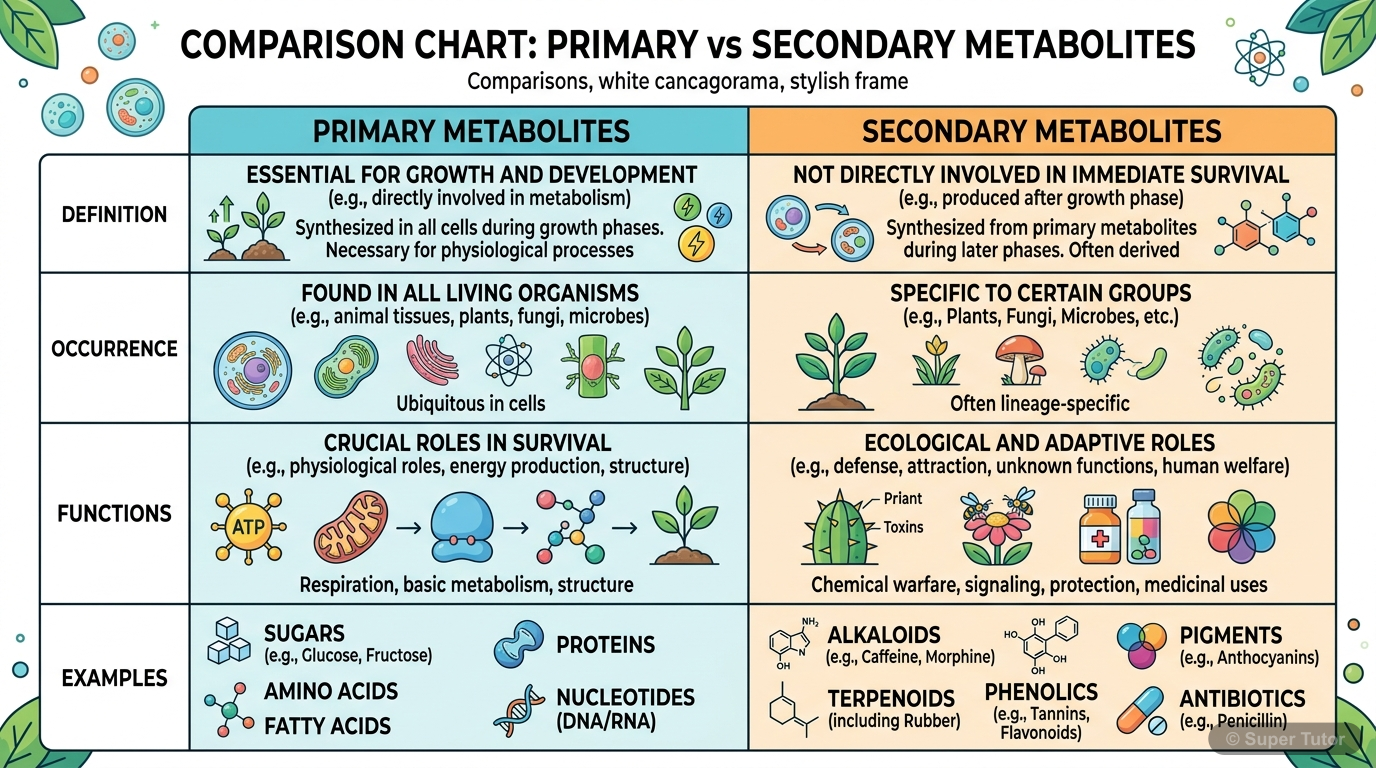
1Differentiate between primary and secondary metabolites based on their functions with example.Show solution
Concept: Metabolites are classified based on their role in the organism's life processes.
| Feature | Primary Metabolites | Secondary Metabolites |
|---|---|---|
| Definition | Compounds directly involved in normal growth, development and reproduction of an organism | Compounds not directly involved in normal growth and development but serve other ecological/physiological roles |
| Function | Essential for the survival of the organism; involved in energy production, biosynthesis and cell structure | Involved in defense against pathogens, competition, tolerance to abiotic stress, attraction of pollinators, etc. |
| Time of production | Produced during the active growth phase (trophophase) | Produced during the stationary/idiophase, after active growth ceases |
| Amount produced | Produced in relatively large amounts | Produced in very small (trace) amounts |
| Industrial use | Ethanol, lactic acid, amino acids, vitamins, enzymes | Antibiotics (penicillin), alkaloids (morphine, quinine), terpenes, phenolics, flavonoids |
| Examples | Glucose, pyruvate, ATP, amino acids, nucleotides | Penicillin, streptomycin, taxol, resveratrol, caffeine |
Conclusion: Primary metabolites are indispensable for life processes, while secondary metabolites serve specialized ecological and protective roles and are of great commercial importance in pharmaceuticals, cosmetics and food industries.
2Explain the challenges encountered during the development of a bioprocess.Show solution
Concept: A bioprocess involves using living organisms or their components to produce desired products at an industrial scale. Several challenges arise at different stages.
Challenges in Bioprocess Development:
(i) Selection of suitable microorganism/cell line:
Identifying and selecting a microorganism or cell line that can produce the desired product in high yield is a primary challenge. The organism must be genetically stable, safe and amenable to genetic manipulation.
(ii) Optimisation of culture conditions:
Maintaining optimal parameters such as temperature, pH, dissolved oxygen, agitation speed and nutrient concentration is critical. Even slight deviations can drastically reduce product yield or quality.
(iii) Scale-up problems:
A process that works efficiently at laboratory scale (small bioreactor) may not perform equally well when scaled up to industrial level. Mixing efficiency, oxygen transfer rate and heat dissipation become difficult to maintain at larger volumes.
(iv) Contamination control:
Maintaining aseptic conditions throughout the process is challenging. Contamination by unwanted microorganisms can destroy the entire batch and cause significant economic loss.
(v) Downstream processing:
Recovery and purification of the desired product from a complex mixture of cells, media components and by-products is technically demanding and expensive. It often accounts for 60–80% of the total production cost.
(vi) Regulatory and safety requirements:
Products intended for pharmaceutical or food use must meet stringent regulatory standards (e.g., GMP — Good Manufacturing Practices), which adds to the complexity and cost.
(vii) Economic viability:
Ensuring that the overall process is cost-effective and commercially viable, including raw material costs, energy consumption and waste management, is a major challenge.
Conclusion: Overcoming these challenges requires interdisciplinary expertise in microbiology, biochemical engineering, genetics and regulatory science.
3Describe briefly the design and components of a typical bioreactor and their applications.Show solution
Definition: A bioreactor (or fermenter) is an engineered vessel that provides optimum conditions (temperature, pH, oxygen, nutrients) for the growth of microorganisms or cells and the production of desired biological products.
Design:
A typical bioreactor is a cylindrical vessel (usually made of stainless steel) with a domed top and bottom. It is designed to be sterilisable (autoclavable or steam-in-place) and to allow aseptic operation.
Components and their Applications:
| Component | Description | Application/Function |
|---|---|---|
| Vessel/Tank | Cylindrical stainless steel container | Holds the culture medium and organisms |
| Agitator (Impeller) | Rotating device inside the vessel | Helps in mixing the contents uniformly; ensures homogeneous distribution of nutrients, oxygen and temperature |
| Sparger | A device (perforated ring/pipe) at the bottom | Provides adequate and continuous supply of sterile air/oxygen to the culture |
| Baffle | Vertical plates attached to the inner wall | Breaks the vortex formation caused by agitation; improves mixing efficiency |
| Jacket / Coils | Water-circulating jacket around the vessel or internal coils | Provides area for circulation of water at desired temperature; maintains temperature control (heating or cooling) |
| pH sensor | Electrode probe | Monitors and controls the pH of the culture medium |
| Dissolved Oxygen (DO) sensor | Polarographic probe | Monitors oxygen levels in the medium |
| Temperature sensor | Thermocouple/RTD | Monitors and regulates temperature |
| Foam sensor & antifoam system | Detects foam; adds antifoam agent | Prevents excessive foaming which can block filters and cause contamination |
| Inlet/Outlet ports | Sterile ports for addition of medium, acid/base, antifoam | Allow aseptic addition and sampling |
| Exhaust filter | HEPA filter on the gas outlet | Prevents contamination from outside; allows gas to escape |
Conclusion: The integrated design of a bioreactor ensures that all physicochemical parameters are maintained at optimal levels, thereby maximising the yield of the desired biological product.
4Explain the basic operational stages of a bioprocess using concept map.Show solution
Concept: A bioprocess is broadly divided into two major stages — Upstream Processing and Downstream Processing — with the bioreactor operation at the centre.
Concept Map of Bioprocess:
Stage 1 — Upstream Processing:
- Selection and development of suitable organism/cell line
- Preparation and sterilisation of culture medium
- Sterilisation of bioreactor and accessories
- Preparation of pure, healthy and active inoculum (seed culture)
- Inoculation of the bioreactor
Stage 2 — Bioreactor Operation (Production Phase):
Three modes of operation:
- (i) Batch process: Closed vessel; no addition of fresh medium; all nutrients added at the start.
- (ii) Fed-batch process: Growth-limiting substrate is fed intermittently or continuously; volume increases over time.
- (iii) Continuous process: Fresh medium is continuously added and spent medium is continuously removed; steady state is maintained.
During operation, parameters monitored and controlled:
Stage 3 — Downstream Processing:
- Separation of biomass from broth (centrifugation, filtration)
- Cell disruption (for intracellular products)
- Primary recovery/isolation of product
- Purification (chromatography, ultrafiltration, reverse osmosis, dialysis)
- Formulation and quality control
- Packaging and storage
Conclusion: The three stages are sequential and interdependent; optimisation at each stage is essential for an economically viable and high-quality bioprocess.
5Describe briefly the following:
(a) upstream processing
(b) downstream processingShow solution
Definition: Upstream processing refers to all the steps that take place before the actual fermentation/bioreactor run. It encompasses everything needed to prepare for the production phase.
Steps involved:
1. Selection of organism: Choosing a suitable microorganism, plant cell or animal cell that can produce the desired product efficiently.
2. Medium formulation: Designing and preparing a nutrient medium that supports optimal growth and product formation. The medium must contain carbon source, nitrogen source, minerals, vitamins and water.
3. Sterilisation: The medium and all equipment (bioreactor, pipes, filters) are sterilised to eliminate contaminating organisms. This is done by autoclaving, filtration or chemical treatment.
4. Inoculum preparation: A pure, healthy and metabolically active starter culture (seed culture) is prepared in small flasks and progressively scaled up before being introduced into the main bioreactor.
5. Inoculation: The prepared inoculum is aseptically transferred into the sterilised bioreactor containing the sterile medium.
Significance: Proper upstream processing ensures contamination-free, reproducible and high-yield fermentation.
---
(b) Downstream Processing:
Definition: Downstream processing refers to all the steps carried out after the fermentation/bioreactor run to recover, isolate and purify the desired product from the fermentation broth.
Steps involved:
1. Separation of biomass: Cells/biomass are separated from the broth by centrifugation or filtration.
2. Cell disruption (if product is intracellular): Cells are broken open by mechanical methods (homogenisation, bead milling), physical methods (sonication) or chemical methods (detergents, solvents) to release the product.
3. Primary recovery: The product is initially isolated from the crude extract by techniques such as precipitation, solvent extraction or adsorption.
4. Purification: The product is further purified using:
- Chromatography (ion exchange, affinity, gel filtration)
- Ultrafiltration / Reverse osmosis (membrane-based separation)
- Dialysis (removal of small molecules)
- Distillation / Drying (for volatile or solid products)
5. Formulation: The purified product is formulated into the final dosage form (liquid, powder, tablet) with appropriate stabilisers and excipients.
6. Quality control and packaging: The product is tested for purity, potency and safety before packaging.
Significance: Downstream processing ensures that the final product meets the required quality, purity and safety standards for commercial use.
6Explain the recovery and purification process of an intracellular product with the help of a flow diagram.Show solution
Concept: Intracellular products are those that are synthesised and retained inside the cell (e.g., recombinant proteins expressed as inclusion bodies, intracellular enzymes). They require cell disruption before purification.
Flow Diagram:
Explanation of key steps:
- Cell disruption is the critical step unique to intracellular products; the method chosen depends on the cell type and the stability of the product.
- Centrifugation at each stage removes insoluble debris and clarifies the extract.
- Chromatography provides high-resolution purification and is essential for pharmaceutical-grade products.
- Dialysis/Ultrafiltration removes small molecular weight impurities and buffer exchange is performed.
Conclusion: The recovery of intracellular products is more complex and costly than extracellular products due to the additional cell disruption step, but the same downstream purification principles apply.
7Write short notes on the following:
(a) reverse osmosis
(b) dialysisShow solution
Definition: Reverse osmosis (RO) is a membrane-based separation technique in which a solvent (usually water) is forced through a semi-permeable membrane from a region of higher solute concentration to lower solute concentration by applying external pressure greater than the osmotic pressure.
Principle:
In normal osmosis, solvent moves from low solute concentration to high solute concentration across a semi-permeable membrane. In reverse osmosis, this natural flow is reversed by applying external hydraulic pressure.
\text{Applied Pressure} > \text{Osmotic Pressure} \Rightarrow \text{Solvent moves from high concentration to low concentration}
Process:
- The fermentation broth or product solution is pressurised against a semi-permeable membrane.
- Water and very small molecules pass through the membrane (permeate).
- Larger molecules, proteins, salts and other solutes are retained (retentate).
Applications in Bioprocessing:
- Concentration of dilute product solutions (e.g., concentrating antibiotics, proteins).
- Removal of water from the product stream.
- Desalination and water purification.
- Pre-treatment step before further purification.
Advantages: No phase change required; energy efficient; can handle heat-sensitive biological products.
---
(b) Dialysis:
Definition: Dialysis is a membrane-based separation technique used to remove small molecular weight solutes (salts, small organic molecules) from a solution containing large molecules (proteins, nucleic acids) by selective diffusion across a semi-permeable membrane.
Principle:
A dialysis membrane (e.g., cellulose tubing) has pores of defined size. Small molecules diffuse freely through the pores down their concentration gradient into the surrounding buffer (dialysate), while large molecules are retained inside the membrane.
Process:
- The crude protein/product solution is placed inside a dialysis bag (semi-permeable tubing).
- The bag is immersed in a large volume of buffer.
- Small impurities diffuse out; the buffer is changed several times to drive the equilibrium.
Applications in Bioprocessing:
- Removal of ammonium sulphate after protein precipitation.
- Buffer exchange (changing the buffer composition of a protein solution).
- Removal of small molecular weight contaminants from protein preparations.
- Desalting of enzyme or antibody solutions.
Advantages: Simple, inexpensive, gentle on biological macromolecules; no special equipment required.
Limitation: Slow process; not suitable for large-scale industrial operations (ultrafiltration is preferred at large scale).
8Match the following:
(a) Agitator — (i) Breaking the vortex formation
(b) Sparger — (ii) Provides area for circulation of water of desired temperature
(c) Baffle — (iii) Helps in mixing the contents
(d) Jacket — (iv) Provides adequate and continuous supply of airShow solution
Concept: Each component of a bioreactor has a specific and distinct function.
Correct Matching:
| Component | Function |
|---|---|
| (a) Agitator | (iii) Helps in mixing the contents |
| (b) Sparger | (iv) Provides adequate and continuous supply of air |
| (c) Baffle | (i) Breaking the vortex formation |
| (d) Jacket | (ii) Provides area for circulation of water of desired temperature |
Justification:
- Agitator (Impeller): Rotates inside the bioreactor to mix the culture medium, ensuring uniform distribution of nutrients, oxygen and temperature throughout the vessel.
- Sparger: A perforated ring or pipe located at the bottom of the bioreactor through which sterile air or oxygen is bubbled into the culture medium.
- Baffle: Vertical plates fixed to the inner wall of the bioreactor that disrupt the circular flow (vortex) created by the agitator, thereby improving mixing efficiency.
- Jacket: A water-filled outer casing surrounding the bioreactor vessel through which water at a controlled temperature is circulated to maintain the desired temperature inside the bioreactor.
9A culture in a closed vessel to which no additional medium is added is called __________ culture.
(a) Continuous
(b) Batch
(c) Fed-batch
(d) Semi continuousShow solution
Justification:
In a batch culture, all nutrients are added at the beginning and the vessel is closed — no additional medium is added during the process. The culture goes through all growth phases (lag, log, stationary and decline) and the product is harvested at the end. This is in contrast to:
- Continuous culture: Fresh medium is continuously added and spent medium is continuously removed.
- Fed-batch culture: Growth-limiting substrate is fed intermittently or continuously but the spent medium is not removed.
- Semi-continuous: Partial replacement of medium at intervals.
Therefore, a closed vessel culture with no addition of medium is called a Batch culture.
10Assertion: Secondary metabolites are used in defense against pathogens, phytoplanktons, improving tolerance to abiotic, etc.
Reason: Secondary metabolites are intermediate or indirect products.
(a) Both assertion and reason are true and the reason is the correct explanation of the assertion.
(b) Both assertion and reason are true but the reason is not the correct explanation of the assertion.
(c) Assertion is true but reason is false.
(d) Both assertion and reason are false.Show solution
Justification:
Assertion is TRUE: Secondary metabolites indeed play important roles in defense against pathogens, competition with other organisms (including phytoplanktons), and improving tolerance to abiotic stresses such as UV radiation, drought and temperature extremes. Examples include antibiotics, alkaloids, terpenes and phenolics.
Reason is FALSE: Secondary metabolites are not intermediate or indirect products. They are end products of specialised metabolic pathways that branch off from primary metabolism. They are not intermediates in any metabolic pathway; rather, they are final products that accumulate in the organism and serve ecological/protective functions.
Primary metabolites are the direct products of central metabolic pathways (glycolysis, TCA cycle, etc.), while secondary metabolites are distinct end products synthesised through secondary metabolic pathways.
Therefore, the assertion is correct but the reason given is incorrect, making option (c) the right answer.
Stuck on a step?
Ask Super Tutor AI to explain any solution on this page in a simpler way — free, 24x7.
Ask a Doubt FreeFrequently Asked Questions
What are the important topics in Bioprocessing and Biomanufacturing for CBSE Class 12 Biotechnology?
How to score full marks in Bioprocessing and Biomanufacturing — CBSE Class 12 Biotechnology?
Where can I get free NCERT Solutions for Bioprocessing and Biomanufacturing Class 12 Biotechnology?
Sources & Official References
- NCERT Official — ncert.nic.in
- CBSE Academic — cbseacademic.nic.in
- CBSE Official — cbse.gov.in
- National Education Policy 2020 — education.gov.in
Content is aligned to the official syllabus. Refer to the board website for the latest curriculum.
More resources for Bioprocessing and Biomanufacturing
Important Questions
Practice with board exam-style questions
Syllabus
What topics to cover
Revision Notes
Key points for last-minute revision
Study Plan
Step-by-step plan to ace this chapter
Flashcards
Quick-fire cards for active recall
Formula Sheet
All formulas in one place
Chapter Summary
Understand the chapter at a glance
Practice Quiz
Test yourself with a quick quiz
Concept Maps
See how topics connect visually
For serious students
Get the full Bioprocessing and Biomanufacturing chapter — for free.
Quizzes, flashcards, AI doubt-solver and a step-by-step study plan for CBSE Class 12 Biotechnology.