Chapter 8 of 13
NCERT Solutions

Animal Cell Culture

CBSE · Class 12 · Biotechnology

NCERT Solutions for Animal Cell Culture — CBSE Class 12 Biotechnology.

Interactive on Super Tutor

Studying Animal Cell Culture? Get the full interactive chapter.

Quizzes, flashcards, AI doubt-solver and a step-by-step study plan — built for ncert solutions and more.

1,000+ Class 12 students started this chapter today

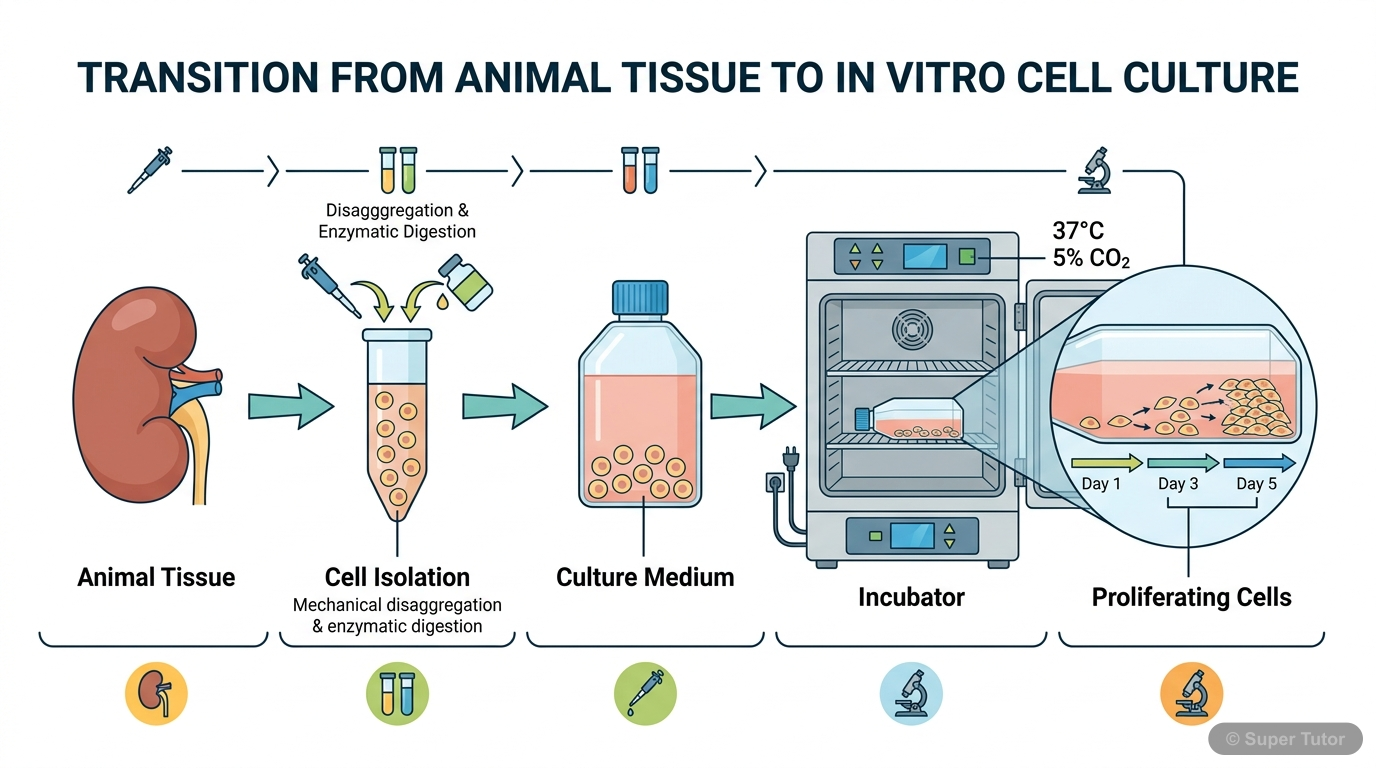
An infographic illustrating the basic concept of animal cell culture, showing cells isolated from an animal tissue and then maintained and proliferated in vitro under controlled laboratory conditions.
Super Tutor

This is just one of 19+ visuals inside Super Tutor's Animal Cell Culture chapter

Explore the full set
21 Questions Solved · 1 Section

EXERCISES — Animal Cell Culture

1What is animal cell culture?Show solution
Given/Concept: Animal cell culture is a fundamental technique in biotechnology.

Answer:
Animal cell culture is defined as the *in vitro* maintenance and proliferation of animal cells in an appropriate nutrient medium under controlled conditions (temperature, pH, CO₂ levels, etc.).

Key points:
- Cells are isolated from animal tissue and grown outside the living organism in a controlled laboratory environment.
- The cells are maintained in a sterile nutrient medium that supplies all essential requirements for growth.
- Optimal conditions include a temperature of 37°C, a pH of 7.2–7.4, and a CO₂ concentration of 5% (to maintain pH via bicarbonate buffer).
- It is used extensively in research, drug development, vaccine production, and genetic studies.

Conclusion: Animal cell culture is an essential tool in modern biotechnology that allows scientists to study cell behaviour, test drugs, and produce biologicals in a controlled *in vitro* environment.
2Describe animal cell culture media and their types.Show solution
Given/Concept: Culture media provide all the nutrients and conditions necessary for the survival and growth of animal cells *in vitro*.

Animal Cell Culture Media and Their Types:

Animal cell culture media are broadly classified into two major categories:

---

A. Natural Media
- Composed of naturally occurring biological fluids.
- Examples: plasma, serum, tissue extracts, lymph, amniotic fluid.
- Suitable for a wide range of animal cells.
- Disadvantage: composition is not precisely defined; risk of contamination.

---

B. Artificial (Synthetic) Media
Made up of defined nutrients — organic and inorganic salts, vitamins, carbohydrates, amino acids, cofactors, O₂, CO₂, serum, etc.
Can be modified according to experimental purpose.

Artificial media are further divided into four sub-categories:

| Type | Description | Example |
|---|---|---|
| 1. Serum-containing media | Contains animal serum (usually 5–20% FBS); provides growth factors, hormones, and attachment factors. | DMEM + FBS, RPMI-1640 + FBS |
| 2. Serum-free media | Lacks serum but is supplemented with specific growth factors, hormones, and proteins to support cell growth. | DMEM/F12 with defined supplements |
| 3. Chemically defined media | Exact chemical composition is known; contains no undefined components; highly reproducible. | MCDB 131, Ham's F-12 |
| 4. Protein-free media | Contains no proteins or peptides; used for production of recombinant proteins to ease downstream purification. | PF-CHO media |

Conclusion: The choice of medium depends on the cell type, purpose of culture, and the need for reproducibility and purity.
3Write the advantages and disadvantages of serum in the culture media.Show solution
Given/Concept: Serum (commonly Fetal Bovine Serum, FBS) is the most widely used supplement in animal cell culture media.

---

Advantages of Serum in Culture Media:

1. Rich source of nutrients: Provides amino acids, vitamins, lipids, and minerals essential for cell growth.
2. Growth factors and hormones: Contains insulin, EGF, FGF, and other growth-promoting factors that stimulate cell proliferation.
3. Cell attachment: Contains fibronectin and other attachment factors that help cells adhere to the culture surface.
4. Buffering capacity: Helps maintain the pH of the culture medium.
5. Protective role: Provides protease inhibitors that protect cells from enzymatic damage.
6. Transport proteins: Albumin and other proteins transport lipids, hormones, and minerals to cells.
7. Detoxification: Binds and neutralises toxic substances present in the medium.

---

Disadvantages of Serum in Culture Media:

1. Undefined composition: The exact composition of serum varies from batch to batch, making experiments difficult to reproduce.
2. Risk of contamination: May contain viruses, mycoplasma, prions, or other biological contaminants.
3. Ethical concerns: Collection from fetal bovine sources raises animal welfare issues.
4. Interference with downstream processing: Serum proteins complicate the purification of recombinant proteins produced by cultured cells.
5. Cost: High-quality serum is expensive.
6. Inhibitory factors: May contain substances that inhibit the growth of certain cell types.

Conclusion: Despite its advantages, the trend in modern cell culture is to move towards serum-free or chemically defined media to overcome the limitations associated with serum.
4Describe any two chemically synthesised media.Show solution
Given/Concept: Chemically defined (synthesised) media have a precisely known composition with no undefined biological components.

---

1. Dulbecco's Modified Eagle's Medium (DMEM)

- Developed by: Dulbecco and Freeman (1959), as a modification of Eagle's Minimum Essential Medium (MEM).
- Composition: Contains a higher concentration of amino acids and vitamins compared to MEM; includes glucose (at high or low concentrations), inorganic salts (NaCl, KCl, Na₂HPO₄, NaHCO₃), and phenol red as a pH indicator.
- pH: Maintained at 7.2–7.4 using a CO₂–bicarbonate buffering system.
- Applications: Widely used for the culture of a variety of mammalian cells including fibroblasts, neurons, glial cells, and endothelial cells.
- Supplementation: Usually supplemented with 5–10% Fetal Bovine Serum (FBS) for routine culture.

---

2. Roswell Park Memorial Institute Medium (RPMI-1640)

- Developed by: Moore *et al.* at Roswell Park Memorial Institute (1966).
- Composition: Contains inorganic salts, glucose, amino acids, vitamins (including biotin, vitamin B12, PABA), glutathione, and HEPES buffer. It has a unique phosphate-buffered formulation.
- pH: 7.2–7.4.
- Applications: Originally developed for the culture of human leukaemic cells; now widely used for suspension cultures of lymphocytes, hybridoma cells, and haematopoietic cells.
- Supplementation: Typically supplemented with 10% FBS.

---

Conclusion: Both DMEM and RPMI-1640 are widely used synthetic media that provide a defined and reproducible environment for animal cell culture, though they are often supplemented with serum for optimal cell growth.
5What is primary cell culture? Also discuss as to how it is developed.Show solution
Given/Concept: Primary cell culture is the first-generation culture established directly from animal tissue.

---

Definition:
Primary cell culture is the culture that is prepared by directly inoculating cells isolated from the tissue of an organism into a culture medium. These cells retain most of the *in vivo* characteristics of the original tissue.

---

Development of Primary Cell Culture:

The development of primary cell culture involves the following steps:

Step 1: Selection and collection of tissue
- A suitable tissue is selected from the donor animal (e.g., kidney, liver, embryonic tissue).
- The tissue is aseptically removed and placed in a sterile container with balanced salt solution (BSS) or phosphate-buffered saline (PBS).

Step 2: Washing
- The tissue is washed 2–3 times with BSS to remove blood, debris, and contaminating microorganisms.

Step 3: Disaggregation of tissue (obtaining single-cell suspension)
Cells must be separated from the tissue. This can be done by:
- Physical disruption: Mechanical cutting or sieving of the tissue.
- Enzymatic digestion: Treatment with proteolytic enzymes such as trypsin or collagenase to break cell–cell and cell–matrix junctions.
- Chelating agents: EDTA chelates Ca²⁺ and Mg²⁺ ions, disrupting cell adhesion.

Step 4: Centrifugation and resuspension
- The cell suspension is centrifuged at low speed to pellet the cells.
- The pellet is resuspended in an appropriate culture medium (e.g., DMEM + 10% FBS).

Step 5: Cell counting and viability check
- Cells are counted using a haemocytometer.
- Cell viability is checked using the Trypan blue dye exclusion test (dead cells take up the dye; live cells exclude it).

Step 6: Seeding into culture vessel
- Cells are seeded at an appropriate density into a culture flask or dish.
- Incubated at 37°C in a 5% CO₂ humidified incubator.

Step 7: Monitoring
- Cells are observed under a microscope for attachment and growth.
- Medium is changed periodically to remove waste products.

---

Types of primary cell growth:
- Adherent/monolayer culture: Cells attach to the surface of the culture vessel and grow as a single layer (e.g., fibroblasts, epithelial cells).
- Suspension culture: Cells grow floating in the medium without attaching (e.g., lymphocytes, leukaemic cells).

Conclusion: Primary cell culture closely mimics the *in vivo* environment and is valuable for physiological and pharmacological studies, but it has a limited lifespan and cannot be subcultured indefinitely.
6What is subculture or passaging of cells?Show solution
Given/Concept: Subculture (passaging) is the process of transferring cells from one culture vessel to a new one to maintain continuous growth.

---

Definition:
Subculture or passaging is the process of transferring a small number of cells from a confluent (fully grown) culture into a fresh culture vessel containing new growth medium, so that the cells can continue to proliferate.

---

Why is it necessary?
- When cells in a culture vessel reach confluence (i.e., they cover the entire surface of the vessel), they stop dividing due to contact inhibition and depletion of nutrients.
- To maintain the culture and allow further growth, cells must be subcultured.

---

Procedure of Subculture:

1. Remove old medium from the culture flask.
2. Wash the cell monolayer with PBS or BSS to remove serum (which inhibits trypsin).
3. Add trypsin–EDTA solution to detach adherent cells from the surface; incubate briefly at 37°C.
4. Neutralise trypsin by adding complete medium containing serum.
5. Collect the cell suspension and centrifuge to pellet the cells.
6. Resuspend the cell pellet in fresh medium.
7. Divide the cell suspension into new culture vessels at a lower (sub-confluent) density.
8. Incubate at 37°C with 5% CO₂.

---

Significance:
- Each subculture is called a passage, and the number of times cells have been subcultured is the passage number.
- Subculturing leads to the establishment of cell lines from primary cultures.
- It allows large-scale expansion of cells for experimental or industrial purposes.

Conclusion: Subculture/passaging is an essential technique in cell culture that maintains cell viability and allows continuous propagation of cells beyond the primary culture stage.
7Differentiate between finite and continuous cell lines.Show solution
Given/Concept: Cell lines are classified based on their lifespan in culture into finite and continuous cell lines.

---

| Feature | Finite Cell Line | Continuous Cell Line |
|---|---|---|
| Definition | Cell lines that have a limited lifespan and can undergo only a fixed number of cell divisions before dying. | Cell lines that have an unlimited lifespan and can proliferate indefinitely *in vitro*. |
| Origin | Derived from primary cultures of normal cells by subculturing. | Arise from finite cell lines when cells undergo spontaneous or induced transformation. |
| Number of divisions | Can divide for a limited number of generations (typically 20–80 population doublings — Hayflick limit). | Can divide indefinitely (immortal). |
| Ploidy | Usually diploid (normal chromosome number). | Usually aneuploid (abnormal chromosome number). |
| Growth rate | Relatively slow. | Relatively fast. |
| Contact inhibition | Present — cells stop dividing when they reach confluence. | Absent — cells continue to divide even after confluence. |
| Anchorage dependence | Anchorage-dependent — require a surface to grow. | Often anchorage-independent — can grow in suspension. |
| Transformation | Not transformed (normal cells). | Transformed (tumour-like properties). |
| Examples | Human diploid fibroblast strains (WI-38, MRC-5). | HeLa cells, Vero cells, CHO cells. |
| Applications | Vaccine production, toxicity testing. | Large-scale production of biologicals, monoclonal antibodies. |

---

Conclusion: Finite cell lines are more representative of normal physiology, while continuous cell lines are more useful for large-scale industrial and research applications due to their unlimited proliferative capacity.
8How is cell viability measurement performed?Show solution
Given/Concept: Cell viability measurement determines the proportion of living (viable) cells in a culture, which is critical for quality control in cell culture experiments.

---

Cell viability is defined as the number of healthy, living cells in a sample as a percentage of the total cell count.

Cell viability is measured by two major types of assays:

---

A. Dye Exclusion / Viability Assays

These are based on the principle that live cells with intact membranes exclude certain dyes, while dead cells with damaged membranes take up the dye.

1. Trypan Blue Dye Exclusion Test:
- Trypan blue is a negatively charged dye.
- Live cells: Intact membrane → exclude the dye → appear colourless/bright under microscope.
- Dead cells: Damaged membrane → take up the dye → appear blue under microscope.
- Cells are counted using a haemocytometer.
- % Viability=Number of viable (unstained) cellsTotal number of cells×100\text{\% Viability} = \frac{\text{Number of viable (unstained) cells}}{\text{Total number of cells}} \times 100

2. Erythrosin B and Eosin Y are other dyes used similarly.

---

B. Metabolic Viability Assays

These are based on the metabolic activity of living cells.

1. MTT Assay (3-(4,5-dimethylthiazol-2-yl)-2,5-diphenyltetrazolium bromide):
- MTT is a yellow-coloured tetrazolium salt.
- Live cells contain active mitochondrial dehydrogenase enzymes that reduce MTT to purple-coloured formazan crystals.
- Dead cells cannot reduce MTT.
- The formazan crystals are dissolved in DMSO and absorbance is measured at 570 nm using a spectrophotometer.
- Higher absorbance = greater number of viable cells.
- Cell viability (%)=Absorbance of test sampleAbsorbance of control×100\text{Cell viability (\%)} = \frac{\text{Absorbance of test sample}}{\text{Absorbance of control}} \times 100

2. MTS and WST-1 assays are similar colorimetric assays used for the same purpose.

3. ATP Bioluminescence Assay:
- Based on the fact that only living cells produce ATP.
- Luciferase enzyme converts ATP + luciferin → light (bioluminescence).
- Light intensity is proportional to the number of viable cells.

---

Conclusion: Cell viability measurement is an essential step in cell culture to ensure the quality of the cell population. The Trypan blue exclusion test is the simplest and most commonly used method, while the MTT assay is preferred for quantitative, high-throughput analysis.
9Write a detailed account of application of cell culture.Show solution
Given/Concept: Animal cell culture has wide-ranging applications in research, medicine, and industry.

---

Applications of Animal Cell Culture:

1. Vaccine Production:
- Animal cell cultures are used to grow viruses for the production of viral vaccines.
- Examples: Polio vaccine (Salk vaccine), rabies vaccine, hepatitis B vaccine, influenza vaccine.
- Cells such as Vero cells and MRC-5 cells are used as substrates for virus propagation.

2. Production of Monoclonal Antibodies (MAbs):
- Hybridoma technology involves fusing antibody-producing B-lymphocytes with myeloma (cancer) cells to produce hybridoma cells.
- Hybridoma cells are cultured *in vitro* to produce large quantities of specific monoclonal antibodies.
- MAbs are used in diagnostics (ELISA, pregnancy tests), cancer therapy (e.g., Trastuzumab/Herceptin for breast cancer), and targeted drug delivery.

3. Production of Recombinant Proteins and Biopharmaceuticals:
- Animal cells (especially CHO cells) are used to produce complex recombinant proteins that require post-translational modifications (glycosylation).
- Examples: Erythropoietin (EPO), tissue plasminogen activator (tPA), clotting factors (Factor VIII for haemophilia), insulin.

4. Gene Therapy:
- Animal cell culture is used to study and develop gene therapy strategies.
- Cells are isolated from patients, genetically corrected *in vitro*, and reintroduced into the patient.
- Example: ADA-SCID (Severe Combined Immunodeficiency) treatment.

5. Molecular Genetics and Genomics:
- Cell cultures are used to study gene expression, gene regulation, DNA replication, and cell signalling pathways.
- Transfection experiments allow introduction of foreign genes into cells to study their function.

6. Cancer Research:
- Tumour cell lines (e.g., HeLa, MCF-7) are used to study the biology of cancer, identify oncogenes, and test anti-cancer drugs.
- Cell culture models help understand mechanisms of metastasis, drug resistance, and apoptosis.

7. Drug Development and Toxicity Testing:
- Cell cultures are used as *in vitro* models to screen new drug candidates for efficacy and toxicity before animal and clinical trials.
- Reduces the need for animal experimentation (3Rs principle: Replace, Reduce, Refine).
- Cytotoxicity assays (e.g., MTT assay) are used to determine IC₅₀ values of drugs.

8. Tissue Engineering and Regenerative Medicine:
- Stem cells and differentiated cells are cultured to engineer tissues and organs (e.g., skin grafts for burn patients, cartilage repair).
- 3D cell culture models and organoids mimic organ structure and function.

9. Molecular Pharming:
- Genes encoding therapeutic proteins are transferred into animals (transgenic animals).
- The proteins are produced in large quantities in the milk, blood, or eggs of these animals.
- Example: Production of human alpha-1-antitrypsin in sheep's milk.

10. Immunological Studies:
- Cell culture is used to study immune cell function, cytokine production, and immune responses.
- Used in the development of immunotherapies and allergy testing.

11. Virology:
- Cell cultures serve as hosts for virus propagation, isolation, and characterisation.
- Used in antiviral drug testing.

---

Conclusion: Animal cell culture is an indispensable tool in modern biotechnology and medicine. Its applications span from basic research to the production of life-saving medicines, making it one of the most important technologies in the life sciences.
10The example of animal cell culture media is:
(a) DMEM
(b) MS media
(c) LB Media
(d) All of the above
Show solution
Correct Answer: (a) DMEM

Justification:
- DMEM (Dulbecco's Modified Eagle's Medium) is a widely used synthetic medium specifically designed for animal cell culture.
- MS medium (Murashige and Skoog medium) is used for plant tissue culture.
- LB medium (Luria-Bertani medium) is used for the culture of bacteria (*E. coli*).
- Therefore, only DMEM is an example of animal cell culture media.
11Name the type of culture that is prepared by inoculating directly from the tissue of an organism to culture media.
(a) Primary cell culture
(b) Secondary cell culture
(c) Cell lines
(d) Transformed cell culture
Show solution
Correct Answer: (a) Primary cell culture

Justification:
Primary cell culture is defined as the culture established by directly inoculating cells isolated from the tissue of an organism into a culture medium. It is the first-generation culture and has not been subcultured. Secondary cell cultures and cell lines are derived from primary cultures after subculturing.
12Sodium bicarbonate is added to animal cell culture media to
(a) keep cells stuck to the plastic
(b) promote the uptake of CO₂ into animal cells
(c) maintain the correct pH when CO₂ is present
(d) keep iron soluble
Show solution
Correct Answer: (c) maintain the correct pH when CO₂ is present

Justification:
Sodium bicarbonate (NaHCO₃) acts as a buffering agent in animal cell culture media. It works in conjunction with the dissolved CO₂ (supplied at 5% in the incubator atmosphere) to maintain the medium at the optimal pH of 7.2–7.4 through the bicarbonate buffering system:
CO2+H2OH2CO3H++HCO3\text{CO}_2 + \text{H}_2\text{O} \rightleftharpoons \text{H}_2\text{CO}_3 \rightleftharpoons \text{H}^+ + \text{HCO}_3^-
13Which of the following is NOT present in growth medium for animal cell culture?
(a) Inorganic salts
(b) Bicarbonate
(c) Carbon source
(d) Starch
Show solution
Correct Answer: (d) Starch

Justification:
Animal cell culture media contain inorganic salts (for osmotic balance), bicarbonate (for pH buffering), and a carbon source (usually glucose as the primary energy source). Starch is a complex polysaccharide that animal cells cannot directly utilise; it is not a component of animal cell culture media. Starch is used in microbial culture media.
14Disaggregating of cells can be performed by:
(a) Physical disruption
(b) Enzymatic digestion
(c) Treating with chelating agents
(d) All of the above
Show solution
Correct Answer: (d) All of the above

Justification:
Disaggregation of tissue into single cells for primary cell culture can be achieved by all three methods:
- (a) Physical disruption: Mechanical cutting, mincing, or sieving of tissue.
- (b) Enzymatic digestion: Using proteases like trypsin or collagenase to break cell–cell and cell–matrix junctions.
- (c) Chelating agents: EDTA chelates divalent cations (Ca²⁺, Mg²⁺) that are required for cell adhesion, thereby loosening cell contacts.
All three methods are used, often in combination, for effective tissue disaggregation.
15The approach in which genes are transferred into animals to obtain a large scale production of the proteins encoded by these genes in the milk, blood, etc., is called
(a) In situ culture
(b) Molecular pharming
(c) Gene therapy
(d) Hybridoma technology
Show solution
Correct Answer: (b) Molecular pharming

Justification:
Molecular pharming (also called pharming) is the technique in which therapeutic genes are introduced into transgenic animals so that the encoded proteins are produced in large quantities in easily harvestable biological fluids such as milk, blood, urine, or eggs. For example, human alpha-1-antitrypsin is produced in the milk of transgenic sheep. This is distinct from gene therapy (which aims to correct genetic defects in patients) and hybridoma technology (which produces monoclonal antibodies).
16Which of the following is a protein-free animal cell culture media?
(a) RPMI-1640 Media
(b) MS media
(c) LB media
(d) None of the above
Show solution
Correct Answer: (d) None of the above

Justification:
- RPMI-1640 is a serum-containing (or serum-free) synthetic medium for animal cells, but it is not classified as protein-free media in the standard sense.
- MS medium is used for plant tissue culture.
- LB medium is used for bacterial culture.
- Protein-free media (e.g., PF-CHO) are specialised formulations not listed among the options. Therefore, none of the above options correctly represents a protein-free animal cell culture medium.
17MTT assay is used for
(a) Cell viability test
(b) Monitoring of variation in pH of culture media
(c) Transformation screening
(d) Cell dissociation from substratum
Show solution
Correct Answer: (a) Cell viability test

Justification:
The MTT assay is a colorimetric assay used to measure cell viability and proliferation. The yellow MTT dye is reduced by mitochondrial dehydrogenase enzymes in metabolically active (living) cells to form purple formazan crystals. The intensity of the purple colour, measured spectrophotometrically at 570 nm, is directly proportional to the number of viable cells. Dead cells cannot perform this reduction.
18Passaging of animal cells in animal cell culture is
(a) Sub-culturing of the cells
(b) Isolation of cells
(c) Passing the cells from culture tube to Petri dishes
(d) Counting of cells
Show solution
Correct Answer: (a) Sub-culturing of the cells

Justification:
Passaging (also called subculturing) refers to the process of transferring a portion of cells from a confluent culture vessel into a new vessel with fresh medium to allow continued cell growth. Each transfer is called a passage, and the number of passages is the passage number. It is not merely moving cells between vessel types or counting them.
19Which of the following is NOT the major function of serum?
(a) Enhance cell attachment
(b) Stimulate cell growth
(c) Promotion of tuber and bulb formation
(d) Provide transport proteins
Show solution
Correct Answer: (c) Promotion of tuber and bulb formation

Justification:
The major functions of serum in animal cell culture include:
- (a) Enhancing cell attachment (via fibronectin and other adhesion factors) ✓
- (b) Stimulating cell growth (via growth factors like EGF, FGF, insulin) ✓
- (d) Providing transport proteins (albumin transports lipids, hormones, etc.) ✓

Promotion of tuber and bulb formation is a function associated with plant growth regulators in plant tissue culture, not with serum in animal cell culture. Hence, option (c) is NOT a function of serum.
20Assertion: Serum is the most important component of culture media.
Reason: Serum is a good source of nutrients and also helps in cell proliferation and cell-matrix attachment.
(a) Both assertion and reason are true and the reason is the correct explanation of the assertion.
(b) Both assertion and reason are true but the reason is not the correct explanation of the assertion.
(c) Assertion is true but reason is false.
(d) Both assertion and reason are false.
Show solution
Correct Answer: (a) Both assertion and reason are true and the reason is the correct explanation of the assertion.

Justification:
- The Assertion is TRUE: Serum is indeed considered the most important and complex component of animal cell culture media, as it provides a wide range of essential factors.
- The Reason is TRUE and correctly explains the Assertion: Serum serves as a rich source of nutrients (amino acids, vitamins, lipids), growth factors that stimulate cell proliferation, and attachment factors (like fibronectin) that facilitate cell–matrix attachment. These functions collectively justify why serum is the most important component of culture media.
- Therefore, both the assertion and reason are true, and the reason is the correct explanation of the assertion.
21Assertion: Cell lines derived from the primary culture of normal cells are finite cell line.
Reason: Some cells of the finite cell line undergoes transformation and retain the ability to divide indefinitely.
(a) Both assertion and reason are true and the reason is the correct explanation of the assertion.
(b) Both assertion and reason are true but the reason is not the correct explanation of the assertion.
(c) Assertion is true but reason is false.
(d) Both assertion and reason are false.
Show solution
Correct Answer: (b) Both assertion and reason are true but the reason is not the correct explanation of the assertion.

Justification:
- The Assertion is TRUE: Cell lines derived from primary cultures of normal cells are indeed finite cell lines — they can undergo only a limited number of divisions (Hayflick limit) before senescence.
- The Reason is also TRUE: Some cells within a finite cell line can undergo spontaneous or induced transformation, acquiring the ability to divide indefinitely, thereby giving rise to continuous cell lines.
- However, the reason does not explain the assertion. The assertion states that primary-derived cell lines are finite; the reason describes what happens to *some cells* of the finite line (transformation into continuous lines). These are two separate, sequential events — the reason describes the origin of continuous cell lines, not why primary-derived lines are finite.
- Therefore, both statements are true but the reason is not the correct explanation of the assertion.

Stuck on a step?

Ask Super Tutor AI to explain any solution on this page in a simpler way — free, 24x7.

Ask a Doubt Free

Frequently Asked Questions

What are the important topics in Animal Cell Culture for CBSE Class 12 Biotechnology?
Animal Cell Culture covers several key topics that are frequently asked in CBSE Class 12 board exams. Focus on the core concepts listed on this page and practise related questions to build confidence.
How to score full marks in Animal Cell Culture — CBSE Class 12 Biotechnology?
Start by understanding all key concepts. Practise previous year questions from this chapter. Revise formulas and definitions regularly. Use flashcards for quick revision before the exam.
Where can I get free NCERT Solutions for Animal Cell Culture Class 12 Biotechnology?
This page has free step-by-step NCERT Solutions for every exercise question in Animal Cell Culture (CBSE Class 12 Biotechnology) — written the way examiners award marks: given, formula, working, answer.

Sources & Official References

Content is aligned to the official syllabus. Refer to the board website for the latest curriculum.

For serious students

Get the full Animal Cell Culture chapter — for free.

Quizzes, flashcards, AI doubt-solver and a step-by-step study plan for CBSE Class 12 Biotechnology.